
🔥 Teaching a Humanoid Robot to Play Cornhole with Gemini 4 Argon: A Powerful Breakthrough in AI Robotics!
Teaching a humanoid robot to play cornhole is an exciting demonstration of how artificial intelligence is transforming robotics. By combining advanced AI models such as Gemini 4 Argon with robotic vision, motion planning, and real-time decision-making, researchers are exploring how humanoid robots can understand games, recognize targets, calculate throwing angles, and improve their physical movements. This experiment demonstrates how AI could help robots move beyond simple programmed tasks and develop more intelligent, human-like abilities.
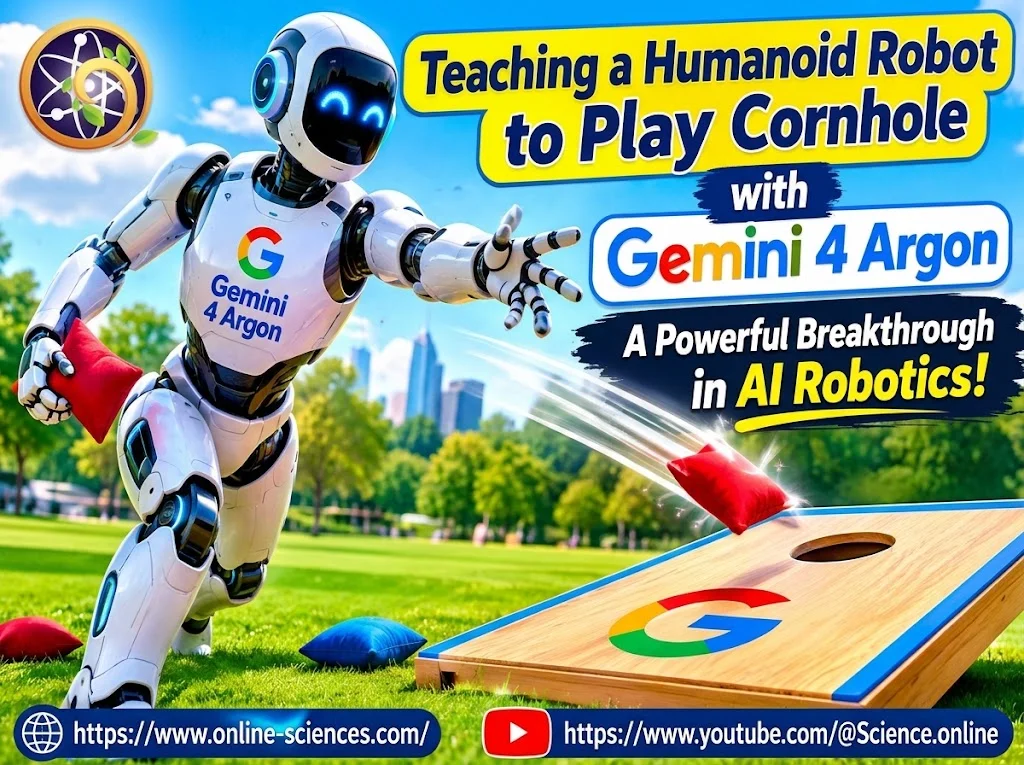
Teaching a Humanoid Robot to Play Cornhole with Gemini 4 Argon
Gemini 4 Argon
Gemini 4 Argon is a name used in discussions of advanced artificial intelligence and robotics. AI models such as Google’s Gemini family demonstrate how multimodal AI can help machines understand images, interpret instructions, analyze information, and support complex tasks. Combined with robotic control systems, these technologies could help robots understand their surroundings, plan movements, and perform physical tasks more intelligently. However, Gemini 4 Argon should not be presented as an officially released Google model without reliable confirmation.
Humanoid Robots
Humanoid robots are advanced machines designed to resemble the human body, with a head, arms, hands, and legs. They use artificial intelligence, computer vision, sensors, and motion-control systems to interact with people and perform physical tasks. Modern humanoid robots are being developed to assist in factories, warehouses, homes, healthcare, and entertainment. With machine learning and reinforcement learning, they can improve their movements, recognize objects, follow instructions, and learn new skills, bringing the future of human-robot interaction closer to reality.
1. Teaching a Humanoid Robot to Play Cornhole with Gemini 4 Argon
Teaching a humanoid robot to play cornhole represents an interesting step toward more intelligent and interactive robots. Cornhole is a popular outdoor game in which players throw small bean bags toward a raised wooden platform with a hole near the far end. Although the game looks simple, successfully playing it requires several abilities, including visual recognition, distance estimation, balance, hand-eye coordination, and accurate movement.
Using an advanced AI model such as Gemini 4 Argon as a conceptual example of an intelligent robotics system highlights how artificial intelligence could help humanoid robots understand physical activities and perform complex tasks. Instead of relying entirely on fixed instructions, an AI-powered robot could analyze its surroundings, recognize the game board, estimate distances, and adjust its throwing strategy.
Note: Gemini 4 Argon should be treated as an unverified model name unless an official announcement or technical documentation confirms its existence and capabilities.
2. What is Cornhole and Why is it Difficult for Robots?
Cornhole is a game that requires players to throw bean bags toward a board positioned several feet away. Players score points by landing bags on the board or throwing them through the hole. For humans, this activity depends on experience, coordination, and an understanding of physics. For humanoid robots, however, it introduces several technical challenges.
A robot must identify the location of the board, determine the distance between itself and the target, calculate the appropriate throwing angle, and control the force applied to the bean bag.
It must also maintain balance while moving its arm. Even a small error in the throwing angle or release timing can cause the bean bag to miss the target. This makes cornhole an interesting experiment for testing the physical intelligence of humanoid robots.
3. How Gemini-Like AI Models Could Teach Robots to Play
Advanced multimodal AI models can process different types of information, including images, video, and natural-language instructions.
In a robotics application, an AI model could help a humanoid robot understand commands such as:
- Find the cornhole board.
- Identify the hole in the target.
- Pick up a bean bag.
- Estimate the throwing distance.
- Aim toward the center of the board.
- Adjust the next throw based on the previous result.
The AI system could interpret visual information and translate the task into instructions for the robot‘s control system. However, language and vision models do not automatically provide precise physical control. A complete robotics system also needs motion-planning software, sensors, feedback controllers, and hardware capable of executing the movements safely.
4. The Role of Computer Vision in Robotic Cornhole
Computer vision is one of the most important technologies in teaching robots to interact with physical objects. Cameras allow humanoid robots to observe their environment and identify important objects. In a cornhole experiment, the robot could use visual recognition to locate the board, detect the hole, identify the bean bag, and estimate their positions.
Depth cameras and other sensors could provide additional information about distances and spatial relationships. The robot could continuously analyze camera images to determine whether the target has moved or whether its position has changed. This combination of visual perception and AI reasoning could make robotic gameplay more flexible and reliable.
5. Teaching the Robot to Throw a Bean Bag
Throwing a bean bag accurately is a challenging physical task. The robot must coordinate its shoulder, elbow, wrist, and hand movements. It must also calculate how much force is needed and determine the correct moment to release the bean bag. Physics plays an important role because the trajectory depends on several factors:
- Throwing speed.
- Release angle.
- Release height.
- Gravity.
- Distance to the target.
- Air resistance.
A robotic control system could use these variables to estimate a suitable throwing motion. The robot could then perform a throw, observe the result, and modify its next attempt. This feedback process is essential for improving accuracy.
6. How Reinforcement Learning Can Improve Robotic Skills
Reinforcement learning is a machine-learning approach that allows an agent to improve its behavior through interaction with an environment. For example, a humanoid robot could receive a positive reward when a bean bag lands on the cornhole board and a higher reward when it passes through the hole.
If the bean bag misses, the system could use the result to adjust its next attempt. After many training attempts, the robot may discover throwing movements that produce better results. Simulation can make this process faster and safer because robots can practice thousands of virtual throws before attempting the task in the real world.
However, successful simulation training does not guarantee perfect real-world performance. Differences between virtual environments and physical hardware can affect accuracy.
7. Why Balance and Motion Control Matter
Humanoid robots must maintain stability while performing movements that shift their center of gravity. Throwing a bean bag involves moving the upper body and extending an arm. If the robot cannot maintain its balance, it may lose stability or produce an inaccurate throw.
Advanced motion-control systems use information from cameras, joint encoders, inertial measurement units, and other sensors to monitor body position. These systems help coordinate the robot‘s movements and maintain stability throughout the throwing process. This is particularly important for humanoid robots designed to perform tasks in environments created for humans.
8. What Does This Experiment Mean for the Future of AI Robotics?
Teaching a humanoid robot to play cornhole is more than an entertaining demonstration. It represents a useful way to explore the combination of artificial intelligence and physical robotics. The same technologies involved in recognizing a target, planning movements, controlling force, and learning from mistakes could eventually support more practical applications.
For example, humanoid robots could use similar capabilities to:
- Pick up and move household objects.
- Sort packages in warehouses.
- Perform simple sports activities.
- Assist people with everyday tasks.
- Interact with objects in unfamiliar environments.
- Learn new movements through demonstrations.
These capabilities could make robots more adaptable and reduce the need to program every individual movement manually.
9. Can AI Make Humanoid Robots Better Than Humans at Games?
AI-powered robots may eventually become highly accurate at certain physical games. They can repeat movements consistently, analyze previous attempts, and optimize their strategies using large amounts of training data.
However, human performance involves more than mathematical calculations. Humans can adapt naturally to unexpected situations, adjust their movements intuitively, and respond to changing environmental conditions.
Humanoid robots still face challenges involving perception, dexterity, balance, reaction time, and real-world adaptability. Therefore, teaching robots to play cornhole is an interesting step toward more advanced physical intelligence, but it does not mean that robots are already better than humans at sports.
10. The Future of Gemini AI and Humanoid Robots
The combination of multimodal AI, computer vision, reinforcement learning, and advanced robotic hardware could transform how humans interact with machines.
Future humanoid robots may be able to understand spoken instructions, observe people performing activities, and learn new physical tasks through demonstrations.
Instead of programming every movement separately, developers could use AI systems to help robots understand the purpose of a task and coordinate the actions needed to complete it.
Teaching a humanoid robot to play cornhole illustrates the exciting possibilities of this direction in robotics research. The next generation of intelligent robots could move beyond repetitive industrial operations and become more capable assistants in homes, workplaces, educational environments, and entertainment.
Frequently Asked Questions (FAQ)
1. What is teaching a humanoid robot to play cornhole?
It is a robotics task in which a humanoid robot learns to pick up bean bags, aim at a cornhole board, and throw them toward the target using computer vision, motion planning, and AI.
2. What is Gemini 4 Argon?
Gemini 4 Argon is an unverified AI model name. Its existence and capabilities should be confirmed through official Google documentation before describing it as an actual released product.
3. How can AI help a humanoid robot play cornhole?
AI can help interpret camera images, recognize the target, estimate distances, plan movements, and analyze previous throwing attempts.
4. Can humanoid robots learn to throw objects?
Yes. Robots can learn object-throwing movements through demonstrations, simulation, physics-based calculations, and reinforcement learning.
5. What is the role of computer vision in humanoid robotics?
Computer vision helps robots recognize objects, understand their surroundings, estimate positions, and interact with physical environments.
6. Can reinforcement learning improve robotic throwing accuracy?
Yes. Reinforcement learning allows robots to improve their actions by receiving feedback and adjusting their movements after successful or unsuccessful attempts.
7. Why is playing cornhole difficult for humanoid robots?
It requires accurate distance estimation, hand-eye coordination, force control, release timing, trajectory prediction, and body balance.
8. What are the future applications of AI-powered humanoid robots?
Potential applications include household assistance, warehouse operations, manufacturing, healthcare support, education, and entertainment.
Explore more science and technology articles on Science Online: https://www.online-sciences.com/
Watch more technology videos on Science Online Channel: https://www.youtube.com/@Science.online
🔥 Google Gemini 4 Argon: Google’s Powerful AI Model Changing the Future 🔥 🚀
Gemini 4 Argon: 7 Powerful AI Features, Expected Capabilities, and What to Know
🔥 Google Flow AI Tutorial 2027: 10 Powerful Steps to Create Stunning AI Videos 🚀🔥
🔥 Google Flow Unlimited Free 2027: 7 Powerful Ways to Create AI Videos Without Paying 🚀
🔥 Google Flow Credits 2027: 7 Powerful Ways to Get More Free AI Credits 🚀
🔥 Google Flow AI Video Generator 2027: 15 Powerful Features & Free Credits 🚀
🔥 Google Flow AI Free in 2026: Create Amazing AI Videos Without Paying 🚀
🔥 Google Flow Unlimited Credits FREE 2027: 7 Powerful Ways to Create AI Videos 🚀
🔥 Google Flow Unlimited Credits FREE in 2026: Get 50 Daily Credits & Create Amazing AI Videos!
Google Veo 3 AI Video Generator: How to Create INSANE Videos in Gemini AI Ultra! 🚀
Goodbye Google Assistant? 10 Powerful Reasons Gemini AI Is the Future in 2026
Will Gemini AI Replace Google Assistant? The Ultimate Guide to Google’s Powerful AI Upgrade 2026
Google Assistant Review 2026: Features, Pros, Cons and What It Can Do