
Electric circuits and methods of connecting electric lamps in electric circuits
The electric circuit is known as a closed, continuous path through which electricity passes, making a complete cycle. Electric circuits are an essential part of modern life because they allow electricity to flow and power many devices we use every day. From simple household appliances to complex electronic systems, electric circuits play a vital role in transmitting electrical energy from a power source to different components.
Simple electric circuit
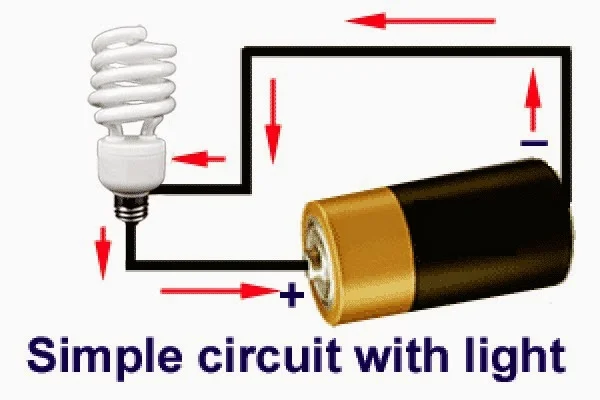 |
| A simple electric circuit consists of the battery, the lamp, and the electric wires. |
The simple electric circuit consists of the battery, the electric wires, and the lamp. The battery works as a source of the electric current in the electric circuit. It has two poles (the positive and the negative poles). The electric wires are used to connect the battery to the lamp in the electric circuit.
The lamp lights when all the parts of the electric circuit are connected together (a closed circuit), so the electric current passes through the circuit, and the lamp does not light when all the parts of the electric circuit are not connected together (an open circuit), so the electric current does not pass through the circuit.
An electric circuit usually consists of several basic parts, such as a power source, conducting wires, switches, and electrical loads like lamps or motors. Understanding how electric circuits work helps us learn how electricity is controlled and used safely in homes, industries, and technology.
Methods of connecting the electric lamps in the electric circuit
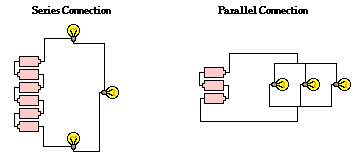
The electric lamps are connected in the electric circuits by series connection and parallel connection.
 Series connection and parallel connection |
| Methods of connecting the electric lamps in the electric circuit. |
Series connection
The series connection is a way in which the light bulbs are connected one after another in one route. By increasing the number of connected light bulbs, the lighting (The light intensity) of the bulbs decreases, and vice versa.
In the series connection, there is one route for the electric current to pass through the circuit. So, by unscrewing or burning out one bulb, the electric current does not flow.
Parallel connection
The parallel connection is a way in which the light bulbs are connected in branching routes. And by increasing the number of connected light bulbs, the lighting (The light intensity) of the bulbs remains as it is.
There are branching routes for the electric current to pass through the circuit. So, by unscrewing one of the lamps, the electric current passes through the other routes, and the lamps in the circuit do not turn off.
All the lamps and the machines in the house are connected in parallel with the main distributer of the energy, So, their function is independent.
In the decorative lights that are used in the religious celebrations and the weddings, the lamps are connected in parallel. So, if one or more lamps burn out, the other lamps do not turn off.
FAQ about Electric Circuits
1. What is an electric circuit?
An electric circuit is a closed path through which electric current flows from a power source through wires and electrical components such as lamps, switches, and resistors.
2. What are the main components of an electric circuit?
The main components of an electric circuit include:
- Power source (battery or generator).
- Conducting wires.
- Electrical load (such as lamps or motors).
- Switch to control the flow of current.
3. What are the common methods of connecting electric lamps in circuits?
Electric lamps are usually connected in two main ways:
- Series connection.
- Parallel connection.
4. What is a series connection of electric lamps?
In a series circuit, electric lamps are connected one after another in a single path. The same current flows through all lamps.
5. What happens if one lamp stops working in a series circuit?
If one lamp fails or is removed, the circuit becomes open, and all lamps stop working because the current cannot flow.
6. What is a parallel connection of electric lamps?
In a parallel circuit, lamps are connected in separate branches across the same power source. Each lamp receives the same voltage.
7. What happens if one lamp stops working in a parallel circuit?
If one lamp stops working in a parallel circuit, the other lamps continue to work normally because each lamp has its own path for current.
8. Which method of connecting lamps is used in homes?
Parallel connection is commonly used in homes because it allows each lamp or appliance to work independently.
9. What are the advantages of parallel circuits?
Advantages include:
- Each device works independently.
- If one lamp fails, others remain on.
- Each lamp receives full voltage.
10. Why are series circuits sometimes used?
Series circuits are used in some devices, such as simple electronic circuits and decorative lights, where controlling current through all components together is required.
You can subscribe to Science Online on YouTube from this link: Science Online
Properties of Electric current, Simple electric circuit, Current intensity and Potential difference
Electrical current, Potential difference, Electric resistance and Ohm’s law
Resistances connection (series & parallel), Electric energy and Electric power