Lunar eclipse and safety precautions on observing the lunar eclipse
The lunar eclipse occurs when the Sun, the Earth, and the Moon are nearly in one straight line, with the Earth in the middle, hiding the sunlight from the Moon. The lunar eclipse occurs in the middle of the lunar month (the moon phase is a full moon) at a rate of two lunar eclipses per year.
Lunar eclipse
The lunar eclipse can be easily seen from the surface of the Earth, as it lasts for an hour or two hours, in which the surface of the moon gets colored red and then returns to its original natural color. When the Earth passes in front of the Sun it forms two types of shadow, which are:
-
The cone shadow (the umbra).
-
The semi-shadow (the penumbra).
Types of lunar eclipse
There are three types of lunar eclipse, which are the total lunar eclipse, the partial lunar eclipse, and the semi-shaded (Penumbra) lunar eclipse.
Total lunar eclipse
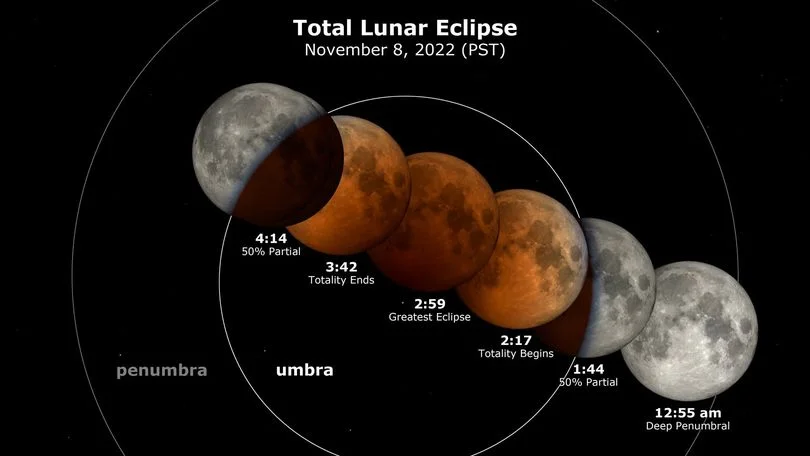
The Total lunar eclipse occurs when the Sun, the Earth, and the Moon all lie in a straight line with the Earth in the middle. And it occurs when the whole moon enters the shadow area (umbra) of the Earth, the moon appears with red colour.
In a total lunar eclipse, although the sunlight is blocked from reaching the moon, there are some rays (the red rays) that are not absorbed by the Earth’s atmosphere; these red rays are refracted (by the Earth’s atmosphere), reaching the moon to appear with red color.
The partial lunar eclipse, which is a type of lunar eclipses that occurs when a part of the moon enters the umbra region of the Earth, In the partial lunar eclipse, We can see a part of the moon enter the umbra region.
The semi-shaded (Penumbra) lunar eclipse occurs when the moon enters the semi-shaded area only (the penumbra) of the Earth, in which the moonlight turns faint without being darkened.
There is no annular lunar eclipse because the Earth is a great size relative to that of the moon. So, it always blocks all the sunlight when it comes between the sun and the moon.
The lunar eclipse started with the semi-shaded lunar eclipse (in the penumbra region), then changed into the partial lunar eclipse (a part of the moon enters the umbra region), then changed into the total lunar eclipse (the whole moon enters the umbra region) then it changed into the partial lunar eclipse again and finally it changed to the semi-shaded lunar eclipse.
You can watch the Lunar eclipses. They are completely safe to watch. You do not need any kind of protective filters. It isn’t even necessary to use a telescope.
It does not require the precautions, the warnings, and the special devices to observe it because it does not cause any harm to the eye.
FAQ about Lunar Eclipse and Safety Precautions
1. What is a lunar eclipse?
A lunar eclipse happens when the Earth moves between the Sun and the Moon, causing the Earth’s shadow to fall on the Moon. This event can only occur during a full moon.
2. What are the types of lunar eclipses?
- Total Lunar Eclipse: The entire Moon passes into Earth’s shadow. The Moon turns reddish or copper-colored. Often called a “Blood Moon.”
- Partial Lunar Eclipse: Only part of the Moon enters Earth’s shadow. A dark shadow appears on a section of the Moon.
- Penumbral Lunar Eclipse: The Moon passes through Earth’s outer shadow (penumbra). The dimming is very subtle and sometimes hard to notice.
3. Why does the Moon turn red during a total lunar eclipse?
The red color appears because Earth’s atmosphere bends and filters sunlight. Blue light is scattered, while red light reaches the Moon, making it look reddish.
4. Is it safe to look at a lunar eclipse?
Yes, it is completely safe to watch a lunar eclipse with the naked eye. Unlike a solar eclipse, a lunar eclipse does not harm your eyes.
5. Are there any safety precautions for observing a lunar eclipse?
Although it is safe, here are some helpful tips:
- No Special Glasses Needed: You do NOT need eclipse glasses. Regular viewing is safe.
- Use Binoculars or a telescope (Optional): They can enhance the view. No special filters are required.
- Choose a Dark Location: Go away from city lights for a clearer view. Open areas with a wide sky view are best.
- Check the Weather Forecast: Clear skies provide the best experience.
- Use a Camera with a Tripod: For better lunar eclipse photography.
6. How long does a lunar eclipse last?
A total lunar eclipse can last several hours, with totality lasting about 1 to 1.5 hours.
7. How often do lunar eclipses occur?
Lunar eclipses happen about 2 to 4 times per year, but total lunar eclipses are less common.
You can subscribe to Science Online on YouTube from this link: Science Online
Types of solar eclipses and safety precautions for observing the solar eclipse
What are the advantages & disadvantages of Refracting Telescopes?