
Force, Newton’s First law of Motion, Inertia and Factors that affect the momentum
Force
The object moves at an acceleration when affected by a force , The force is an external influence that affects the objects to change its state of motion or direction , Force is measured using the spring balance in Newtons ( N ) .
Such as the force exerted by your muscles helps to pull or push things , The force of the car engine helps the car to start motion and the force of brakes acts to stop the moving car .
Appreciation to Galileo and Newton for their contribution in formulating a reliable theory of motion by the end of the seventeenth century where they explored and explained motion and its causes .
Newton’s First law of Motion
Newton’s First Law of motion
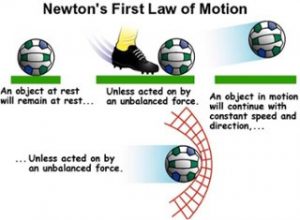
A static object keeps its state of rest and a moving object keeps its state of motion at a uniform velocity in a straight line unless acted upon by a resultant force .
Explanation of Newton’s First Law :
When a book is placed on a table , It remains stationary in position unless somebody acts to affect it and change its state .
When an object is pushed on the floor , It rolls for a certain distance , then slows down till it stops by the effect of frictional forces between the object and the floor that resist rolling ( Friction is an external force that acts to change the object state ) .
If these forces do not exist , the object would keep moving at a uniform velocity and would not stop .
The mathematical formula that expresses Newton’s First Law :
∑ F = 0
The symbol ( ∑ ) is pronounced sigma and means ” resultant ” , If a number of forces act on an object , they may cancel the effect of each other and their resultant equals zero , Thus , acceleration ( a ) = 0 and no change happens in object velocity either being static or dynamic .
Inertia
Newton’s First Law is known as the Law of Inertia since the object can not change its state of rest or motion by itself .
Inertia is the tendency of an object to keep either its state of rest or state of motion at its original velocity uniformly in a straight line , or it is the property of objects to resist the change of its static or dynamic state .
Inertia can be clarified by the following applications
The static object tends to keep its state of rest , such as the passengers in a vehicle tend to fall backwards when the vehicle suddenly moves forwards , Fall of a coin into a cup when the card is removed rapidly .
The moving object tends to keep its state of motion , Such as the passengers in a vehicle tend to fall forwards when the vehicle crashes against a barrier , The continuity of fan motion when the electric current is turned off .
Technological Applications
Seat belt should be fastened on driving to stop inertia during sudden stop and protect passenger from being hurt .
Space rockets do not consume fuel to keep moving when being out from the Earth’s gravity because inertia keeps them moving at a uniform velocity in a straight line .
Momentum
Stopping objects which are moving under the effect of inertia depends on Mass and velocity ,The velocity and mass are related to a physical quantity known as Momentum ( p ) .
Objects of large masses are much difficult to be stopped than objects of small masses , Objects of high velocities are much difficult to be stopped than objects of low velocities .
Factors that affects the momentum
Mass : The momentum is directly proportional to the mass of the object at constant velocity , Velocity : The momentum is directly proportional to the velocity of the object at constant mass .
Momentum is a vector quantity as it is the dot product of a vector quantity ( velocity ) and a scalar quantity ( mass ) , where momentum has the same direction of the velocity , The dimensions of momentum are MLT−1 and the unit of measurement is kg.m/s .
Newton’s Second Law of motion , Factors that affect the acting force & the acceleration




good