Amazing Phantom Twist drone Technology 2026: This AI-Designed Drone Tricks Your Eyes Into Not Seeing It
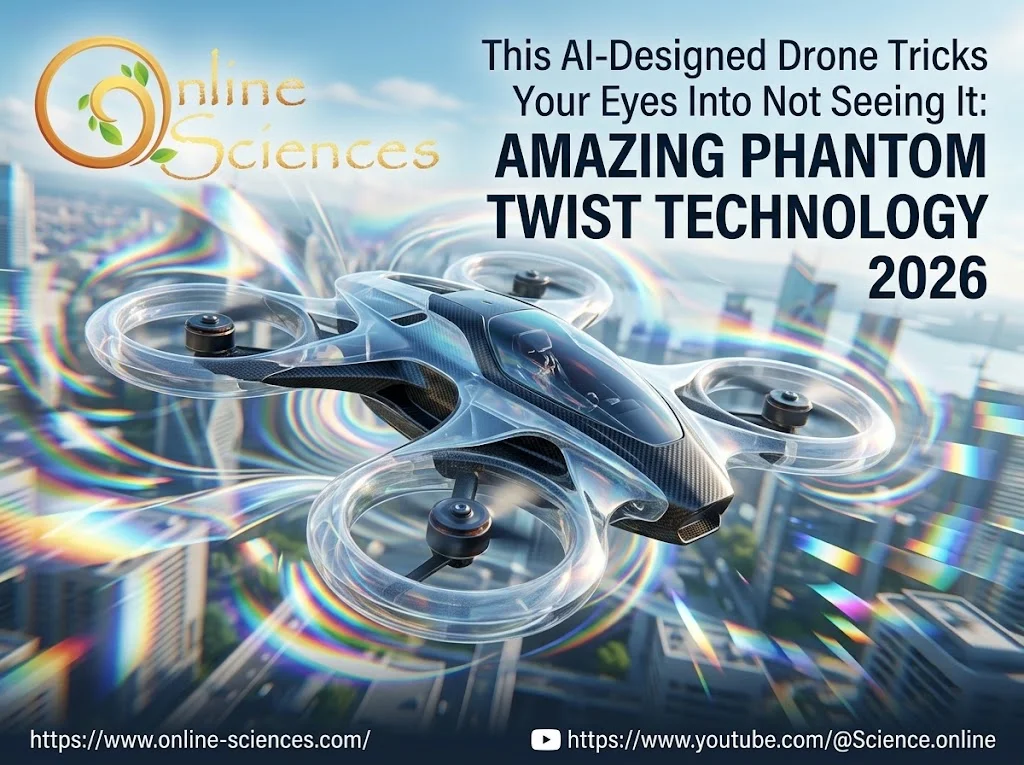
Phantom Twist drone spins rapidly so that its structure becomes a faint blur rather than a clearly visible flying machine. Artificial intelligence helped optimize the placement of its components specifically to reduce how noticeable it is to human observers. This AI-designed drone tricks your eyes into not seeing it—but it does not use a traditional invisibility cloak. Developed by researchers at Northwestern University.
Amazing Phantom Twist Drone Technology
Phantom Twist drone
Imagine watching a drone fly overhead, but instead of seeing a recognizable aircraft, you see only a faint haze that almost disappears into the background. This is the unusual idea behind Phantom Twist, an experimental drone developed by engineers and computer scientists at Northwestern University. Rather than relying on camouflage, transparent materials, or sophisticated optical cloaking, the researchers designed the drone around the limitations of human vision.
The project demonstrates a fascinating combination of artificial intelligence, robotics, computer vision, optimization, and human perception. The drone is not literally invisible, but its rapid rotation and carefully optimized physical structure make it substantially harder for people to notice while it is flying. According to the researchers’ visibility metric, the optimized design was about 10 times less visually perceptible than a conventional quadcopter.
What is Phantom Twist?
Phantom Twist is an experimental low-visibility unmanned aerial vehicle created by researchers at Northwestern University. The unusual aircraft takes a different approach to reducing visibility: instead of hiding the drone from the eye, it changes the way the drone moves so the eye has difficulty seeing its shape.
A conventional quadcopter has a relatively stationary central body while its propellers rotate. This gives an observer a stable object that the visual system can recognize and track. Phantom Twist reverses this concept. It uses one motor and one propeller, with the propeller rotating in one direction while the drone‘s body rotates in the opposite direction. As a result, the entire aircraft is continuously moving rather than having a large stationary structure.
The prototype can rotate at approximately 25 revolutions per second. At this speed, the individual components become blurred together, producing what researchers describe as a faint, semi-transparent cloud or haze.
How Does the AI-Designed Drone Become Harder to See?
The key technology is motion blur. Human vision does not process every moment as a perfectly isolated photograph. When an object moves rapidly, visual information can effectively accumulate over a period of time. A fast-moving object may therefore lose its sharp edges and recognizable features.
The Phantom Twist takes advantage of this phenomenon. Because the entire drone rotates rapidly, its components do not remain visually fixed in one location. Instead, their images are distributed across the observer’s visual field, producing a blurred appearance.
The researchers also carefully positioned the drone‘s components at different heights and angles. The motor, batteries, circuit board, counterweights, and other major components were arranged with space between them so they would be less likely to overlap visually while the aircraft rotates. The result is not a truly invisible drone. Instead, the drone becomes much less visually distinctive.
How Artificial Intelligence Designed Phantom Twist
One of the most interesting aspects of Phantom Twist is that AI was not simply used to control the drone. It helped determine what the drone should physically look like.
The Northwestern researchers first generated approximately 20,000 possible drone configurations capable of stable flight. AI and optimization algorithms then repeatedly rearranged the major components in search of configurations that could fly while remaining difficult to see.
The computer simulations considered different component positions and evaluated how noticeable each configuration would be from different viewing angles. The researchers then simulated the drones against approximately 100 real-world backgrounds. A perception model designed to approximate aspects of human visual perception was used to evaluate how noticeable each design appeared.
The best candidates were subjected to additional optimization, allowing the system to search for configurations that reduced visibility even further. The final design was then physically constructed and tested. This represents an important idea in AI-assisted engineering: instead of asking humans to design every component arrangement manually, an optimization system can explore thousands of possible configurations and identify unusual solutions that might be difficult to discover through conventional design methods.
The Science Behind the Visual Illusion
The Phantom Twist concept is closely related to motion blur and visual perception. Consider a rapidly spinning fan. When the fan is moving quickly, its blades can become difficult to distinguish individually. The faster the movement, the more the blades appear to merge into a translucent disk.
Phantom Twist applies a similar principle to the drone itself. A conventional drone has stationary elements that allow the human visual system to recognize its structure. Phantom Twist removes much of that stable visual information by making the entire aircraft rotate.
As the drone spins, its components are visually averaged with the background. Instead of a clearly defined aircraft, an observer may perceive only a subtle change in brightness or a ghost-like haze. This is why the technology can appear almost like an invisibility trick, even though the drone remains physically present.
Is Phantom Twist Actually Invisible?
No. This distinction is important. Phantom Twist does not bend light around itself, disappear from cameras, or become physically transparent. It remains detectable under many conditions. The researchers describe it as low-visibility rather than completely invisible. Its effectiveness depends on factors such as movement, viewing conditions, and the background behind the drone.
The drone also produces sound, and some components—including wires and support rods—remain visible. The Northwestern team has identified quieter propulsion and more transparent materials as possible directions for future versions. Therefore, the technology should be understood as a sophisticated perceptual camouflage system, not an invisibility cloak.
Why Make a Drone That is Harder to See?
The researchers say the technology could eventually have applications where the presence of a visible drone changes the behavior of people or animals. One potential area is wildlife research. A clearly visible or noisy drone can disturb animals, causing them to change their behavior or move away. A less visually noticeable aircraft could potentially observe wildlife while producing less visual disruption.
Other possible research directions include environmental observation and infrastructure inspection, although the Phantom Twist work itself is presented as a research demonstration rather than a finished commercial drone. The concept also illustrates a broader possibility for robotics: robots could be designed not only around mechanical performance, but also around how humans perceive them.
Phantom Twist vs. a Conventional Quadcopter
Phantom Twist vs. a Conventional Quadcopter: Phantom Twist is fundamentally different from a conventional quadcopter in both its propulsion system and visual design. A traditional quadcopter normally uses four motors and four propellers, while its central body remains relatively stable during flight, making the aircraft easy for the human eye to recognize and track.
In contrast, Phantom Twist uses a single motor and propeller, with the propeller rotating in one direction while the drone‘s body rotates in the opposite direction. This continuous whole-body rotation creates strong motion blur, causing the drone‘s structure to appear more like a faint haze than a clearly defined aircraft.
Its components are also arranged using computational optimization to reduce visual perceptibility from different viewing angles. According to the researchers, the optimized Phantom Twist was about 10 times less visually perceptible than a conventional quadcopter under their visibility metric.
However, Phantom Twist is not truly invisible: it can still produce sound and remain detectable through other sensing technologies, while its main advantage is reducing how easily humans can visually identify the drone. The reported 10× reduction refers to the researchers’ perceptual visibility metric, not a guarantee that people will always have 10 times more difficulty seeing the aircraft.
The Future of AI-Designed Robotics
Phantom Twist is particularly interesting because it demonstrates how AI can influence physical robot design, rather than simply providing software intelligence. Traditional engineering often starts with a human-designed architecture and then optimizes parameters such as weight, strength, energy consumption, or aerodynamic performance. Phantom Twist adds another objective: human perceptual visibility.
This approach could lead to future robots designed for specific environments and interactions. AI could potentially optimize robots simultaneously for mobility, energy efficiency, acoustics, appearance, and human perception.
The research also shows that sometimes an unusual engineering solution can emerge when computers are allowed to search a large design space. Instead of making a drone look like its environment, the Northwestern team effectively asked: What if the drone itself could be designed around the way humans see motion?
Limitations of the Phantom Twist Drone
Despite its remarkable appearance, Phantom Twist is still an experimental technology.
The aircraft is not completely invisible, and its wires and support structures can remain noticeable. Its operation also produces sound, which means low visual visibility does not equal complete stealth.
Furthermore, reducing visual visibility does not automatically eliminate detection by cameras, sensors, radar, microphones or other systems. The research specifically focuses on human visual perception.
Future versions could investigate more transparent structures, quieter propulsion, and optimization of smaller components that were not fully incorporated into the initial visibility design.
Conclusion
The AI-designed Phantom Twist drone is a striking example of how artificial intelligence can create unconventional engineering solutions. Instead of using futuristic cloaking materials, Northwestern researchers combined rapid rotation, motion blur, computational optimization, and models of human perception to make a drone that is much harder for the human eye to notice.
It is not truly invisible—but when spinning at high speed, the drone can transform from a recognizable flying machine into a faint visual haze. The project could influence future research into low-disruption robots for wildlife observation, environmental monitoring, and infrastructure inspection.
Most importantly, Phantom Twist demonstrates a new way of thinking about robotics: AI can design machines not only to move and function efficiently, but also to interact with the limitations of human perception.
FAQ About the AI-Designed Phantom Twist Drone
What is the AI-designed drone that tricks your eyes into not seeing it?
It is Phantom Twist, an experimental low-visibility drone developed by Northwestern University researchers. It uses rapid whole-body rotation and AI-optimized component placement to reduce its visual perceptibility.
Is the Phantom Twist drone really invisible?
No. Phantom Twist is not completely invisible. It becomes difficult to distinguish visually because rapid rotation creates motion blur and makes the aircraft appear more like a faint haze.
How fast does Phantom Twist spin?
The drone can spin at approximately 25 times per second, allowing its structure to blur significantly during flight.
How did AI design Phantom Twist?
Researchers used computational modeling, AI, and optimization algorithms to explore thousands of possible component configurations and identify arrangements that could maintain flight while reducing visual visibility.
Why does Phantom Twist spin its entire body?
Unlike a conventional quadcopter, Phantom Twist has one motor and one propeller. The propeller spins in one direction while the rest of the drone rotates in the opposite direction, minimizing stationary structures that the eye could easily track.
What makes the drone difficult for humans to see?
Its rapid rotation creates motion blur, while the AI-optimized arrangement spreads the components across different positions so they visually blend together rather than forming a clear drone-shaped silhouette.
Is Phantom Twist useful for wildlife research?
The researchers have suggested wildlife monitoring as one possible future application because a less visually disruptive drone could potentially reduce changes in animal behavior during observation.
Can cameras see the Phantom Twist drone?
The research focuses primarily on human visual perception. Being difficult for the human eye to notice does not mean the drone is undetectable by cameras or other sensing technologies.
What are the main limitations of Phantom Twist?
The drone still produces sound, and some wires and support structures remain visible. The researchers have suggested quieter propulsion and more transparent materials as possible future improvements.
Where was Phantom Twist presented?
The research was presented at Robotics: Science and Systems 2026 in Sydney, Australia, in July 2026.
You can subscribe to Science Online on YouTube from this link: Science Online
Drones, Unmanned Aerial Vehicle (UAV) uses, advantages, and disadvantages
Parrot mini drone features, advantages, disadvantages and popular models
Remotely-operated underwater vehicles (ROVs) features, types, advantages, and disadvantages
Applications of Artificial intelligence in agriculture, Agricultural robots, Drones and Plantix app
Unmanned ground vehicle (UGV) advantages and disadvantages