Atlas Airborne | Boston Dynamics: Amazing Humanoid Robot Technology, AI & Capabilities 2026
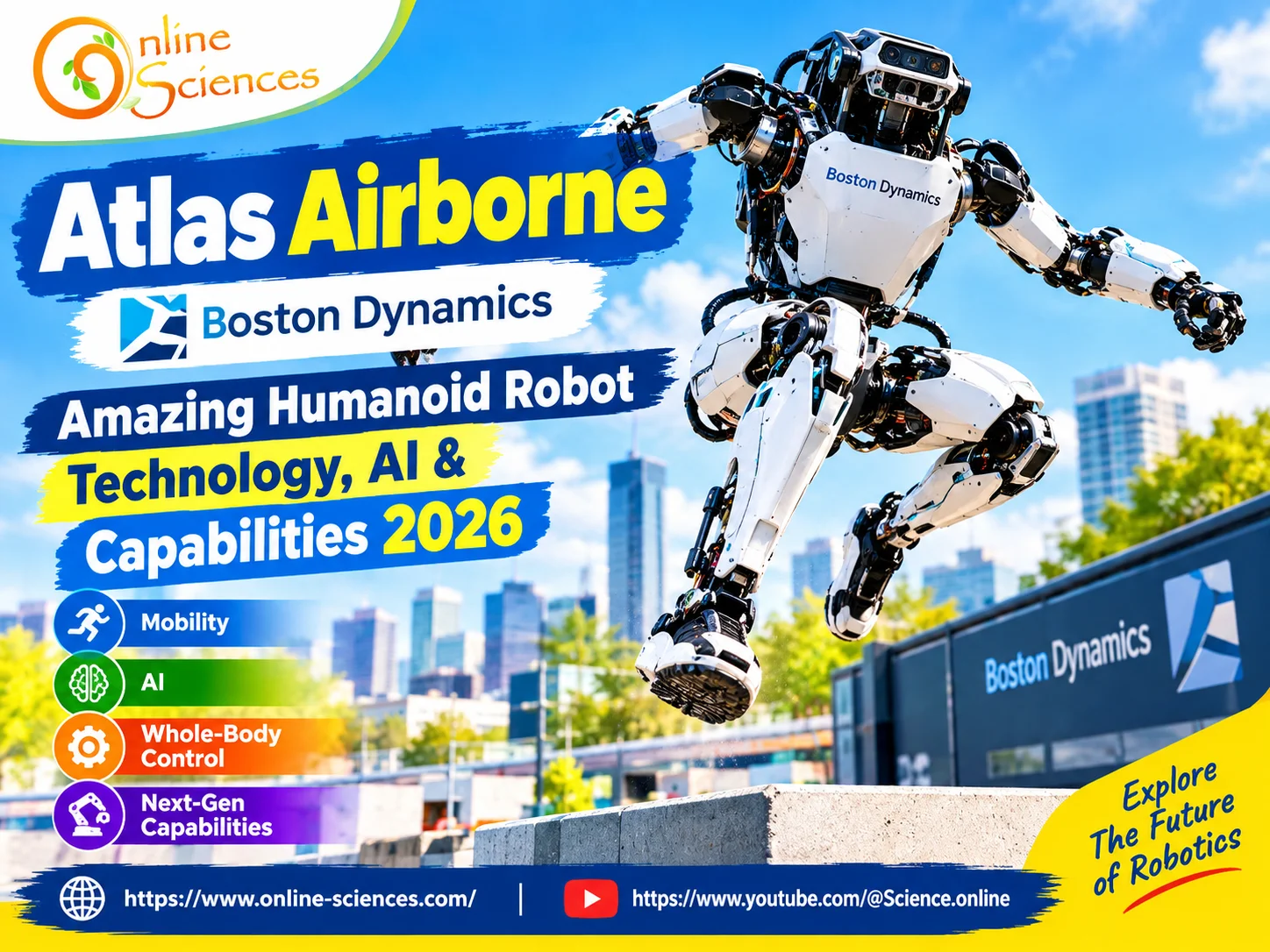
Atlas Airborne | Boston Dynamics showcases the extraordinary mobility research behind one of the world’s most advanced humanoid robots. Developed through collaboration between Boston Dynamics and the Robotics and AI Institute (RAI Institute), the demonstration highlights Atlas performing highly dynamic movements that push the boundaries of humanoid robotics. While the famous airborne behaviors are primarily research-oriented, today’s electric Atlas is moving toward practical industrial applications such as material handling, sequencing, machine tending, and other physically demanding tasks.
Atlas Airborne | Boston Dynamics: 2026
What is Atlas Airborne | Boston Dynamics?
Atlas Airborne is a robotics research demonstration by Boston Dynamics and the RAI Institute, focusing on dynamic aerial movement and whole-body control. It belongs to the broader research story of Atlas, the humanoid platform that Boston Dynamics has developed over decades.
Atlas became famous for demonstrating movements that were difficult for traditional robots, including jumping, balancing, running, climbing, and recovering from unusual positions. Newer research explores how humanoid robots can coordinate their entire bodies during extremely dynamic motions.
The important point is that Atlas Airborne should not be confused with a separate commercial robot named “Atlas Airborne.” Boston Dynamics currently identifies Atlas as its enterprise humanoid robot, while Atlas Airborne appears among the company’s innovation videos and resources.
How Does Atlas Perform Such Dynamic Movements?
Humanoid robots need more than powerful motors. They must constantly understand their body position, surroundings, momentum, and contact with the ground.
Atlas uses sensors and control systems to coordinate its movement. Boston Dynamics explains that Atlas uses inertial measurement units, joint-position information, and force sensors for controlling body motion and maintaining balance. Its perception systems can also use information from cameras and other sensors to identify obstacles and understand the environment.
This combination allows Atlas to coordinate its arms, legs, torso, and other body components rather than treating each joint as an isolated mechanism. That whole-body approach becomes especially important when a robot leaves the ground. During an airborne movement, Atlas cannot rely on its feet to correct its position. The robot must control its body orientation and prepare for landing.
Atlas Airborne and Whole-Body Robotics
One of the most interesting aspects of Atlas research is whole-body control. Humans naturally use many parts of the body when performing difficult physical tasks. A person lifting a large object might use the arms, legs, torso, shoulders, and even knees to maintain stability.
Boston Dynamics is applying a similar concept to robotic physical intelligence. Its 2026 research describes Atlas using its entire body to handle difficult loads and emphasizes that physical work requires adaptation to an object’s shape, mass, and rigidity.
The company has demonstrated Atlas rotating its torso, squatting to lift a mini-fridge, and carrying it using coordinated movements involving its arms, legs, and torso. These demonstrations show how research into dynamic movement can connect with practical industrial robotics.
From Amazing Robot Stunts to Industrial Work
The biggest change in Atlas’s development is its transition from a research platform toward a commercial industrial robot. In January 2026, Boston Dynamics introduced the product version of its fully electric Atlas. The company announced plans for 2026 deployments and described Atlas as an enterprise humanoid intended for real-world industrial applications. The commercial Atlas is designed around tasks such as:
- Material handling.
- Part sequencing.
- Machine tending.
- Order building.
- Industrial automation.
- Repetitive physical work.
- Tasks requiring mobility and dexterity.
Boston Dynamics says Atlas is designed to require minimal supervision for a range of material-handling applications and can support barcode scanning and workflow integrations.
Atlas Specifications
The current enterprise Atlas has specifications aimed at continuous industrial operation. According to Boston Dynamics, Atlas has:
- Battery life: up to 4 hours.
- Instantaneous weight capacity: 50 kg / 110 lb.
- Sustained weight capacity: 30 kg / 66 lb.
- Self-swappable battery.
- Autonomous navigation to a charging station.
- Enterprise software integration through Orbit.
The self-swapping battery is particularly important because industrial robots need to minimize downtime. Instead of requiring a human operator to replace the battery, Boston Dynamics says Atlas can autonomously navigate to a charging station, swap its own battery, and return to work.
Artificial Intelligence Behind Atlas
Advanced physical movement is only one part of the Atlas story. Artificial intelligence is increasingly important because a useful humanoid robot must learn new behaviors and adapt to changing environments. Boston Dynamics has described using AI-driven behaviors and reinforcement learning to train Atlas. In one example, the robot practiced lifting different versions of a mini-fridge in simulation before transferring the behavior to the physical robot.
The company also announced a partnership with Google DeepMind in 2026 to explore the use of Gemini Robotics foundation models with Atlas. The partnership is intended to combine Boston Dynamics’ robotics capabilities with Google’s AI research for humanoid robots.
Boston Dynamics has also collaborated with NVIDIA around AI capabilities and the Jetson Thor computing platform for humanoid robotics.
Why Atlas Airborne Matters
Atlas Airborne is interesting because it demonstrates a fundamental challenge in advanced robotics: how can a machine control its entire body during rapid, unpredictable movement?
The research contributes to a broader understanding of balance, perception, motion planning, reinforcement learning, and physical interaction.
However, impressive demonstrations should not automatically be interpreted as evidence that a humanoid robot can perform every human task. Real industrial deployment requires reliability, safety, repeatability, maintenance, integration with factory systems, and consistent performance over long periods.
Boston Dynamics‘ commercial strategy reflects this distinction. The company describes the current Atlas as an enterprise-grade robot designed around manufacturability, reliability, serviceability, and industrial applications.
Atlas Airborne vs. Commercial Atlas
Atlas Airborne vs. Commercial Atlas: Atlas Airborne and the commercial Atlas represent two different stages of Boston Dynamics’ humanoid robotics development. Atlas Airborne is primarily a research and innovation demonstration focused on advanced dynamic movement, aerial motion, agility, balance, and whole-body control, showing how the robot can coordinate its arms, legs, torso, and sensors during highly complex movements.
In contrast, the commercial Atlas is a fully electric enterprise humanoid robot developed for practical industrial applications, including material handling, part sequencing, machine tending, and order building. While Atlas Airborne demonstrates what advanced humanoid mobility can achieve in research environments, commercial Atlas focuses on reliability, safety, autonomous operation, battery management, and integration into real industrial workflows.
Together, they show Boston Dynamics’ progression from demonstrating spectacular robotic capabilities to developing humanoid robots intended to perform useful physical work in factories and other enterprise environments.
The Future of Atlas Robotics
The future of Atlas will likely depend not only on spectacular movement but on how successfully the robot can learn useful skills and operate reliably around people and industrial equipment.
Boston Dynamics describes a development path in which Atlas progresses from initial customer pilots to product deployment, skill development, and broader customer integration. The company has identified applications including part sequencing, machine tending, and order building.
This makes Atlas Airborne part of a much larger story. The ability to jump, balance, manipulate objects, and coordinate the whole body represents the technological foundation. The ultimate commercial challenge is turning that capability into dependable everyday work.
Conclusion
Atlas Airborne | Boston Dynamics demonstrates how far humanoid robot mobility and whole-body control have progressed. The airborne research is spectacular, but its deeper significance is the technology behind it: advanced sensing, dynamic balance, AI-driven behaviors, reinforcement learning, and coordinated control.
At the same time, Boston Dynamics is moving Atlas beyond research demonstrations toward an electric enterprise humanoid designed for industrial automation. With a 50-kg instantaneous weight capacity, up to four hours of battery life, autonomous battery swapping, and integration with enterprise systems, the commercial Atlas represents a different phase of the robot’s development.
The combination of Atlas Airborne research and industrial Atlas development illustrates an important direction for robotics: robots that are not only capable of impressive movements, but can eventually apply physical intelligence to useful real-world tasks.
FAQ: Atlas Airborne | Boston Dynamics
What is Atlas Airborne?
Atlas Airborne is an innovation/research video from Boston Dynamics and the Robotics and AI Institute demonstrating advanced dynamic capabilities of the Atlas humanoid robot.
Is Atlas Airborne a separate Boston Dynamics robot?
No. Atlas Airborne refers to a research demonstration involving Atlas rather than a separate commercial robot model.
Is Boston Dynamics Atlas electric?
Yes. The current product version of Atlas is fully electric. Boston Dynamics introduced the electric Atlas as the next generation of its humanoid robot program.
How much can Atlas lift?
Boston Dynamics lists an instantaneous weight capacity of 50 kg (110 lb) and a sustained weight capacity of 30 kg (66 lb) for the current Atlas product.
How long can Atlas operate?
Boston Dynamics lists up to 4 hours of battery life for the current Atlas.
Can Atlas replace human workers?
Atlas is being developed for industrial physical tasks, but whether and where it can replace particular human tasks depends on the application, safety requirements, reliability, economics, and deployment environment.
What industries could use Atlas?
Boston Dynamics identifies industrial applications including material handling, part sequencing, machine tending, and order building.
What AI does Atlas use?
Boston Dynamics has described AI-driven behaviors and reinforcement learning for Atlas, and in 2026 announced a partnership with Google DeepMind involving Gemini Robotics foundation models.
Who makes Atlas?
Atlas is developed by Boston Dynamics, a robotics company founded in 1992.
You can follow Science Online on YouTube from this link: Science Online
Boston Dynamics Atlas review, advantages and features, How does Atlas robot work?
Tesla robots (Optimus) review, use, advantages and disadvantages
Emo robot review, advantages, disadvantages, features and what can Emo do?
Advantages and disadvantages of using robots in our life
Artificial intelligence (AI) definition, advantages, disadvantages, features and applications
Robot teachers use, advantages and disadvantages
Sophia robot review, features, use, advantages and disadvantages
Vector robot review, advantages, disadvantages and specifications