Boston Dynamics Stretch Robot Review 2026: Powerful Features, Specifications, Price, Performance & Warehouse Automation
Boston Dynamics Stretch robot is transforming warehouse automation by replacing repetitive, physically demanding box-handling tasks with an intelligent mobile robot. Designed specifically for distribution centers and logistics facilities, Stretch combines advanced computer vision, AI-powered autonomy, and a powerful robotic arm to unload trailers, move cartons, and improve warehouse productivity. As labor shortages continue to affect global logistics, Stretch has become one of the most promising industrial robots available today.
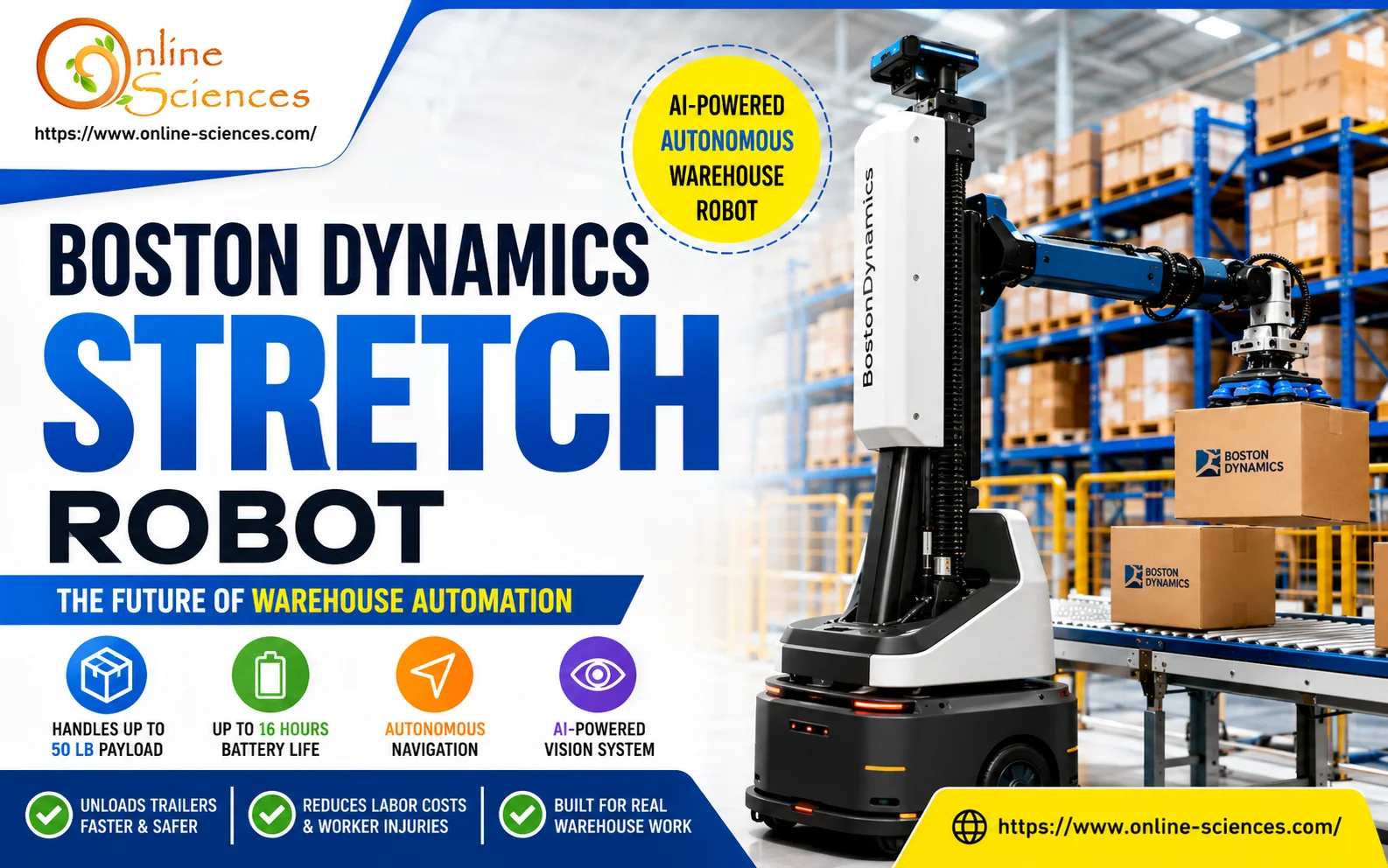
Boston Dynamics Stretch Robot
Boston Dynamics Stretch Robot Review
Unlike humanoid robots such as Atlas or quadruped robots like Spot, Stretch has one clear purpose: warehouse automation. It features a compact mobile base, a long robotic arm, and a vacuum gripper capable of lifting heavy cartons from shipping containers and placing them onto conveyors or pallets.
Instead of requiring expensive fixed automation systems, Stretch can move freely around existing warehouses, making deployment much faster and more cost-effective. This flexibility is one of the robot’s biggest competitive advantages.
Boston Dynamics Stretch Robot Design and Build Quality
Boston Dynamics designed Stretch specifically for industrial environments.
Its design includes:
- Mobile omnidirectional base.
- Long telescoping robotic arm.
- Intelligent vision system.
- High-capacity vacuum gripper.
- Integrated battery system.
- Autonomous navigation.
The robot easily navigates warehouse floors while identifying and handling thousands of differently sized cartons.
Boston Dynamics Stretch Performance
Performance is where Stretch truly stands out.
The robot can:
- Unload shipping containers.
- Move cartons continuously.
- Detect box orientation automatically.
- Recover dropped packages without human intervention.
- Operate with minimal supervision.
According to Boston Dynamics, Stretch unloads approximately 600–800 cases per hour, maintaining consistent productivity throughout long shifts.
AI and Computer Vision
Stretch uses advanced AI algorithms alongside multiple cameras and sensors to:
- Detect cartons.
- Measure box dimensions.
- Identify gripping points.
- Avoid collisions.
- Navigate warehouses autonomously.
Unlike traditional warehouse robots that require pre-programmed layouts, Stretch makes decisions in real time.
Boston Dynamics Stretch Specifications
- Robot Type: Mobile warehouse robot.
- Primary Function: Trailer unloading & case handling.
- Maximum Payload: 50 lb (23 kg).
- Vertical Reach: 10.5 ft (3.2 m).
- Horizontal Reach 6.4 ft (1.95 m).
- Battery Life: Up to 16 hours (configuration dependent).
- Driving Speed: Up to 2 m/s.
- Charging: 90% charge in about 1 hour and 45 minutes (fast charger).
- Robot Weight: Around 1,500 kg.
- Navigation: Autonomous.
- Vision: AI-powered computer vision.
- Gripper: Industrial vacuum gripper.
- Warehouse Integration: Minimal infrastructure required.
Boston Dynamics Stretch Payload
The Stretch robot payload reaches 50 pounds (23 kg), allowing it to handle the majority of standard warehouse cartons.
Its vacuum gripper accommodates:
- Cardboard boxes.
- Shipping cartons.
- Consumer product packages.
- Mixed-size cases.
This payload capacity makes Stretch suitable for retail, e-commerce, and logistics warehouses.
Boston Dynamics Stretch Battery Life
One of Stretch‘s strongest features is its battery endurance. The robot can operate through one or even two warehouse shifts before needing to recharge, depending on workload and configuration. Fast charging significantly minimizes downtime.
Warehouse Automation Benefits
Stretch helps warehouses by:
- Reducing worker injuries.
- Increasing unloading speed.
- Lowering labor costs.
- Operating around the clock.
- Improving productivity.
- Maintaining consistent performance.
These benefits are especially valuable for high-volume logistics centers.
Boston Dynamics Stretch DHL Partnership
One of Stretch‘s largest commercial deployments is with DHL Supply Chain. DHL became the first major commercial customer, investing millions of dollars in warehouse automation using Stretch robots. The collaboration later expanded, with DHL announcing plans to scale deployment to more than 1,000 robotic units across its global operations. The partnership demonstrates that Stretch is no longer an experimental prototype but a commercially deployed warehouse robot.
Boston Dynamics Stretch Price
Boston Dynamics does not publicly disclose the official price of the Stretch robot. The final cost depends on factors including:
- Warehouse size.
- Number of robots purchased.
- Support services.
- Maintenance contracts.
- Software integration.
- Deployment requirements.
Companies interested in purchasing Stretch must contact Boston Dynamics for a customized quotation.
Stretch Robot vs Hello Robot Stretch
Many people confuse the two robots because they share the name “Stretch.”
Boston Dynamics Stretch
- Built for industrial warehouses.
- Handles heavy cartons.
- Large autonomous mobile robot.
- Enterprise solution.
Hello Robot Stretch (Stretch RE1)
- Designed for research and home robotics.
- Lightweight mobile manipulator.
- Used in laboratories and universities.
- Focused on assistive robotics and AI research rather than warehouse logistics.
Stretch Robotics vs Traditional Warehouse Robots
Compared with traditional warehouse automation systems, Stretch offers several advantages:
Advantages
- No fixed infrastructure required.
- Fast deployment.
- AI-powered autonomy.
- Mobile platform.
- High flexibility.
- Lower installation costs.
- Handles mixed box sizes.
Limitations
- Designed mainly for carton handling.
- Not intended for irregular bags or loose items.
- Large upfront investment.
- Best suited for medium-to-large warehouses.
Who Should Buy Boston Dynamics Stretch?
Stretch is ideal for:
- Logistics companies.
- E-commerce fulfillment centers.
- Retail distribution centers.
- Third-party logistics providers (3PL).
- Manufacturers.
- Large warehouse operators.
It is generally not intended for small businesses due to its enterprise-focused design and investment requirements.
Boston Dynamics Stretch robot Pros
- Excellent warehouse automation.
- Autonomous operation.
- AI-powered vision.
- High payload capacity.
- Long battery life.
- Fast deployment.
- Reduces workplace injuries.
- Reliable performance.
Boston Dynamics Stretch robot Cons
- Public pricing unavailable.
- Specialized primarily for box handling.
- Enterprise-oriented solution.
- Significant initial investment.
Final Verdict
Boston Dynamics Stretch is one of the most advanced warehouse robots currently available. Rather than imitating human movement, it focuses on solving one of logistics’ most labor-intensive challenges: moving boxes efficiently and safely. With AI-driven vision, autonomous navigation, impressive battery life, and successful large-scale deployments such as DHL, Stretch represents a major step forward in warehouse automation. For organizations seeking higher productivity, improved safety, and scalable logistics operations, Stretch is among the strongest solutions on the market.
Frequently Asked Questions (FAQ) about Boston Dynamics Stretch
1. How much is the Boston Dynamics Stretch?
Boston Dynamics does not publish the retail price of Stretch. Pricing is customized based on warehouse requirements, deployment size, service agreements, and support packages. Businesses need to contact the company directly for a quote.
2. What is Stretch Boston Dynamics?
Stretch is an autonomous mobile warehouse robot developed by Boston Dynamics for unloading trailers, handling cartons, and automating warehouse logistics using AI-powered vision, robotic manipulation, and autonomous navigation.
3. What is the Boston Dynamics Stretch payload?
Stretch can lift cartons weighing up to 50 pounds (23 kg).
4. Does DHL use Boston Dynamics Stretch?
Yes. DHL was the first commercial customer and has expanded its partnership with Boston Dynamics to deploy more than 1,000 robotic units across its logistics network.
5. Is Stretch a humanoid robot?
No. Stretch is a purpose-built warehouse robot with a mobile base and robotic arm, optimized for logistics rather than human-like movement.
You can subscribe to science online on YouTube from this link: Science Online
Dynamics Atlas review, advantages & features, How does Atlas robot work?
Boston Dynamics Handle robot review, features and importance
Emo robot review, advantages, disadvantages, features & What can Emo do?
Eilik Desktop Companion Robot structure, features, use, advantages & disadvantages
Tesla robots (Optimus) review, use, advantages & disadvantages