🔥 Best Humanoid Robots 2027: 🤖 Top 10 Amazing AI Robots Changing the Future!
Best Humanoid Robots 2027 showcase how artificial intelligence, advanced sensors, computer vision, and human-like movement are transforming the future of robotics. From Tesla Optimus and Figure AI robots to Unitree, Agility Robotics, and Boston Dynamics Atlas, humanoid robots are becoming more capable of performing industrial tasks, assisting humans, handling objects, and navigating complex environments. Discover the 10 best humanoid robots in 2027, their features, advantages, disadvantages, and how they compare.
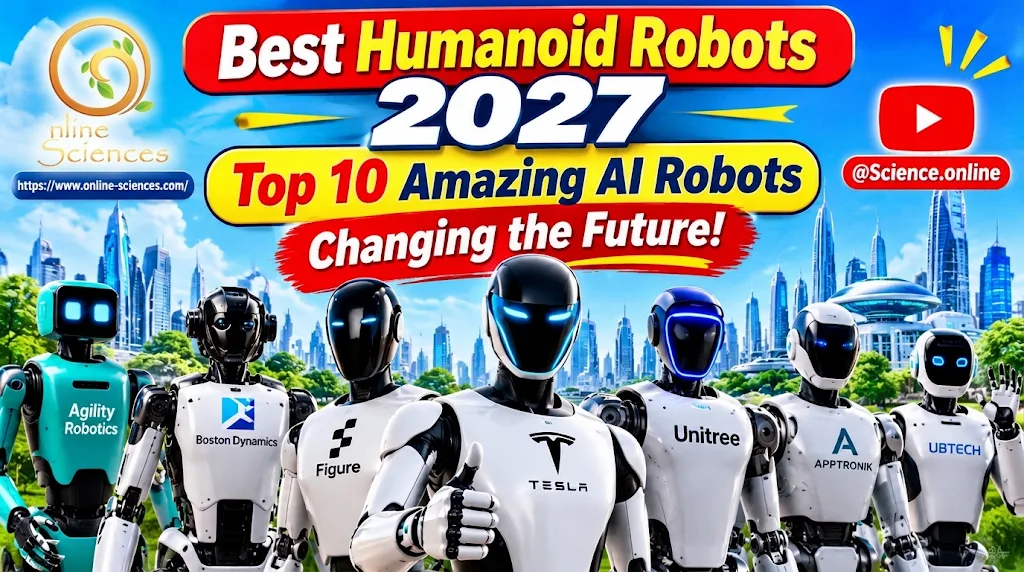
Best Humanoid Robots 2027 featuring Tesla Optimus, Figure 03, Boston Dynamics Atlas, Unitree G1, and other advanced AI robots.
What Are Humanoid Robots?
Humanoid robots are machines designed with a human-like body structure, usually featuring a head, torso, arms, and legs. They use artificial intelligence, cameras, sensors, actuators, and advanced software to understand their surroundings and perform physical tasks.
Unlike traditional industrial robots that usually operate in fixed positions, humanoid robots are designed to work in environments built for people. They can potentially help in factories, warehouses, hospitals, homes, and other workplaces.
Top 10 Best Humanoid Robots in 2027
1. Tesla Optimus – Best General-Purpose Humanoid Robot
Tesla Optimus is designed to perform repetitive, dangerous, and physically demanding tasks. It combines artificial intelligence, computer vision, neural networks, and advanced robotic movement. Its potential applications include factory operations, material handling, and eventually household assistance.
- Key features: AI-powered navigation, object recognition, autonomous movement, human-like hands, and task learning.
- Advantages: Potential for mass production, integration with Tesla AI technology, and versatile applications.
- Disadvantages: Reliable autonomous operation across different environments remains a challenge, and widespread commercial availability is not yet established.
2. Figure 03 – Best AI-Powered Humanoid Robot
Figure 03 from Figure AI is designed for both industrial environments and future household applications. Its Helix AI system combines visual understanding, reasoning, and physical movement. The robot features improved cameras, tactile sensing, wireless charging, and redesigned hands.
- Key features: Helix AI, advanced vision, tactile sensors, natural voice interaction, and wireless charging.
- Advantages: Advanced AI integration, improved object manipulation, and flexible applications.
- Disadvantages: High development complexity, limited commercial availability, and challenges in achieving reliable everyday autonomy.
3. Atlas – Best for Advanced Movement
Boston Dynamics Atlas is one of the most impressive humanoid robots in terms of mobility, balance, and physical performance. The electric Atlas is designed for industrial applications, including handling objects and performing demanding factory tasks.
- Key features: Full-body movement, advanced balance, electric actuators, autonomous manipulation, and sophisticated control systems.
- Advantages: Exceptional mobility, impressive engineering, and strong industrial potential.
- Disadvantages: Expensive development, complex maintenance, and limited availability for ordinary consumers.
4. Digit – Best for Warehouses
Agility Robotics Digit is designed to work in warehouses, logistics centers, and factories. Its human-like legs allow it to move through environments designed for people while handling totes and other materials.
- Key features: Bipedal walking, material handling, autonomous navigation, and industrial workflow integration.
- Advantages: Real-world warehouse experience, practical industrial applications, and growing commercial deployments.
- Disadvantages: It is specialized for logistics rather than general household activities.
5. Unitree G1 – Best Affordable Research Humanoid Robot
Unitree G1 is a compact humanoid robot designed for research, education, and robotics development. It offers advanced movement, flexible joints, and AI development capabilities at a comparatively accessible price.
- Key features: Compact design, multi-joint movement, robotic hands, sensors, and programmable capabilities.
- Advantages: More accessible than many industrial humanoids, suitable for research, and impressive agility.
- Disadvantages: Limited payload, smaller body size, and the need for technical expertise to develop advanced applications.
6. Apollo – Best for Industrial Work
Apptronik Apollo is designed to support manufacturing, logistics, and other industrial operations. Its human-like design allows it to work in spaces originally built for human employees.
- Key features: Human-like movement, modular design, object handling, and AI-powered task execution.
- Advantages: Designed for practical industrial work, flexible applications, and potential collaboration with human workers.
- Disadvantages: Commercial deployment and long-term productivity still need further validation.
7. Walker S2 – Best for Smart Factories
UBTECH Walker S2 is an industrial humanoid robot developed for manufacturing and logistics. One of its notable capabilities is automated battery swapping, which can help reduce interruptions during extended operations.
- Key features: Bipedal movement, industrial manipulation, autonomous battery swapping, and intelligent navigation.
- Advantages: Factory-focused design, potential for extended operation, and industrial automation capabilities.
- Disadvantages: Complex integration, high initial investment, and limited independent performance data.
8. NEO – Best Humanoid Robot for Home Assistance
1X NEO is designed to bring humanoid robotics into everyday homes. Its focus includes household assistance, natural interaction, and performing simple domestic tasks.
- Key features: Human-like body, soft exterior design, AI interaction, and household task assistance.
- Advantages: Home-focused development, human-friendly design, and potential to assist with everyday activities.
- Disadvantages: Safety, reliability, privacy, and autonomous performance remain important concerns.
9. XPENG Iron – Best for Human-Like Design
XPENG Iron is a humanoid robot developed by Chinese electric vehicle manufacturer XPENG. It focuses on human-like movement, intelligent interaction, and potential applications in commercial and industrial environments.
- Key features: Bipedal walking, advanced motion control, AI interaction, and human-inspired design.
- Advantages: Strong engineering background, advanced robotics research, and potential integration with intelligent manufacturing.
- Disadvantages: Practical applications, commercial scalability, and long-term reliability need further demonstration.
10. Agibot A2 – Best for Service and Commercial Applications
Agibot A2 is a general-purpose humanoid robot designed for interaction, service, and commercial environments. It demonstrates the growing competition among Chinese robotics companies to develop practical humanoid machines.
- Key features: AI interaction, visual perception, autonomous navigation, and human-like movement.
- Advantages: Flexible application potential, intelligent interaction, and growing robotics ecosystem.
- Disadvantages: Real-world performance depends on software development, task reliability, and deployment costs.
Comparison of the 10 Best Humanoid Robots in 2027
The 10 best humanoid robots in 2027 offer different capabilities and are designed for various applications. Tesla Optimus and Figure 03 focus on general-purpose tasks, combining artificial intelligence, computer vision, and advanced robotic hands to perform physical work.
Boston Dynamics Atlas stands out for its exceptional mobility, balance, and complex movements, while Agility Robotics Digit is designed specifically for warehouse operations and material handling. Unitree G1 offers an interesting option for robotics research and education, whereas Apptronik Apollo focuses on manufacturing and industrial assistance.
Other robots also bring unique advantages to the growing humanoid robotics industry. UBTECH Walker S2 focuses on smart factories and automated battery swapping, while 1X NEO targets household assistance and everyday activities.
XPENG Iron emphasizes human-like movement and intelligent interaction, and Agibot A2 is designed for service and commercial applications. Although these robots differ in design, price, performance, and intended use, they share the same goal: making robots more intelligent, autonomous, and useful in real-world environments.
This is an editorial comparison based on intended applications and publicly reported development, not an independently verified performance ranking. Some features and capabilities may change during 2027.
What Are the Most Important Features of Humanoid Robots?
The best humanoid robots combine several advanced technologies:
- Artificial Intelligence: Helps robots understand instructions, make decisions, and learn tasks.
- Computer Vision: Enables robots to recognize objects, people, and obstacles.
- Advanced Sensors: Provide information about movement, touch, distance, and balance.
- Robotic Hands: Allow robots to grasp, lift, and manipulate different objects.
- Autonomous Navigation: Helps them move through homes, factories, and warehouses.
- Natural Language Processing: Makes communication with humans easier.
- Battery Technology: Supports longer working periods and automatic charging.
Advantages of Humanoid Robots
Humanoid robots could transform industries and everyday life by performing repetitive, dangerous, and physically demanding tasks. They can potentially improve productivity, reduce workplace injuries, support workers during labor shortages, and operate in environments designed for humans.
Another major advantage is their ability to use AI to learn new tasks and adapt to changing situations. In the future, humanoid robots could help with cleaning, carrying objects, manufacturing, logistics, customer service, and elderly assistance.
Disadvantages of Humanoid Robots
Despite their potential, humanoid robots still face several challenges. Their manufacturing and maintenance costs can be high, while battery life and computing requirements limit continuous operation.
They may also struggle with unexpected situations, delicate objects, and complex environments. Safety, privacy, cybersecurity, and job displacement are additional concerns. Most importantly, impressive demonstrations do not always prove that a robot can perform the same tasks reliably for an entire working day without human assistance.
Best Humanoid Robots 2027: Advantages and Disadvantages Comparison
The biggest advantage of the best humanoid robots in 2027 is their ability to perform tasks in environments designed for humans. They can potentially handle repetitive work, transport materials, assist factory employees, improve productivity, and perform dangerous jobs that may put people at risk.
Their integration with artificial intelligence allows them to recognize objects, understand instructions, navigate environments, and learn new tasks. Robots such as Tesla Optimus, Figure 03, and Boston Dynamics Atlas demonstrate how advanced robotics can combine intelligent software with human-like physical movement.
However, humanoid robots still have several disadvantages that limit their widespread adoption. High manufacturing costs, expensive maintenance, limited battery life, and difficulties handling unexpected situations remain major challenges. Some robots are still undergoing development and testing, so their advertised capabilities may not always reflect reliable everyday performance.
Privacy, cybersecurity, workplace safety, and potential job displacement are also important concerns. Ultimately, the best humanoid robot will depend on its intended application, affordability, reliability, AI capabilities, and ability to perform useful tasks safely without continuous human supervision.
What is the Future of Humanoid Robots in 2027?
The future of humanoid robots looks promising as companies invest in artificial intelligence, robotics hardware, and mass manufacturing. In 2027, we may see more robots working in warehouses, factories, commercial buildings, and selected homes.
Tesla Optimus is expected to pursue broader commercial deployment, while Figure AI is developing more advanced AI-powered robots. Agility Robotics is expanding Digit’s warehouse applications, and Boston Dynamics is advancing Atlas for industrial operations. These developments suggest that humanoid robots are moving from experimental demonstrations toward practical applications.
However, widespread adoption will depend on affordability, safety, reliability, battery performance, and the ability to complete useful tasks without constant human supervision.
Best AI Humanoid Robots
The best AI humanoid robots in 2027 combine artificial intelligence, machine learning, computer vision, and advanced sensors to interact with humans and perform complex physical tasks. Robots such as Tesla Optimus, Figure 03, Boston Dynamics Atlas, and Unitree G1 demonstrate how AI can improve robot movement, object recognition, decision-making, and autonomous operation. These intelligent robots are expected to play an important role in factories, warehouses, healthcare, and everyday life.
Humanoid Robots for Home
Humanoid robots for home are designed to make everyday life easier by helping with household chores, carrying objects, organizing items, and assisting people with daily activities. Robots such as 1X NEO and Figure 03 are exploring the potential of AI-powered home assistance, including natural communication and intelligent task execution. In the future, home humanoid robots could help elderly people, support people with limited mobility, and provide convenient assistance, although affordability, safety, and reliable performance remain important challenges.
Frequently Asked Questions (FAQ)
1. What is the best humanoid robot in 2027?
Tesla Optimus, Figure 03, and Boston Dynamics Atlas are among the leading humanoid robots to watch in 2027. Each has different strengths in AI, industrial automation, and advanced movement.
2. Which humanoid robot is best for home use?
1X NEO and Figure 03 are interesting candidates for home assistance because they are designed with domestic applications in mind. However, reliable, fully autonomous household assistance remains a developing technology.
3. What is the most advanced humanoid robot?
Boston Dynamics Atlas and Figure 03 are among the most advanced platforms, particularly in physical movement and AI-powered manipulation, respectively.
4. Can humanoid robots replace human workers?
Humanoid robots could automate certain repetitive and physically demanding jobs, especially in manufacturing and logistics. However, they are unlikely to replace all human workers because many jobs require creativity, judgment, social intelligence, and complex decision-making.
5. How much does a humanoid robot cost in 2027?
Prices vary considerably depending on the manufacturer, hardware, software, and intended application. Some research robots have published prices, while advanced industrial robots are often sold through business contracts or customized agreements. Not every manufacturer has announced an official retail price.
6. Are humanoid robots powered by artificial intelligence?
Yes. Modern humanoid robots use AI for object recognition, navigation, understanding instructions, decision-making, and learning physical tasks.
7. Will humanoid robots become common in homes?
They could become more common as AI improves and manufacturing costs decrease. However, safety, affordability, privacy, and reliable autonomous operation must improve before widespread household adoption.
Explore more science and technology articles on Science Online: https://www.online-sciences.com/
Watch more technology videos on Science Online Channel: https://www.youtube.com/@Science.online
🔥 Best Humanoid Robots 2027: 🔥 Top 10 Amazing AI Robots Changing the Future! 🤯
🔥 New Elon Musk’s Tesla Bot Optimus Gen 3 Capabilities LEAKED 🤯
🔥 Tesla Bot Gen 3: 1,000 Robots a Week — 7 Powerful Reasons You Still Can’t Buy One 🤯
🔥 Tesla Bot Gen 4 UPDATE 5000 Tasks As HOMEMAKER & Surgeon! Elon Musk SHOCKED Inside Optimus! 🤯
Boston Dynamics Atlas review, advantages and features, How does Atlas robot work?
Tesla robots (Optimus) review, use, advantages and disadvantages
Emo robot review, advantages, disadvantages, features and what can Emo do?
Advantages and disadvantages of using robots in our life
Artificial intelligence (AI) definition, advantages, disadvantages, features and applications
Robot teachers use, advantages and disadvantages
Sophia robot review, features, use, advantages and disadvantages
Vector robot review, advantages, disadvantages and specifications