Drone swarms importance, Are drone swarms illegal?, How swarming drones will change warfare
Drone swarm is a self-organizing system of multiple drones that collaborate intelligently to complete complex missions more efficiently than a single drone could. It can collect data on air quality, wildlife movement, or forest health. It can detect and track wildfires, pollution, or deforestation in real time.
Drone swarm
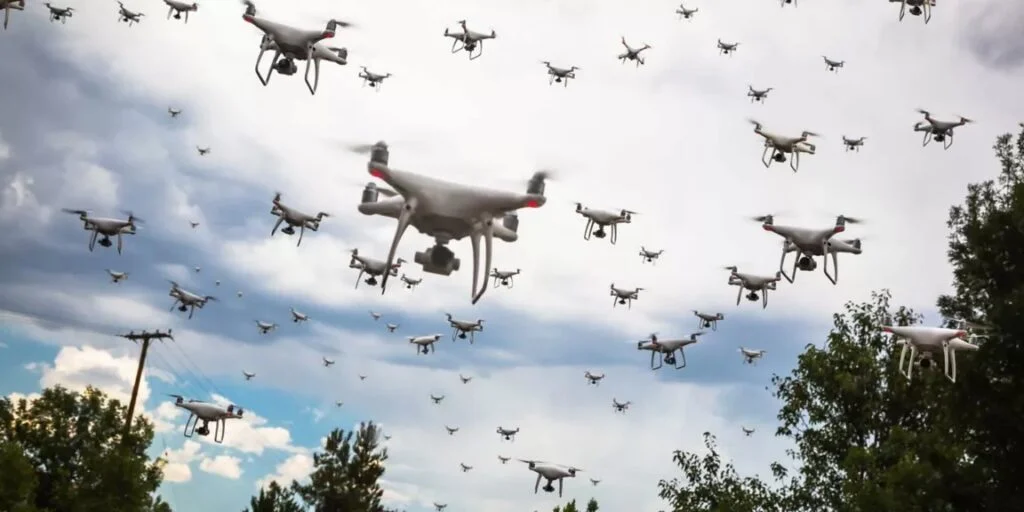
A drone swarm is a group of drones (unmanned aerial vehicles, UAVs) that operate together in a coordinated, autonomous manner to perform a shared task. These drones communicate with each other—often using artificial intelligence, sensors, and wireless networks to share data, avoid collisions, and make collective decisions without requiring direct control of each drone.
The drones work together like a team, similar to how birds or insects move in swarms. They are used in military operations, search and rescue, environmental monitoring, agriculture, and light shows. Each drone can adjust its behavior based on the group’s movements and mission goals.
Drone Swarms
What can Drone Swarms?
A drone swarm can observe, analyze, deliver, and coordinate — doing tasks faster, safer, and more efficiently than any single drone. A drone swarm can perform a wide range of collaborative and complex tasks by working together intelligently.
- Search and Rescue Operations: A drone swarm can scan large disaster areas to locate missing people quickly. It can map dangerous zones (e.g., after earthquakes or floods) where humans cannot safely enter.
- Surveillance and Security: A drone swarm can monitor large areas (like borders, events, or cities) from multiple angles simultaneously. It can detect and track suspicious activity more effectively than a single drone.
- Military and Defense Missions: A drone swarm can conduct reconnaissance, target tracking, or coordinated attacks. It can confuse enemy radar systems through distributed movement and communication.
- Environmental Monitoring: A drone swarm can collect data on air quality, wildlife movement, or forest health. It can detect and track wildfires, pollution, or deforestation in real time.
- Agriculture and Farming: A drone swarm can monitor crop health, soil moisture, and pest activity over vast fields. It can spray fertilizers or pesticides evenly and efficiently.
- Mapping and Surveying: A drone swarm can create accurate 3D maps of terrains, construction sites, or disaster zones much faster than single drones.
- Delivery and Logistics: A drone swarm can work together to deliver packages efficiently or transport supplies to remote areas.
- Entertainment and Light Shows: A drone swarm can perform synchronized aerial light shows or artistic displays with hundreds of drones.
- Scientific Research: A drone swarm can gather synchronized atmospheric or oceanic data for environmental and climate studies.
- Disaster Management: A drone swarm can assess damage, deliver first aid kits, or establish temporary communication networks after a crisis.
Drone swarm features
- Autonomous Coordination: Drones operate and make decisions collectively using artificial intelligence or programmed algorithms without the need for constant human control.
- Inter-Drone Communication: Drones exchange information in real time using wireless networks (like Wi-Fi, radio, or 5G) to maintain formation, avoid collisions, and coordinate actions.
- Swarm Intelligence: The group acts as a single intelligent system, inspired by natural swarms (like bees or birds), where simple individual rules lead to complex group behavior.
- Decentralized Control: No single drone is the “leader”; decisions are distributed across the swarm, which makes the system more resilient to failure.
- Self-Organization and Adaptability: The swarm can reorganize itself if one or more drones fail or if mission conditions change.
- Scalability: The number of drones can be increased or decreased easily depending on the mission’s complexity or area coverage.
- Cooperative Task Execution: Drones can divide large or complex tasks (like mapping, surveillance, or delivery) into smaller parts and complete them collaboratively.
- Real-Time Data Sharing and Analysis: Swarm members collect and share sensor data simultaneously, improving accuracy and speed of decision-making.
- Energy Efficiency: Some swarm algorithms optimize flight paths and formations to conserve battery power across all drones.
- Redundancy and Reliability: If one drone fails, others can continue the mission, ensuring overall system robustness.
Advantages of Drone Swarms
- Efficiency and Speed: Multiple drones can cover large areas or complete complex tasks faster than a single drone.
- Redundancy and Reliability: The system continues to function even if one or more drones fail.
- Cost-Effective Operations: Many small, inexpensive drones can achieve results similar to a single large, costly drone.
- Scalability: Easy to add or remove drones depending on the mission’s size or complexity.
- Autonomous Operation: Minimal human control required; AI allows coordinated decision-making.
- Adaptability: The swarm can dynamically change formation or behavior in response to new conditions.
- Wide Range of Applications: Drone swarms are useful for military defense, disaster response, surveillance, agriculture, delivery, and entertainment.
- Data Accuracy: Simultaneous data collection from multiple points improves analysis and mapping precision.
- Risk Reduction for Humans: Drones can perform dangerous tasks (e.g., search-and-rescue, firefighting, or military missions) without endangering people.
Disadvantages of Drone Swarms
- High Development Cost: Creating reliable swarm technology and communication systems is expensive.
- Complex Coordination: Maintaining stable and collision-free cooperation among many drones is technically challenging.
- Communication Issues: Swarms rely heavily on strong, uninterrupted wireless connections; interference can disrupt operations.
- Limited Battery Life: Each drone’s flight time is constrained by a power supply.
- Security Risks: Swarms are vulnerable to hacking, jamming, or GPS spoofing.
- Ethical and Legal Concerns: Use in surveillance or warfare raises privacy and moral questions.
- Environmental Factors: Weather conditions like wind, rain, or dust can affect performance.
- Data Management Challenges: Handling and processing massive amounts of real-time data from multiple drones is complex.
You can subscribe to Science Online on YouTube from this link: Science Online
Drones, Unmanned Aerial Vehicle (UAV) uses, advantages, and disadvantages
Parrot mini drone features, advantages, disadvantages and popular models
Remotely-operated underwater vehicles (ROVs) features, types, advantages, and disadvantages
Applications of Artificial intelligence in agriculture, Agricultural robots, Drones and Plantix app
Unmanned ground vehicle (UGV) advantages and disadvantages