Gemini Robotics 2 is Doing Household Chores! Powerful Google AI Robot Could Change Your Home Forever!
Gemini Robotics 2 represents an important step toward a future in which AI-powered robots can understand their surroundings, follow natural-language instructions, plan multi-step actions, and physically interact with objects. Google DeepMind’s robotics models have already demonstrated tasks such as preparing salads, packing lunches, folding origami, and manipulating unfamiliar objects, while newer Gemini Robotics systems are designed to improve spatial reasoning, task planning, progress tracking, and collaboration.
Gemini Robotics 2 is Doing Household Chores!
Gemini Robotics 2
Traditional robots are often designed to perform a limited number of predefined tasks. Gemini Robotics takes a different approach by combining AI reasoning with physical action. Google DeepMind describes Gemini Robotics as a vision-language-action model that can take information from the world and translate it into actions performed by a robot.
The idea behind whole-body intelligence is that a useful robot needs more than an intelligent brain. It also needs to understand where objects are, how its body is positioned, how much force to use, and how to coordinate movements. This is particularly important in a home, where objects, furniture, people, and tasks can change constantly.
Gemini Robotics models are designed to help robots generalize beyond individual tasks. Google has demonstrated robots handling unfamiliar objects and instructions, including placing pens into a shoe and performing a toy basketball slam dunk. The technology is intended to make robots more adaptable instead of requiring a separate model for every possible household task.
Gemini Robotics: A New Era of AI-Powered Robots
The breakthrough is the combination of vision, language, reasoning, and physical action. A robot can potentially receive an instruction such as “clean the table,” look at its environment, identify relevant objects, determine a sequence of actions, and then execute those actions.
Google’s robotics research separates some of these capabilities into complementary systems. Gemini Robotics focuses on vision-language-action capabilities, while Gemini Robotics-ER provides embodied reasoning that can help robots understand objects, their locations, and the physical environment.
More recently, Gemini Robotics ER 2, introduced in July 2026, expanded these capabilities with real-time spatial reasoning, multi-step task planning, continuous video understanding, progress tracking, and multi-robot collaboration. Google says the model can monitor a robot’s progress and adapt when something goes wrong instead of simply executing a fixed sequence.
Can Gemini Robotics Do Household Chores?
The answer is yes; in demonstrations and research settings, Gemini-powered robots have shown abilities relevant to household work — but this does not mean that a commercially available home robot can currently perform every chore autonomously.
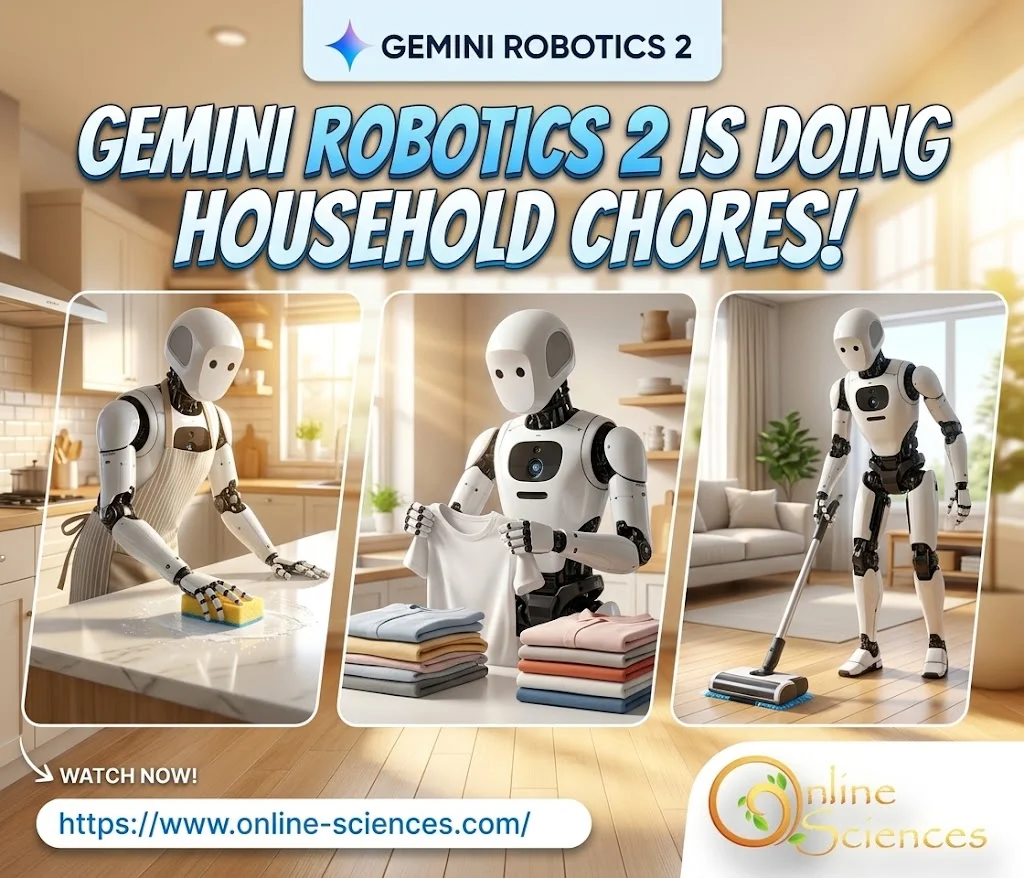
Google has demonstrated Gemini Robotics-powered machines performing tasks including preparing salads, packing children’s lunches, folding an origami fox, manipulating objects, and wiping a whiteboard. These examples show the potential for robots to handle practical activities that involve multiple physical movements.
Household chores are especially challenging because they require flexibility. A kitchen table can have different objects on it every day, clothes can be arranged differently, and a spilled liquid may require the robot to recognize an unexpected situation.
The newer Gemini Robotics ER 2 system is designed to improve this kind of adaptability. Google says robots can use continuous video to understand task progress, detect failures, retry actions, and determine when a multi-step task has actually been completed.
What Household Chores Could AI Robots Handle?
As robotic hardware and AI models improve, household robots could potentially assist with tasks such as:
- Picking up and organizing objects.
- Moving items from one location to another.
- Packing lunches.
- Wiping surfaces.
- Helping prepare simple food.
- Opening and closing drawers.
- Fetching requested objects.
- Sorting household items.
- Cleaning up selected areas.
- Loading or unloading objects.
- Performing repetitive organization tasks.
Earlier Google robotics research also explored helper robots performing actions such as picking and placing objects, opening and closing drawers, retrieving items from drawers, opening jars, and pulling napkins.
However, tasks involving hot surfaces, sharp objects, fragile items, stairs, electrical equipment, or close interaction with children and pets require particularly strong safety systems and reliable physical control.
Can AI Do Household Chores?
AI by itself cannot physically clean a house. AI software can understand instructions, reason about objects, and create plans, but a physical robot needs motors, cameras, sensors, manipulators, batteries, and other hardware to turn those decisions into actions.
This is why Gemini Robotics is significant. It connects AI intelligence with robotic bodies. Google describes Gemini Robotics as a vision-language-action model that can turn visual and language information into physical actions.
For example, instead of programming a robot with a rigid sequence such as “move your arm 20 centimeters, close the gripper, and move backward,” a future home robot could potentially receive a more natural request such as “Please put the dishes away.”
The robot would then need to understand what dishes are present, locate appropriate storage spaces, determine how to safely grasp each item, navigate around obstacles, and recognize when the task is complete.
How Gemini Robotics Understands the Physical World
One of the biggest challenges in robotics is spatial intelligence. A robot must understand not only what an object is but also where it is and how it relates to other objects.
Gemini Robotics ER has been developed to support capabilities such as object detection, identifying parts of objects, 3D understanding, and spatial reasoning.
Gemini Robotics ER 2 goes further by using continuous video feeds to monitor what is happening during task execution. Google reports that the system can detect whether actions are succeeding, recognize problems such as spills, slips, or misalignments, and help robots adjust their behavior. This type of intelligence is essential for household robots because real homes are unpredictable.
From Simple Commands to Multi-Step Household Tasks
A truly useful home robot cannot simply respond to one movement at a time. Household work usually consists of multiple steps. Consider the instruction:
“Clean up the kitchen table.”
A capable robot would need to:
- Observe the table.
- Identify objects and determine what belongs elsewhere.
- Pick up objects safely.
- Move around obstacles.
- Place items in appropriate locations.
- Recognize anything that needs special handling.
- Determine whether the table is actually clean.
- Correct mistakes if necessary.
Gemini Robotics ER 2 is specifically designed to improve multi-step orchestration and progress tracking. Google describes it as a high-level “brain” that can coordinate lower-level robotic action models while monitoring progress.
Can Robots Help With Household Work?
Yes. Robots can already help with some household work, and AI is making them increasingly flexible. Robotic vacuum cleaners are a familiar example, but the next generation of robots aims to interact with a much wider variety of objects and environments. The long-term goal is a robot that can operate in human spaces without requiring the home to be redesigned.
Gemini Robotics is designed to work across different robot embodiments, including research robots and humanoid robots. Google has highlighted the ability of its models to adapt to different robotic platforms and perform tasks such as packing a lunch or wiping a whiteboard.
This adaptability could eventually make AI-powered robots useful in homes, offices, hospitals, warehouses, and other environments.
Why Household Robotics Is So Difficult
A home is one of the hardest environments for a robot. Factories usually provide controlled environments where objects have predictable positions and tasks are repeated. A home is completely different. Furniture moves, objects are left in unexpected places, lighting changes, and humans and pets constantly move through the robot’s workspace.
Robots also need dexterity. Picking up a solid box is relatively simple, while handling a wet cloth, a fragile glass, a spoon, or a tangled cable requires considerably more sophisticated manipulation. Google has identified dexterity as a major challenge and says Gemini Robotics made significant advances in complex physical manipulation and multi-step tasks.
Safety Is Critical for AI-Powered Home Robots
A household robot must be intelligent, but it must also be safe.
Gemini Robotics ER 2 includes improvements aimed at physical safety. Google reports that the model can recognize when a person is nearby and halt a humanoid robot, resuming only when the area is clear. It also evaluates safety instruction following and human proximity.
This is particularly important because a home robot could operate near children, elderly people, pets, glass objects, hot appliances, and other hazards.
The future of household robotics therefore depends not only on making robots smarter but also on making their physical actions predictable, cautious, and reliable.
The Future of Gemini Robotics and Household Chores
The ultimate vision is not simply a robot that can perform one impressive demonstration. The real breakthrough would be a general-purpose home robot capable of learning and completing many different tasks.
Imagine saying: “Please tidy the living room before the guests arrive.”
A future Gemini-powered robot could potentially identify objects that are out of place, collect them, organize them, wipe surfaces, and report when the task is finished.
That future is not fully here yet. Google itself has described helpful robots in homes as a longer-term goal, while its current robotics models and demonstrations represent steps toward that vision.
The development of Gemini Robotics ER 2 in 2026 shows how quickly the field is progressing, particularly in spatial reasoning, task orchestration, video-based progress tracking, safety, and collaboration between robots.
Conclusion
Gemini Robotics is helping move AI from the screen into the physical world. Instead of AI simply answering questions, robotics models can connect language and visual understanding with physical actions.
The most exciting possibility is household assistance. Robots that can understand natural instructions, manipulate everyday objects, recover from mistakes, and safely work around people could eventually take over some repetitive household chores.
For now, Gemini Robotics should be viewed as an important step toward that future rather than proof that fully autonomous household robots are already available. But with Google’s advances in embodied reasoning, dexterity, task planning, progress tracking, and safety, the idea of an AI-powered robot helping around the home is becoming increasingly realistic.
Frequently Asked Questions about Gemini Robotics 2
- Is there a robot that can do household chores?
Yes. Robots can already perform specific household tasks, while research robots powered by advanced AI have demonstrated broader capabilities such as manipulating objects, packing lunches, preparing food, and cleaning surfaces. However, a fully autonomous general-purpose household robot capable of reliably doing all common chores is not yet a mainstream consumer product.
- Can AI do household chores?
AI software cannot physically perform chores on its own. It can understand instructions, reason about the environment, and plan actions, while a physical robot provides the mechanical ability to carry them out. Gemini Robotics combines AI capabilities with robotic action models to bridge this gap.
- What does Gemini Robotics do?
Gemini Robotics is a vision-language-action model designed to help robots understand visual information and natural-language instructions and translate them into physical actions. Google has demonstrated capabilities including object manipulation, packing lunches, preparing salads, and folding origami.
- Can robots help with household work?
Yes. Robots can help with repetitive or structured household tasks, and advances in embodied AI are making robots more capable of handling unfamiliar objects and multi-step instructions. More general household assistance remains an ongoing area of research.
- What is Gemini Robotics ER 2?
Gemini Robotics ER 2 is Google’s embodied-reasoning model introduced in July 2026. It is designed to provide robots with capabilities including spatial reasoning, task planning, video-based progress tracking, tool orchestration, safety reasoning, and multi-robot collaboration.
- Can Gemini Robotics clean an entire house?
Not reliably as a general consumer capability today. Gemini Robotics research demonstrates important components of household assistance, but cleaning an entire home autonomously requires robust navigation, dexterity, object recognition, safety, planning, and error recovery.
- What household chores could future AI robots perform?
Potential applications include tidying rooms, moving objects, organizing items, wiping surfaces, preparing simple food, packing lunches, retrieving objects, and other repetitive tasks. The exact capabilities will depend on the robot‘s physical hardware as well as its AI model.
- Is Gemini Robotics available as a household robot?
Gemini Robotics is an AI technology for robotics rather than a single consumer household robot. Google has been developing and testing the technology with robotic platforms and partners, with the broader goal of making robots more useful in real-world environments.
You can follow science online on YouTube from this link: Science online
Gemini Takes Over: The End of Google Assistant in 2026! 🚀
Goodbye Google Assistant: Can Your Android Phone Actually Run Gemini? 🚀
Goodbye Google Assistant? 10 Powerful Reasons Gemini AI Is the Future in 2026
Will Gemini AI Replace Google Assistant? The Ultimate Guide to Google’s Powerful AI Upgrade 2026
Google Assistant Review 2026: Features, Pros, Cons and What It Can Do
Claude AI advantages, disadvantages, features and Is Claude better than GPT 4?
Claude Sonnet 4.5 features, advantages, disadvantages, Is Claude Sonnet 4 better than GPT 4?
Gemini AI review, advantages, disadvantages and Is Gemini AI better than ChatGPT?
ChatGPT review, features, advantages and disadvantages
Google Bard AI chatbot advantages, disadvantages, review, features and Bard vs ChatGPT