
Kilobot Robot: Definition, Features, Advantages, Disadvantages, and What It Can Do
A Kilobot is a very small, low-cost research robot designed specifically for swarm robotics experiments. It was developed at Harvard University to allow researchers to study how large groups of simple robots can cooperate and produce complex, intelligent behavior without central control. A single Kilobot is limited, but together, hundreds or thousands can act like a coordinated system.
What is a Kilobot?
The Kilobot is a small, low-cost research robot designed for swarm robotics studies. It was developed at Harvard University to enable scientists and engineers to experiment with large groups of robots—often hundreds or even thousands—working together. Individually, a Kilobot has very limited capabilities, but collectively, Kilobots can demonstrate complex and intelligent behaviors through simple local interactions.
How do Kilobots move?
Kilobots move using vibration-based locomotion, not wheels or legs. They have two tiny vibration motors that create controlled shaking. By adjusting the vibration patterns, the robot can:
- Move forward.
- Turn left or right.
- Rotate in place.
This movement method is simple and low-cost but slow and not very precise, which is acceptable for swarm experiments.
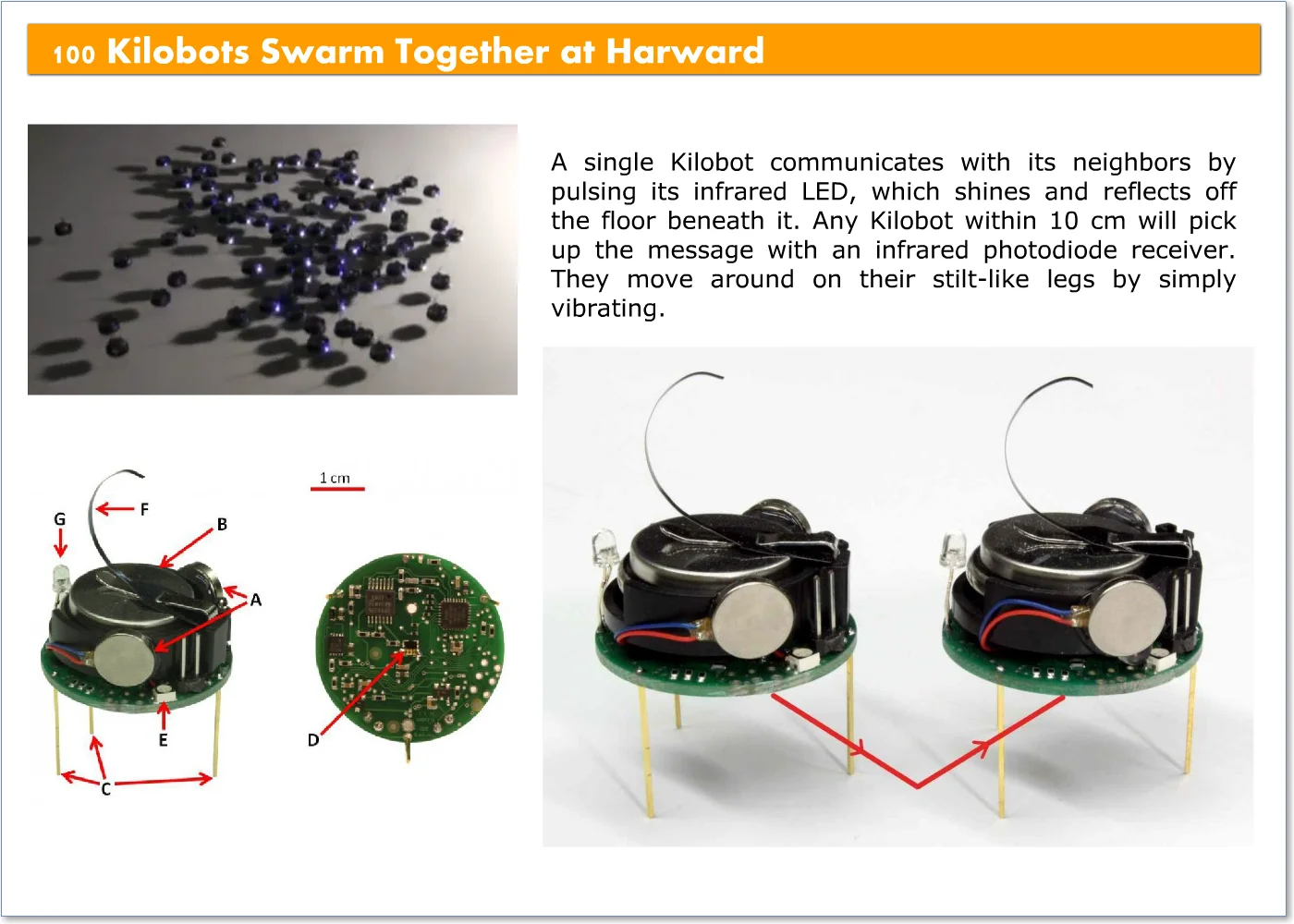
Kilobot
What are swarm robots used for?
Swarm robots are used to study and apply collective intelligence, in which many simple robots work together according to local rules. They are used in:
- Scientific research: Studying self-organization and emergent behavior.
- Search and rescue: Exploring dangerous or collapsed areas.
- Environmental monitoring: Tracking pollution, fires, or wildlife.
- Agriculture: Crop monitoring and automated farming.
- Military & security: Surveillance and reconnaissance.
- Space exploration: Cooperative exploration of planets or asteroids.
- Education: Teaching AI, robotics, and distributed systems.
Kilobot Features
Kilobot robots are intentionally simple in design, making them ideal for large-scale experiments in distributed intelligence.
- Compact Size: Approximately the size of a coin.
- Locomotion System: Moves using vibration motors instead of wheels.
- Communication: Infrared (IR) communication with nearby robots.
- Distance Measurement: Estimates distance to neighbors using IR signals
- Processing Unit: Basic microcontroller for simple algorithms.
- Power Supply: Small onboard battery.
- Scalability: Kilobot is designed to operate efficiently in large swarms.
Advantages of Kilobot
Kilobot offers several benefits, especially for academic and research environments:
- Low Cost: Kilobot enables experiments with hundreds or thousands of robots.
- Scalable Platform: Kilobot is ideal for studying large-scale swarm behavior.
- Simple Hardware: Kilobot is easy to deploy and maintain.
- Excellent for Research: Kilobot is widely used in swarm robotics and collective intelligence studies.
- Educational Value: Kilobot helps students understand distributed systems and self-organization.
Disadvantages of Kilobot
Despite its strengths, Kilobot has notable limitations:
- Limited Individual Capabilities: Very basic sensing and processing.
- Slow and Imprecise Movement: Vibration-based motion lacks accuracy.
- Short Communication Range: Restricted to nearby robots only.
- Not Industrial-Grade: Kilobot is unsuitable for real-world or commercial applications
- No Payload Capacity: Kilobot cannot carry tools or objects.
What Can Kilobot Do?
While simple on its own, Kilobot becomes powerful when operating as part of a swarm:
- Self-Assembly: Form complex shapes and patterns collectively.
- Swarm Coordination: Demonstrate leaderless coordination and cooperation.
- Distributed Algorithms: Execute decentralized decision-making processes.
- Biological Modeling: Simulate behaviors of ants, bees, and other social insects.
- Artificial Intelligence Research: Study emergent behavior and collective intelligence.
The Kilobot is a groundbreaking platform in swarm robotics. Although it is not designed for industrial use, its low cost and scalability make it an essential tool for research, education, and experimentation with collective robotic systems. By focusing on simplicity at the individual level, Kilobot enables powerful insights into how intelligent behavior can emerge from large groups of simple agents.
You can follow Science Online on YouTube from this link: Science online
Swarm robotics features, advantages, disadvantages, and what is swarm robotics used for?
Emo robot review, advantages, disadvantages, features and What can Emo do?
Top trending topics on Emo robots and What can Emo do?
Ameca robot review, features, advantages, disadvantages and What can Ameca Do?
Eilik Desktop Companion Robot structure, features, use, advantages and disadvantages
Humanoid robots use, types, risks, advantages and disadvantages
Sophia robot review, features, use, advantages and disadvantages
Robot teachers use, types, advantages, and disadvantages
Tesla robots (Optimus) review, use, advantages and disadvantages