Laika AI Robot Dog Designed as Astronaut Companion that offers emotional support in space
Laika is an advanced AI-powered robotic dog designed as a companion robot that uses artificial intelligence, sensors, and autonomous movement to interact with humans. It is built to mimic the behavior of a real dog while offering smart features such as obstacle avoidance, voice interaction, facial recognition, and emotional response.
What is Laika AI Robot Dog?
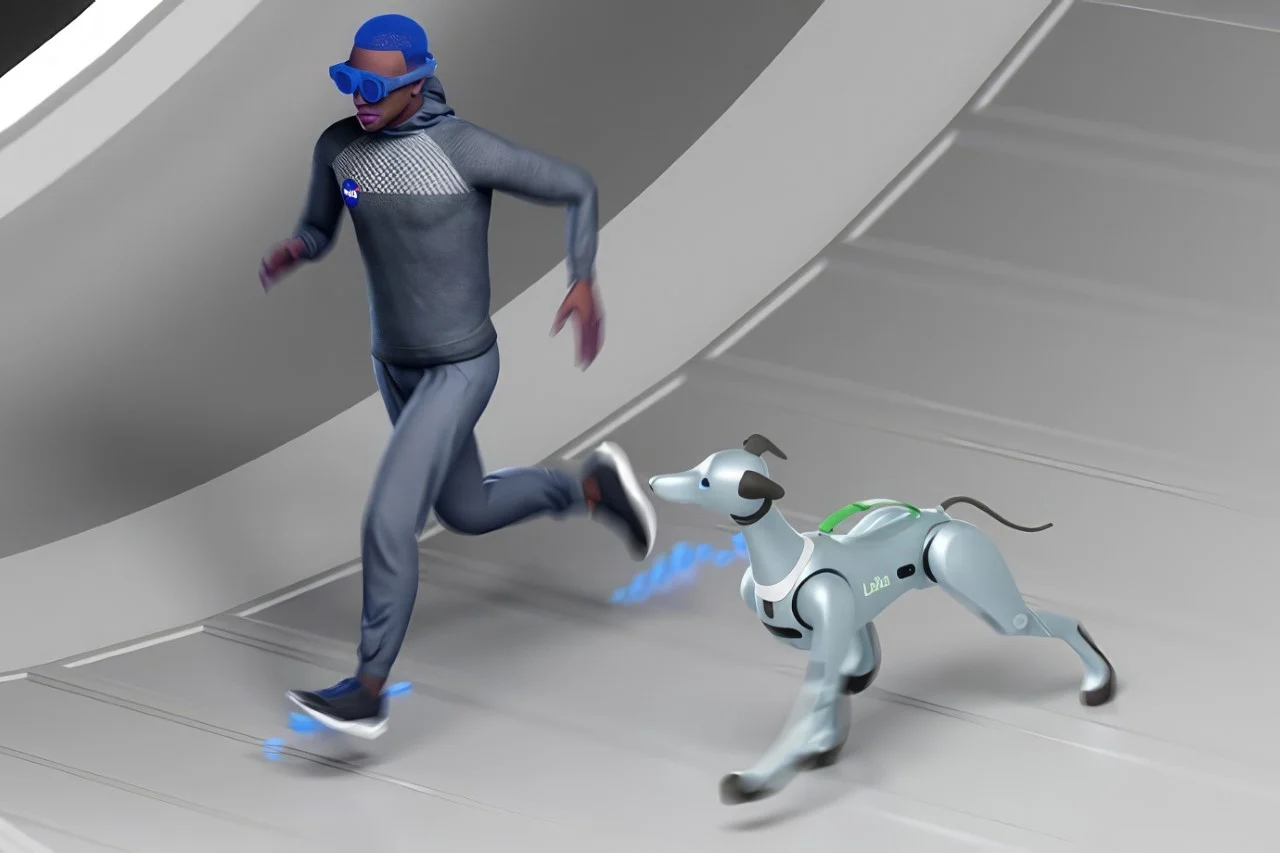
Laika is a robotic dog concept designed by Jihee Kim (a design student) for use in space. It’s named after Laika, the first dog to orbit Earth. It is intended to be a companion for astronauts on long-duration missions, addressing both loneliness and psychological stress. It is also intended to serve practical functions, providing not only emotional support but also health monitoring.
Laika is designed for homes, education, and entertainment, providing a friendly and interactive robotic pet. There’s a vision for Laika to be used on Earth, too (in domestic settings) in the future. Laika is made from titanium, which makes it durable enough for harsh environments (like space) while maintaining a sleek, robotic, but approachable form. It has a “stretchable handle” on its back — for carrying small items or for a human to lift it.
Laika has depth cameras, thermal imaging cameras, ultrasonic sensors, and SLAM (Simultaneous Localization and Mapping) for navigation. It has ECG (electrocardiography) sensors in its neck (similar to a collar) to monitor an astronaut’s vital signs when they interact physically with Laika. It has multi-joint articulation to allow lifelike movements (e.g., head tilting, walking) to simulate realistic pet behavior.
Laika AI Robot Dog
Beyond companionship, Laika is envisioned as a “health coach”: it monitors physical well-being, can respond emotionally, and be a comforting presence. Because of its design for human-robot emotional connection, Laika’s form is more “organic” and friendly than some more industrial or aggressive robot dogs.
The concept includes possible integration with mixed reality glasses, which would let users see data about Laika’s status or health metrics in real time. Its design could be adapted for use on Earth — as a support companion, therapy animal substitute, or even as a part of health-monitoring systems.
Laika is not (currently) a consumer robot dog you can buy off the shelf — it’s a design concept aimed at long-duration space missions. It’s meant to combine emotional companionship with practical health-monitoring — making it more than just a pet robot, but a kind of “crew mate” in space.
Laika AI Robot Dog features
- AI-Powered Interaction: Laika responds to voice commands. It recognizes faces and reacts differently to each person. It shows “emotional” responses using LED eyes, gestures, or sound.
- Autonomous Movement: Laika walks, runs, turns, and performs tricks. It has 6-axis sensors for balance. It can perform obstacle detection and smart navigation.
- Smart Sensors: Laika has cameras for vision. It has touch sensors to respond when petted, and it has microphones for accurate sound localization.
- Connectivity: Laika connects via Wi-Fi or Bluetooth. It is controlled through a dedicated mobile app. It can update its AI behavior through firmware updates.
- Entertainment Capabilities: Laika plays games. It dances or performs special movement routines. It can act as a learning robot for kids and students.
- Multimedia: Some models include speakers, music playback, and expressive LED lights.
What Can Laika AI Robot Dog Do?
Laika can follow its owner using tracking cameras. It can respond to petting with happy animations. It can perform tricks like sitting, rolling, or dancing. It can patrol a room and send alerts through the app. It can interact socially using expressions and sounds. It can learn new commands over time (AI training), and it can act as an educational STEM tool.
Advantages of Laika AI Robot Dog
- Emotional Support & Companionship: Laika is designed to provide emotional support to humans, especially in isolated or stressful environments. Expressive, life-like movements (multi-joint articulation) help it feel more like a real pet.
- Advanced Sensing & Awareness: Laika is equipped with depth cameras, thermal imaging, ultrasonic sensors, and SLAM (Simultaneous Localization and Mapping) to navigate its surroundings. It can detect people, objects, and space, which helps it move autonomously.
- Health Monitoring: Laika has an ECG sensor in its neck to monitor a person’s vital signs during interaction, which is especially useful for long missions (e.g., in space). Structural design uses titanium, making it robust and able to endure difficult conditions (like space) but also usable on Earth.
- Safety & Low Risk: Because it’s a robot, there’s no risk of allergies, disease, or animal care responsibilities (feeding, walking, vet, etc.). It can be “turned off” or controlled, reducing unexpected behavior risk.
- Potential for Integration: There is a vision to integrate with mixed-reality glasses, so users could get real-time data or feedback about Laika’s status. Laika can handle on the back for carrying or for humans to lift it, making it practical.
- Support in Extreme Environments: Laika is specifically envisioned for use in space missions, where real pets are not feasible. It could be a psychological “crew mate.”
- Laika is a safe alternative to real pets (no allergies, no feeding). It teaches robotics and coding. It has an emotionally engaging experience with realistic behaviors. It is a fun companion for kids and adults. Low maintenance, Smart navigation, and obstacle avoidance.
Disadvantages of Laika AI Robot Dog
- Lack of Genuine Emotion: Although it simulates affection, its “emotional” responses are programmed, not felt. Some users may find the connection superficial compared to a real dog. The emotional bond is limited by the fact that it’s a machine, which may not fully satisfy people wanting “real” pet companionship.
- Complexity and Cost: Building with titanium and advanced sensors likely makes Laika very expensive. Maintenance, repairs, and upgrades could be costly.
- Power / Energy Constraints: As a robot, it needs a power source. Frequent recharging or battery changes could be required, especially with heavy sensor use. In long-duration missions (or long use at home), managing power could be a challenge.
- Dependence on Technology: Highly dependent on its software, sensors, and connectivity. If any system fails (camera, SLAM, ECG), its utility drops. Laika needs periodic software updates; bugs or glitches could break the illusion of “real” interaction.
- Weight / Portability: A titanium body may be strong but also heavy, making it less portable or more difficult to handle. The design includes a handle, but lifting a heavy robot repeatedly is not ideal.
- Limited Social & Developmental Impact: For children or people who would benefit from real pet interaction (empathy, responsibility, social bonding), a robot dog may not substitute fully. According to general criticisms of robot pets: interactions can feel repetitive or “inauthentic.”
- Unproven in Real Use: As far as available sources show, Laika is a concept design. There may be limited (or no) mass-produced working units. Real-world durability, long-term behavior, and reliability under continuous human use are untested/unproven.
- Psychological Risk: Some argue that robot pets might reduce motivation to form relationships with real animals or people, especially in emotionally vulnerable individuals. Laika could create unrealistic expectations about companionship (“if only a robot could be this responsive”), which real relationships don’t match.
- Laika is expensive, depending on the model. It is not a replacement for a real pet in terms of emotion or bonding. Battery limitations require frequent recharging. It requires a stable Wi-Fi/app for full features. Its durability depends on usage (may not handle rough play).
You can follow Science Online on YouTube from this link: Science online
WowWee CHiP robot, What can chip the robot dog do?, How to use chip robot dog?
Cupboo AI robotic pet review, features, advantages and disadvantages
Sophia robot review, features, use, advantages and disadvantages
Top trending topics on Sophia robots and Can Sophia Destroy humans
Educational robotics, Robot teachers, Social robots review, features advantages and drawbacks
Humanoid robots use, risks, advantages, and disadvantages