TIAGo robot features, advantages, disadvantages, What can TIAGo robot do?
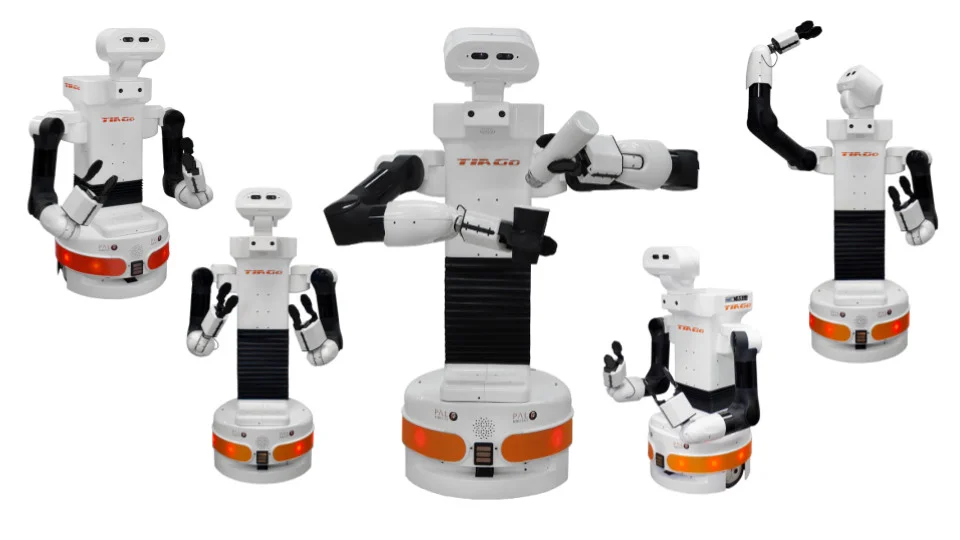
The TIAGo robot is a mobile service and research robot developed by PAL Robotics. Its name comes from “TIAGo” = Take It And Go, highlighting its ability to navigate autonomously, perceive its environment, and manipulate objects with a robotic arm.
TIAGo robot
TIAGo is a customizable mobile manipulator robot that combines autonomous navigation, a 7-degree-of-freedom robotic arm, and advanced perception systems, designed for research, healthcare, industrial service, and human–robot interaction applications.
TIAGo is a versatile indoor robot that can move, see, interact with people, and handle objects—making it ideal for research labs, healthcare, and service robotics. It can move around and use its arm to pick, carry, and interact with objects.
The TIAGo robot has a modular design with different grippers, sensors, and configurations. It is fully compatible with ROS (Robot Operating System) for research and development. It is safe, collaborative, and built to operate in environments shared with people.
TIAGo robot
What can TIAGo robot do?
The TIAGo robot (by PAL Robotics) is a multipurpose service and research robot designed to work alongside humans. TIAGo can move, see, interact, and manipulate objects, making it suitable for healthcare, service robotics, industrial assistance, and academic research.
- Assistive & Service Tasks: The TIAGo robot can fetch and carry objects (cups, bottles, tools, etc.). It can deliver items to specific locations autonomously. It can assist elderly or disabled people with daily activities (reminders, bringing objects, monitoring).
- Research & Industry: TIAGo robot can act as a research platform for robotics, AI, machine learning, and human–robot interaction studies. It can perform light manipulation tasks like pressing buttons, opening drawers, or operating simple machines. It can support logistics: moving small payloads, sorting, or transporting items indoors.
- Healthcare & Social Interaction: The TIAGo robot can interact with patients through speech, gestures, and a touchscreen. It can provide companionship, entertainment, or cognitive training exercises. It can monitor environments and alert caregivers in emergencies.
- Navigation & Exploration: TIAGo robot can move autonomously in indoor spaces using SLAM (maps and localizes itself). It can avoid obstacles and plan safe paths in real time. It can patrol or monitor defined areas (e.g., in hospitals, offices, or research labs).
- Perception & Recognition: TIAGo robot can recognize and track objects using cameras and depth sensors. It can detect human faces, gestures, and positions. It can perform environment mapping for smart space management.
- Customization for Projects: TIAGo robot has a flexible, modular design that allows researchers to attach extra sensors, tools, or custom grippers. It is used in AI, robotics competitions, and universities for testing new algorithms in navigation, manipulation, or HRI (Human–Robot Interaction).
TIAGo Robot Features
TIAGo is a versatile service robot that combines autonomous navigation, object manipulation, and human interaction, making it ideal for research, healthcare assistance, and industrial service robotics.
- Mobility: The TIAGo robot has a differential-drive mobile base with omnidirectional movement. It is equipped with laser scanners and depth sensors for safe navigation. It uses SLAM (Simultaneous Localization and Mapping) to autonomously map and navigate indoor spaces.
- Manipulation: The TIAGo robot has a 7-DoF robotic arm with high precision. It has multiple end-effector options (parallel gripper, underactuated hand, or customized tools). It has an arm payload of around 3–6 kg, suitable for light manipulation tasks.
- Perception: The TIAGo robot has RGB-D cameras (3D vision) for object detection, recognition, and tracking. It has laser rangefinders and LiDAR for obstacle detection and navigation. It has a pan-tilt head unit for a wide field of view.
- Human–Robot Interaction: The TIAGo robot has a touchscreen display for communication and a user interface. It has microphones and speakers for voice interaction. It can recognize faces, gestures, and speech (with proper software integration).
- Software & Control: The TIAGo robot is fully compatible with ROS (Robot Operating System). It supports Gazebo simulation for testing in virtual environments. APIs are available for AI, perception, navigation, and manipulation tasks.
- Safety: The TIAGo robot has force and torque sensors in the arm for compliant and safe interaction with humans. It has collision avoidance algorithms to prevent accidents.
- Customization: The TIAGo robot can integrate extra sensors (thermal cameras, extra LiDARs, tactile sensors). It is adaptable for healthcare, research, service, or logistics applications. It has a modular design: available with a single-arm or dual-arm configuration.
Advantages of TIAGo Robot
The TIAGo robot (by PAL Robotics) is a mobile service robot designed for research, healthcare, and assistive applications. It combines mobility, manipulation, and perception in a single platform.
- Versatile Design: TIAGo robot combines a mobile base, a robotic arm, and a pan-tilt head with sensors, allowing it to move, see, and manipulate objects.
- Customizable: Researchers can configure it with different arms (single or dual), sensors (RGB-D cameras, LiDAR, etc.), and grippers depending on project needs.
- ROS Compatibility: The TIAGo robot is fully integrated with ROS (Robot Operating System), making it easy for developers to test, simulate, and program.
- Human–Robot Interaction: The TIAGo robot is equipped with cameras, microphones, and a screen for intuitive communication with humans.
- Safe and Reliable: The TIAGo robot is designed to work around people with built-in safety features like collision detection and compliant control.
- Wide Application Areas: The TIAGo robot is useful in healthcare (helping the elderly or disabled), service robotics, logistics, smart factories, and academic research.
- Autonomous Navigation: The TIAGo robot can map environments and navigate autonomously using SLAM (Simultaneous Localization and Mapping).
Disadvantages of TIAGo Robot
- High Cost: The TIAGo robot is expensive, making it difficult for small institutions, startups, or individuals to afford.
- Limited Payload: Its robotic arm has a relatively low payload capacity (around 3–6 kg), restricting use in heavy industrial tasks.
- Speed Constraints: The TIAGo robot moves at a modest pace, not suitable for tasks requiring very fast mobility.
- Indoor Use Focus: TIAGo robot is primarily designed for structured indoor environments; it struggles in rough outdoor terrains.
- Complex Setup for Beginners: While ROS is powerful, it can be challenging for users with little robotics or programming experience.
- Dependence on Environment: TIAGo robot requires structured environments (flat floors, mapped areas) for best performance—less adaptable in highly dynamic or cluttered spaces.
You can follow Science Online on YouTube from this link: Science online
Sophia robot review, features, use, advantages and disadvantages
Robot teachers use, types, advantages and disadvantages
Advantages and disadvantages of using robots in our life
Automation in manufacturing use, advantages and disadvantages
Humanoid robots use, types, risks, advantages and disadvantages
Pepper robot review, features, and What can Pepper do for your business?
Boston Dynamics Atlas review, advantages and features, How does Atlas robot work?