
Examples and some technological applications of Electromagnetic waves
Electromagnetic waves are formed when an electric field couples with a magnetic field. The magnetic and electric fields of electromagnetic waves are perpendicular to each other and to the direction of the wave.
Mechanical waves and Electromagnetic waves cause wave motion.
The electromagnetic waves
Electromagnetic waves are characterized by:
- They are accompanied by electromagnetic forces.
- Their speed is extremely high (the speed of light is about 300 million m/s).
- No medium is required for the electromagnetic waves to travel through. They can travel through free space.
Examples of electromagnetic waves:
- Gamma rays
- The light waves
- Wireless waves (which are used in communications)
- X-rays.
- Ultraviolet and infrared rays (accompanied by Sun rays).
- Radio and television waves.
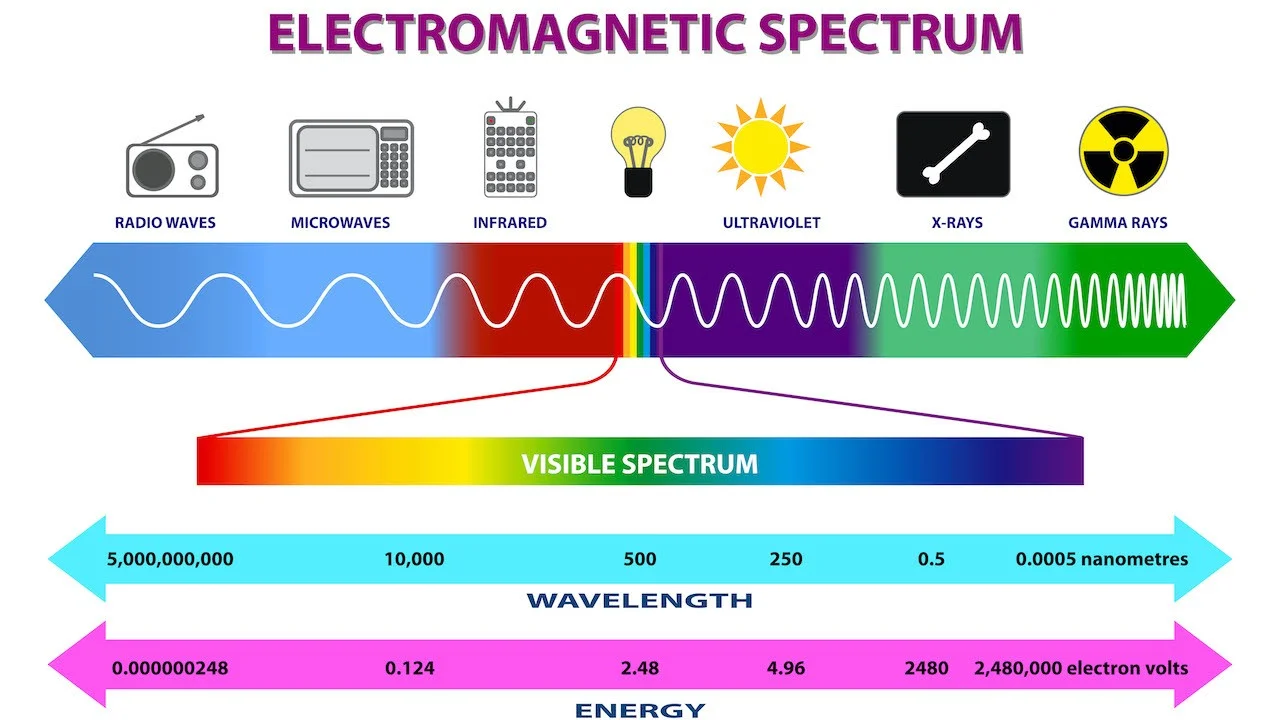
Examples and some applications of electromagnetic waves
Technological applications of electromagnetic waves
Ultraviolet (UV) rays: They have the property of killing the microbes, so they are used to sterilize the sets of surgical operation rooms.
X-rays: They are very important in photographing bones for detecting bone fractures. X-rays are used in examining the mineral raws in industry and showing errors, pores, and cracks in these minerals.
Gamma rays: They are used for medical purposes in the treatment and discovery of some swellings (tumors).
Visible (seen) light: They are used in photography cameras, they are very important in television cameras, and they are used in light shows (data shows).
Infrared (IR) rays: They are used in night vision apparatus used by modern military forces. They are very important in remote sensing instruments to photograph Earth’s surface using satellites.
Also, they are used in cooking food because these rays have heat effect properties, and they are used in making remote sets to control and start electric sets (TV, DVD, air conditioner, etc.).
FAQ about Electromagnetic Waves
1. What are electromagnetic waves?
Electromagnetic (EM) waves are waves of energy that travel through space without needing a medium. They move at the speed of light and include different types such as radio waves, microwaves, infrared, visible light, ultraviolet, X-rays, and gamma rays.
2. What are the main types of electromagnetic waves?
The electromagnetic spectrum includes:
- Radio Waves.
- Microwaves.
- Infrared (IR).
- Visible Light.
- Ultraviolet (UV).
- X-rays.
- Gamma Rays.
They are arranged according to wavelength and frequency.
3. What are examples and technological applications of electromagnetic waves?
- Radio Waves: Examples: FM/AM radio signals, TV broadcasting. Applications: Radio communication, Television transmission, Mobile phone networks, Wi-Fi, and Bluetooth.
- Microwaves: Examples: Microwave ovens, radar systems. Applications: Cooking food, Satellite communication, Weather radar, and GPS systems.
- Infrared Waves (IR): Examples: TV remote controls, heat radiation. Applications: Thermal imaging cameras, Night vision devices, Remote controls, and Fiber optic communication.
- Visible Light: Examples: Sunlight, light bulbs. Applications: Human vision, Photography, Optical instruments (microscopes, telescopes), and Laser technology.
- Ultraviolet (UV): Examples: Sun’s UV rays, UV lamps. Applications: Sterilization and disinfection, detecting fake currency, medical treatments, and forensic analysis.
- X-Rays: Examples: Medical X-ray imaging. Applications: Medical diagnosis, Airport security scanners, and Industrial inspection.
- Gamma Rays: Examples: Radioactive materials. Applications: Cancer treatment (radiotherapy), Sterilizing medical equipment, and Scientific research.
4. Why are electromagnetic waves important in technology?
Electromagnetic waves are essential for:
- Communication systems.
- Medical imaging and treatment.
- Space exploration.
- Security systems.
- Daily electronic devices.
5. Are electromagnetic waves dangerous?
Some types (like X-rays and gamma rays) can be harmful in high doses. Others (like radio waves and visible light) are generally safe in normal everyday use.
6. How do electromagnetic waves travel?
They travel through space (vacuum) at the speed of light (about 300,000 km per second).
You can subscribe to Science Online on YouTube from this link: Science Online
Properties of Mechanical waves and Electromagnetic waves
Properties of electromagnetic waves and Light reflection
Visible spectrum and Properties of light
X-rays properties, uses and method of obtaining X-rays by using Coolidge tube

THANK YOU FOR SOME INFORMATION
You are welcome