MarsCat features, advantages, disadvantages, What can MetaCat do?
MarsCat is a robotic pet cat developed by Elephant Robotics, designed to mimic the behaviors and characteristics of a real cat. It can move, play, and react without human intervention. It can walk, stretch, sit, and sleep like a real cat. It has six capacitive touch sensors. It responds to petting on the head, back, chin, and other areas.
What is MarsCat?
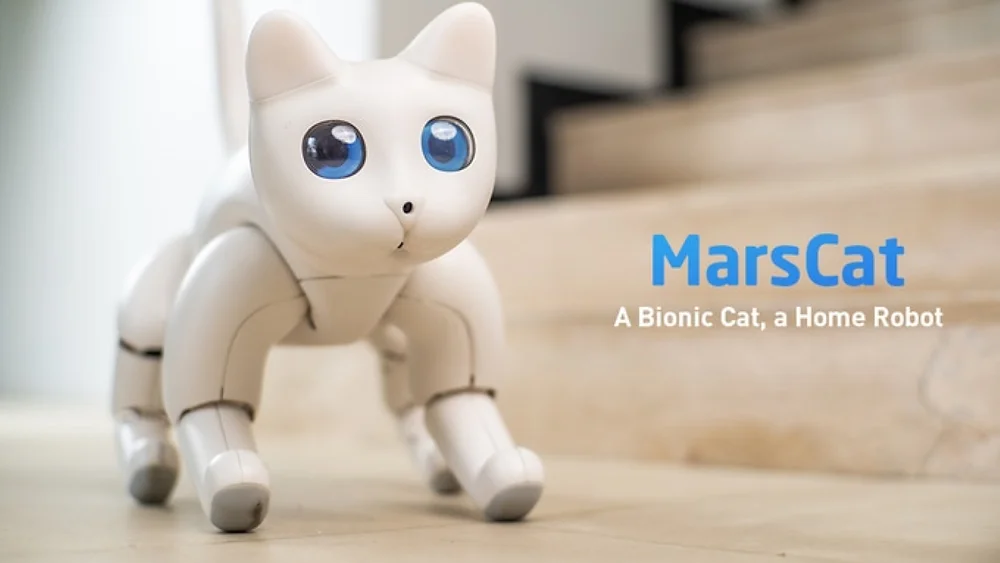
MarsCat is the world’s first bionic pet cat, It is designed to be a fully autonomous, interactive robotic companion. MarsCat mimics the behaviors of a real cat, offering users a unique blend of companionship and technological innovation. It can understand and respond to simple voice commands. It recognizes the owner’s voice over time.
MarsCat operates independently without manual control. It can walk, run, sleep, sit, stretch, knead, and mimic behaviors like burying litter, though it doesn’t produce any waste. It comes with touch sensors, a camera, and a microphone. MarsCat can play with toys and interact with real cats, it can feel your touch, see your face, hear your voice, and respond accordingly.
Each MarsCat develops a unique personality based on how you interact with it. Over time, it may become more enthusiastic, aloof, energetic, lazy, social, or shy, reflecting the nature of your interactions. It is open-source and programmable. Developers and enthusiasts can customize its behaviors and functions using the provided SDK, making it a valuable tool for education and research.
MarsCat
MarsCat has OLED eyes that display various expressions, helping convey its “emotions” and enhancing user interaction. It operates for approximately 2–3 hours on a full charge, depending on usage. It is ideal for individuals who love cats but can’t own one due to allergies, housing restrictions, or lifestyle constraints.
Schools and institutions can use MarsCat as a teaching tool for robotics, programming, and AI. Researchers can utilize MarsCat‘s open-source platform for experiments in human-robot interaction, AI behavior modeling, and more. Hobbyists interested in robotics and programming can explore and expand MarsCat’s capabilities.
MarsCat features
MarsCat, the robotic pet cat developed by Elephant Robotics, develops its personality based on how you interact with it. It can be playful, shy, lazy, or energetic, depending on user behavior. It walks, stretches, plays, and responds without manual control. It uses six motors to mimic cat-like body movements (walking, tail swishing, head turning, etc.).
MarsCat recognizes its name and basic phrases. It can hear and respond to certain voice commands. It responds to being petted or touched on its head, back, belly, and chin. Different touches lead to different reactions (like purring or moving).
MarsCat can track movement and interact with toys or hands, it has a camera in its nose that allows it to see and recognize objects and people. It is capable of facial recognition and tracking motion. It supports Python and comes with an open SDK, making it ideal for developers and educators. It operates for about 2–3 hours on a full charge. It charges via a USB-C cable.
MarsCat can connect via Wi-Fi and Bluetooth for updates and control. It comes in different colors (white, gray, orange, etc.). Some parts are 3D-printable for advanced customization. Behavior evolves based on how you interact with it (playful, shy, lazy, etc.). Each MarsCat becomes unique over time.
MarsCat has expressive digital eyes that allow it to show mood and reactions. It can learn and adapt from user interactions. MarsCat uses AI to simulate complex cat-like behaviors and interactions. A Raspberry Pi powers it. Developers can customize it using the Python SDK and ROS (Robot Operating System). The companion mobile app is available to monitor status and configure settings.
MarsCat advantages
MarsCat can mimic a real cat using AI and advanced robotics. It’s a fully autonomous, programmable, and interactive robot cat that responds to touch, voice, and movement. MarsCat can respond to voice commands, touch, and visual cues. It has a personality that develops over time based on user interactions. Developers can customize behaviors using Raspberry Pi and the open SDK.
MarsCat is useful for learning robotics, AI, and programming, especially in STEM education. It offers companionship for people who can’t keep real pets (e.g., the elderly, small apartments, pet restrictions). No feeding, cleaning, or vet visits, ideal for people with allergies or busy lifestyles. MarsCat is safe for people with pet allergies; it doesn’t shed, scratch furniture, or require a litter box.
Disadvantages of MarsCat
MarsCat costs around $1,000+, making it inaccessible for many casual users. Despite its features, it can’t fully replicate the warmth, affection, or spontaneity of a real cat. Limited usage time before needing to recharge, which interrupts continuous interaction.
As an emerging product, MarsCat may have occasional bugs or limited software support. Some users may find it hard to bond with a robot the same way they would with a real pet, Some users find the mechanical sounds or unnatural movements off-putting.
You can follow Science Online on YouTube from this link: Science online
Top trends on the Cozmo robot, Cozmo in the workplace, education, and as a companion
Vector robot review, advantages, disadvantages, and specifications
Emo robot review, advantages, disadvantages, features, and what can Emo do?
Ameca robot review, features, advantages, disadvantages, and what can Ameca Do?
Eilik Desktop Companion Robot structure, features, use, advantages and disadvantages
Sophia robot review, features, use, advantages and disadvantages
Tesla robots (Optimus) review, use, advantages and disadvantages
Gemini AI review, advantages, disadvantages and Is Gemini AI better than ChatGPT?