TurtleBot features, What is the TurtleBot used for?, What is the top speed of the TurtleBot?
TurtleBot is an open-source, low-cost robot built on the Robot Operating System (ROS) framework, enabling users to easily develop and test robotic algorithms in both simulation and the real world. It can navigate autonomously in indoor environments. It can follow people or objects.
What is a TurtleBot?
A TurtleBot is a mobile robot platform designed for learning, research, and prototyping in robotics and artificial intelligence. It is widely used in universities, research labs, and hobbyist projects to explore concepts like navigation, mapping, computer vision, and human-robot interaction.
A TurtleBot can build and visualize maps using SLAM. It can detect and avoid obstacles. It can execute AI tasks such as object recognition or speech-based control. It can serve as a platform for education, competitions, or research projects.
A TurtleBot is compatible with Gazebo and other 3D simulation environments. It works seamlessly with ROS for programming, control, and simulation. Users can add sensors (like LiDARs, cameras, depth sensors) or robotic arms. It is capable of SLAM (Simultaneous Localization and Mapping) and path planning. It comes with open-source software, Source code, hardware designs, and community support that are freely available.
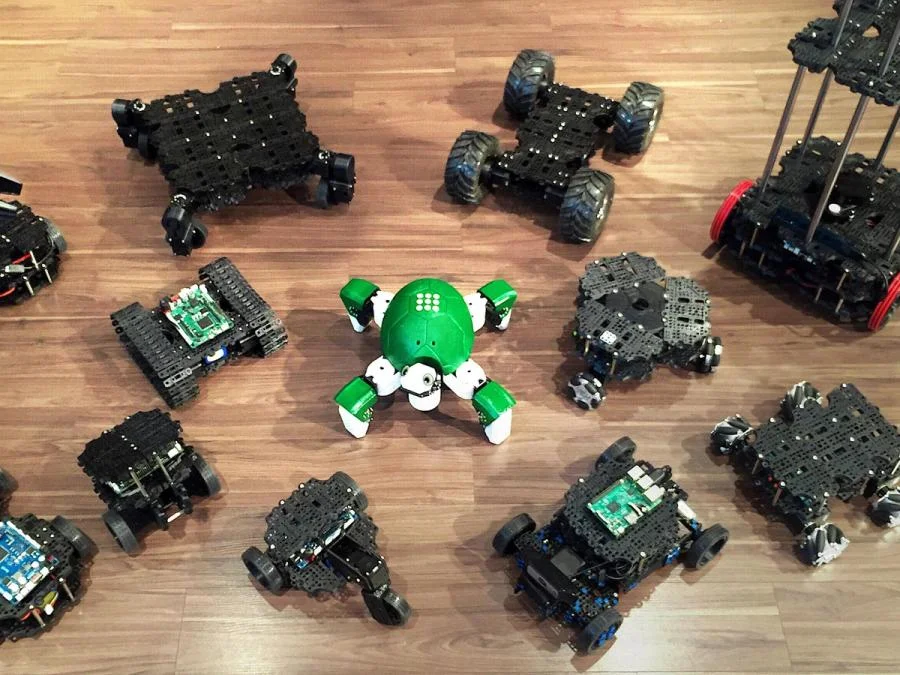
TurtleBot
A TurtleBot is affordable and beginner-friendly. It is excellent for learning ROS and robotics fundamentals. It is flexible and customizable with many accessories. It is a large global community and documentation.
What can TurtleBot do?
The TurtleBot can perform a wide range of robotic tasks — from simple motion control to advanced autonomous navigation and AI applications. It’s designed for education, research, and prototyping, especially in robotics and artificial intelligence.
- Autonomous Navigation: The TurtleBot can move independently through indoor environments. It can use SLAM (Simultaneous Localization and Mapping) to build maps while determining its position. It can plan and follow paths while avoiding obstacles using sensors like LiDAR or cameras.
- Mapping and Localization: The TurtleBot can create detailed 2D or 3D maps of rooms and buildings. It can identify its location within those maps using odometry, IMU, and vision data. It is useful for research in self-driving and exploration robotics.
- Object Detection and Recognition: The TurtleBot can detect and track objects or people using RGB-D cameras (e.g., Intel RealSense). It can recognize visual patterns with computer vision and machine learning models. It supports AI frameworks like TensorFlow, OpenCV, and PyTorch.
- Human–Robot Interaction: The TurtleBot can respond to voice commands or gestures (with added microphones or sensors). It can follow a person or face using tracking algorithms. It is used in human–robot communication and social robotics studies.
- Research and AI Development: The TurtleBot can test algorithms for autonomous driving, reinforcement learning, and multi-robot coordination. It can simulate real-world tasks using Gazebo or Ignition before deployment on hardware. It can integrate AI for decision-making and adaptive behaviors.
- Educational and Prototyping Uses: It can teach students programming in ROS and robotics fundamentals. It can prototype robotic systems before scaling up to industrial or outdoor robots. It can participate in robotics competitions like RoboCup Junior and IEEE robotics challenges.
- Service and Demonstration Tasks: The TurtleBot can deliver lightweight items or perform patrols in a lab or office environment. It can demonstrate robotics concepts such as motion planning, control systems, and computer vision.
TurtleBot features
The TurtleBot is a popular open-source mobile robot platform designed for education, research, and prototyping in robotics:
- Robot Operating System (ROS) Integration: The TurtleBot is fully compatible with ROS and ROS 2, making it ideal for learning robotic programming, mapping, and control. It supports tools like RViz, Gazebo, and rqt for visualization and simulation.
- Modular & Customizable Design: The TurtleBot is easily added to or replaced with components such as sensors, cameras, LiDARs, robotic arms, or custom payloads. Open-source hardware and software allow full customization.
- Autonomous Navigation: The TurtleBot supports SLAM (Simultaneous Localization and Mapping) to map environments and navigate autonomously. It uses path-planning and obstacle-avoidance algorithms.
- Sensor Suite: The TurtleBot includes sensors like IMU (Inertial Measurement Unit), depth camera, LiDAR, and wheel encoders for movement tracking. Some models have RGB-D cameras (e.g., Intel RealSense).
- Onboard Computer Compatibility: The TurtleBot is compatible with small computers, including Raspberry Pi, Intel NUC, and Jetson Nano. It runs Ubuntu and ROS environments for easy programming.
- Battery-Powered Mobility: Rechargeable battery with several hours of operation. Docking capability for automatic charging in advanced models.
- Simulation & Development Support: The TurtleBot is fully supported in Gazebo and Ignition simulation platforms. Users can test algorithms virtually before deploying them on the real robot.
- Strong Community & Documentation: The TurtleBot is backed by a large open-source community, tutorials, and learning resources. It is used globally in robotics competitions and university labs.
Advantages of TurtleBot
- Open-Source and ROS-Compatible: The TurtleBot is one of the most popular educational and research robot platforms in robotics and AI. It is fully integrated with the Robot Operating System (ROS), making it perfect for learning and experimentation. It can access open-source software, tutorials, and community support.
- Excellent for Education & Research: The TurtleBot is ideal for students, educators, and researchers to explore navigation, AI, and computer vision. It is used in universities and robotics competitions worldwide.
- Modular and Customizable: The TurtleBot is easy to modify or expand with new sensors, cameras, or robotic arms. It encourages hands-on learning in hardware and software integration.
- Autonomous Navigation Capabilities: The TurtleBot supports SLAM, path planning, and obstacle avoidance. It can map and move around unknown indoor environments autonomously.
- Simulation Support: The TurtleBot works with simulation tools like Gazebo or Ignition for virtual testing before real-world use. It saves time, cost, and hardware wear during algorithm development.
- Large User Community: Active global community providing troubleshooting help, updates, and shared projects. It is well-documented and supported by major robotics organizations (like Open Robotics).
Disadvantages of TurtleBot
- Limited Payload Capacity: The TurtleBot can’t carry heavy sensors or additional hardware due to its small, lightweight frame.
- Restricted to Indoor Use: The TurtleBot is not suitable for outdoor or uneven terrain—designed primarily for smooth, flat indoor surfaces.
- Cost of Add-Ons: The base unit is affordable, but adding advanced sensors (like LiDAR or depth cameras) increases the total cost. The performance depends on the attached sensors and computer hardware.
- Battery Life Constraints: Moderate operating time; requires frequent recharging for extended projects.
- Setup and Configuration Complexity: The TurtleBot requires familiarity with Linux, ROS, and programming, which can be challenging for complete beginners.
- Processing Limitations: The TurtleBot relies on small computers (like Raspberry Pi or Intel NUC), which may struggle with heavy AI or vision tasks.
You can follow Science Online on YouTube from this link: Science online
Cupboo AI robotic pet review, features, advantages, and disadvantages
Sophia robot review, features, use, advantages and disadvantages
Top trending topics on Sophia robots and Can Sophia Destroy humans
Educational robotics, Robot teachers, Social robots review, features advantages and drawbacks
Humanoid robots use, risks, advantages, and disadvantages