RoboCup Junior 2025 Line Rules, What is the age limit for RoboCup Junior?
RoboCup Junior 2025 Line (also called Rescue Line) is an international educational robotics competition in which student teams design, build, and program an autonomous robot to follow a black line on a white path, navigate through obstacles, rescue simulated victims, and deliver them safely to a designated evacuation zone.
What is RoboCup Junior 2025 Line?
RoboCup Junior 2025 Line (also known as Rescue Line) is an international robotics competition for students in which teams design and program an autonomous robot to follow a black line on a white surface, navigate obstacles, and rescue simulated victims in a disaster-themed course.
The challenge represents a robotic rescue mission. The robot must detect and follow the line path automatically. It can handle ramps, gaps, and speed bumps. It can identify and transport “victims” (objects or colored markers). It can deliver them safely to an evacuation zone — without any remote control.
Robocup Junior 2025 line 6th
Purpose
- RoboCup Junior 2025 Line can encourage STEM learning (Science, Technology, Engineering, and Mathematics).
- RoboCup Junior 2025 Line can develop students’ skills in robot design, coding, programming, electronics, and problem-solving.
- RoboCup Junior 2025 Line can promote creativity, teamwork, and international collaboration among young people.
- RoboCup Junior 2025 Line can inspire young people to create robots that can help in real-life rescue or automation scenarios.
Competition Level
- It’s one of the main leagues under RoboCup Junior, part of the global RoboCup Federation initiative.
- Held at local, regional, national, and world championship levels — the 2025 season follows updated rules published by the official RoboCup Junior Rescue Committee.
- Uses updated 2025 rules that test robots’ autonomy, intelligence, and reliability.
- Robots are typically made from LEGO, Arduino, or custom hardware, depending on the category and age group.
Core Concept
The challenge represents a robotic rescue mission. It simulates a real-life disaster scenario (like an earthquake or fire rescue). The robot represents an autonomous rescue vehicle that must:
- Detect and follow the line path automatically.
- Overcome various obstacles (ramps, gaps, speed bumps, debris).
- Identify and collect “victims” (small objects or colored markers).
- Transport them to a “safe zone” automatically — without human control during the mission.
RoboCup Junior 2025 Line features
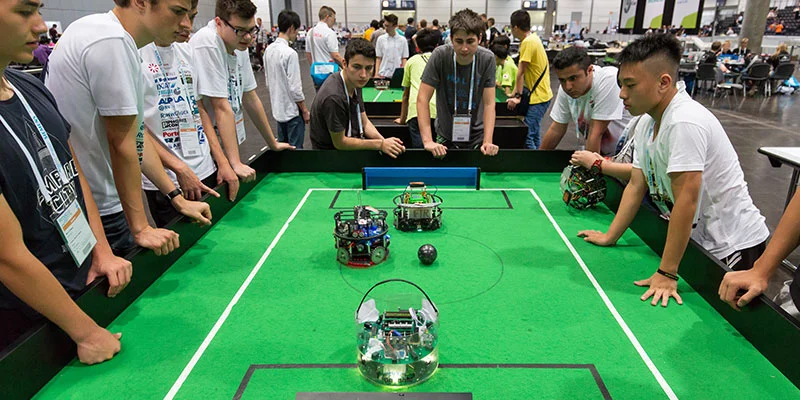
The RoboCup Junior 2025 Line competition is also known as the “Rescue Line” challenge. Teams design an autonomous robot that follows a black line on a white-floor surface through a modular course made of tiles. Along the way, the robot must overcome obstacles such as ramps, intersections, gaps, speed bumps, varying textures or patterns on tiles.
At the end of the path, the robot must “rescue” victims: typically coloured markers or objects that it must manipulate or transport to a designated evacuation zone. After dropping off the victim(s), the robot may need to continue, exit, or perform further tasks depending on the rules.
The field is built from modular tiles (often ~ 30cm × 30cm) so organizers can change the layout each round or event. The tiles may include different hazards: Ramps or level changes, Speed bumps, Gaps or “missing” tiles to jump or bridge, and Intersections where multiple line paths meet.
The course may have checkpoints along the line (so the robot may need to visit or cross them) and different tile patterns to test sensor/algorithm robustness. The evacuation zone has specific size and layout rules: e.g., for some events, the zone is 120 cm × 90 cm with walls, with separate areas for “living” vs “dead” victims.
Rules & Documentation
- Only one robot per team on the field.
- Each team member must have a defined technical role and be able to explain their contribution.
- The robot must be primarily the students’ own design (construction, programming). Commercial kits designed for a single task may be disallowed.
- Safety and control rules: e.g., lasers must be class 1 or 2 if used, and wireless communication from outside the field is restricted.
- The 2025 rules include some specific changes (for example, the “ramp points” are awarded per individual ramp tile rather than for the entire ramp) and updates to obstacles.
- The scoring: Teams are judged on points accumulated during run(s), minus penalties, and in many cases, time is used as a tiebreaker.
What Makes It Interesting/Important
- Multidisciplinary challenge: It combines mechanical design (ramps, terrain), sensors (line following, obstacle detection), algorithm/control logic, and sometimes victim-manipulation mechanisms.
- Robustness matters: Because the course is modular and can vary each round, a robot that only works for one static track may fail. Teams benefit from designing for variability.
- Real-world analogy: The “rescue” theme (simulated victims, evacuation) gives a strong real-life hook and makes the robot’s task meaningful, not just line-following.
- Progression and learning: Good for teams building foundational robotics skills (sensors + navigation) and can act as a stepping stone to more advanced leagues.
- Team & documentation skills: Beyond just building a robot, there is documentation, inspection, interviews, and reflective work about the design process.
RoboCup Junior 2025 Line advantages
- Hands-on STEM learning: The RoboCup Junior 2025 Line competition (often called Rescue Line) encourages teamwork and collaboration: Students gain practical experience in robotics, electronics, programming, and problem-solving. Teams must divide roles (mechanical design, programming, testing, etc.), improving communication and group problem-solving skills.
- Enhances creativity and innovation: Participants design robots to autonomously follow lines, navigate obstacles, and make decisions — encouraging experimentation and innovation.
- Prepares for real-world applications: The competition simulates real rescue missions, teaching navigation, automation, and sensor integration — relevant to autonomous vehicles and robotics industries.
- Promotes international cooperation: RoboCup Junior connects students globally, exposing them to new cultures and technologies.
- Boosts confidence and critical thinking: Participants must debug code, tune sensors, and improve robot performance under pressure, developing resilience and analytical skills.
RoboCup Junior 2025 Line disadvantages
- High cost and resource needs: Components, sensors, and travel expenses can be expensive for some schools or teams.
- Technical complexity: RoboCup Junior 2025 Line requires knowledge of programming, electronics, and mechanics — beginners may find it challenging without proper guidance.
- Time-intensive preparation: Designing, testing, and refining robots takes months, which can conflict with academic schedules.
- Limited access to advanced tools: Teams with fewer resources or limited lab access may be at a disadvantage compared to well-funded schools.
- Pressure and competition stress: Tight deadlines and competitive environments may cause stress for some students.
- Unequal experience levels: Some teams might have mentors or sponsors providing a significant advantage, leading to an imbalance in competition.
You can follow Science Online on YouTube from this link: Science online
Cupboo AI robotic pet review, features, advantages, and disadvantages
Sophia robot review, features, use, advantages and disadvantages
Top trending topics on Sophia robots and Can Sophia Destroy humans
Educational robotics, Robot teachers, Social robots review, features advantages and drawbacks
Humanoid robots use, risks, advantages, and disadvantages