UBTECH’s Walker series humanoid robot, What can Walker Robot do?
Walker is a full-size, walking humanoid robot built to help people in homes, offices, and public spaces by interacting with objects and performing practical tasks. It can understand gestures and conversations. It can help in educational demonstrations about robotics.
UBTECH Walker Robots
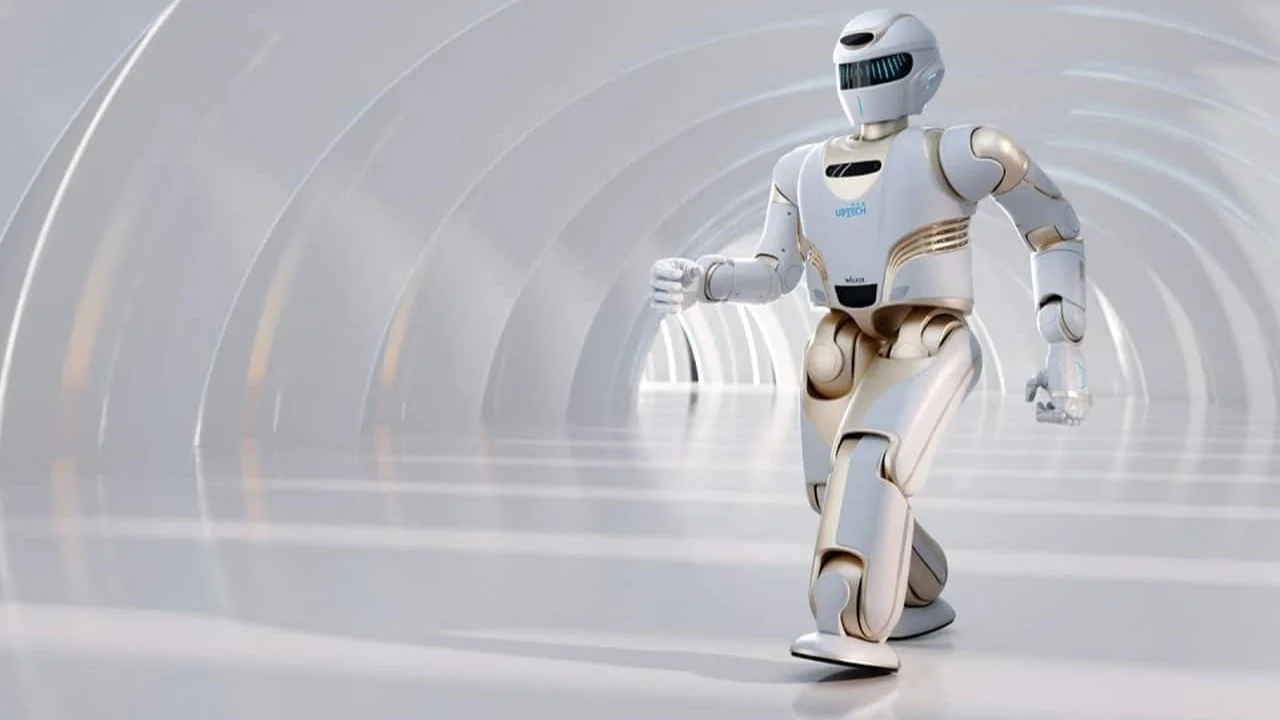
UBTECH Walker is a humanoid service robot developed by the Chinese robotics company UBTECH Robotics. It is designed to operate safely in human environments and perform everyday assistance tasks. Walker integrates bipedal locomotion, AI perception, manipulation, and human–robot interaction to serve as a smart household or commercial assistant.
The UBTECH Walker robot is very promising for industrial automation and research. The autonomous battery-swapping feature (in S2) is a big innovation for practical, continuous deployment. Its dexterity, perception, and humanoid form make it versatile.
UBTECH Walker Robots
What can UBTECH Walker do?
- Walk and Move Like a Human: UBTECH Walker walks on two legs with balance correction. It navigates around obstacles using sensors and AI. It climbs stairs and handles uneven surfaces (in newer versions).
- Manipulate and Carry Objects: UBTECH Walker uses advanced robotic arms and hands to hold and carry items, open doors, pick up objects, push, pull, or place things precisely.
- Smart Home Assistance: UBTECH Walker controls smart home devices (lights, curtains, appliances). It acts as a mobile smart hub. It can perform simple tasks such as fetching items or delivering objects.
- Human Interaction: UBTECH Walker recognizes faces and voices. It understands gestures and conversations. It provides companionship and interactive communication. It can assist with guest welcome or provide basic customer service.
- Security & Monitoring: UBTECH Walker patrols rooms and detects anomalies. It sends alerts about unusual activities. It monitors the environment using cameras and sensors.
- Entertainment & Education: UBTECH Walker demonstrates movements and dances. It helps in educational demonstrations about robotics. It plays simple games or interactive activities with users.
- Support in Commercial Environments: UBTECH Walker works as a receptionist or greeter. It provides information to customers. It guides people to specific locations.
Features of UBTECH Walker Robots
- 36+ Degrees of Freedom (DOF): The original Walker has 36 high-performance servo joints. This gives it good flexibility in its arms, legs, and body for fluid and human-like motion.
- Advanced Drive Units: UBTECH Walker Robot uses frameless torque motors + harmonic reduction + dual encoders for precise, efficient movement. It enables smooth control of walking, manipulation, balancing, etc.
- Stable Locomotion & Terrain Adaptability: UBTECH Walker Robot can walk on different types of terrain: carpet, grass, tiles, stairs, slopes, and more. Self-balancing system: it automatically corrects its posture when the center of gravity is disturbed.
- Hand-Eye Coordination: Each arm has 7 degrees of freedom, giving a wide workspace and flexibility. UBTECH Walker Robot can manipulate objects after visually detecting them, meaning it “sees” and then picks up or moves things.
- Full-Body Flexibility & Safe Interaction: The body is designed to move in a human-like, flexible way, which makes interaction safer and more natural. Flexible arms replicate fluid human movement, reducing the risk of injury when working near people.
- U-SLAM Navigation & Autonomous Path Planning: UBTECH Walker Robot uses visual navigation (SLAM = Simultaneous Localization and Mapping) to map its environment. It plans its path, avoids obstacles, and navigates dynamically in changing environments.
- Perception: Face / Object / Scene Recognition: UBTECH Walker Robot is equipped with stereo vision (depth) systems to recognize faces, objects, and environmental scenes. This perception enables it to respond contextually — e.g. “see a person” vs “see an object.”
- Multimodal Interaction: UBTECH Walker Robot can interact via voice, text, vision, movement, and environmental cues. This makes it more versatile in how it communicates and receives commands.
- Smart Home Control: UBTECH Walker Robot has interfaces for controlling smart-home devices (lights, appliances, sockets). It can serve as a mobile smart hub in a house or office.
- Hardware & Power:
- Height: ~ 1.45 m; Weight: ~ 77 kg.
- Connectivity: Wi-Fi (dual-band), Ethernet, EtherCAT for real-time control.
- Battery: 54.6 V Li-iron phosphate (10 Ah), about 2 kg.
- Charge time: ~2 hours, Usage time: ~2 hours of active motion.
- Processor: Intel i7-7500U (2.7 GHz) or i5-6200U (2.3 GHz).
- Software Layer: Runs Ubuntu + Linux RT Preempt + ROS + Android.
Features of Advanced Variants
Some notable features from other Walker models:
Walker S1
Walker S1 uses a two-stage semantic navigation system that combines semantic perception + VSLAM. Learning-based whole-body motion control: integrates perception and control for dexterous manipulation + stable walking. Walker S1 is designed for industrial tasks (e.g. manufacturing) and working alongside other robots and systems.
Walker X
- 41 servo joints for high articulation.
- Big, curved 4.6K HD screen “face” that can display expressive visuals.
- Modular design + removable battery.
- Very good terrain adaptability: can climb 20° slopes, step up/down up to ~15 cm.
- Powerful perception: four-eye system + stereo depth sensors; strong object- and scene-recognition.
- Smart home control through AloT (AI + IoT) interfaces.
- Navigation: first-person-view AR navigation + 2.5D obstacle avoidance.
Walker S2
- 52 Degrees of Freedom (DOF) — more dexterity.
- Autonomous battery swapping: it can change its battery by itself (swaps in ~3 minutes).
- Dual-battery system for continuous operation.
- High payload: can handle up to ~15 kg in its workspace (0–1.8 m) and rotate its waist ±162°.
- Advanced vision: dual RGB stereo cameras for depth perception.
- AI system: runs UBTECH’s Co-Agent / BrainNet system for reasoning, task planning, and exception handling.
- Dynamic balance and motion control: can squat, reach far, while maintaining stability.
Walker C
- Focused on commercial / tour guide applications.
- Uses UBTECH’s embodied AI large model for multilingual interaction.
- Walk speed: up to ~6 km/h, all-terrain walking.
- Navigation: U-SLAM system + whole-body motion control.
- Sensors: RGB-D cameras, structured light 3D cameras, high-precision inertial sensors.
- Battery: 48 V, 15 Ah; working hours: walking ~2 h, standing ~4 h.
Walker E (Embodied Intelligence)
- Dual-battery with thermal management; hot-swappable.
- 42 DOF; very dexterous arms and hands (7-DOF arms, 6-DOF hands).
- High-speed compute: uses a 550 TOPS Orin board.
- Sensors: depth cameras, 6-axis force sensors, AI voice kit.
- Open interfaces: ROS2 support, motor/sensor APIs.
- Long runtime: 3h continuous motion, 8h overall performance in some modes.
Why These Features Matter
- The walking + self-balance makes Walker more human-like and able to operate in environments made for people (stairs, floors, obstacles).
- High DOF + hand-eye coordination lets it manipulate objects more precisely — useful for picking up things, working on tasks, or interacting safely.
- Vision + SLAM are critical for navigation: it can map spaces, plan routes, and avoid bumping into things.
- Multimodal interaction means it’s not just a dumb machine — it can engage via voice, visual cues, or movement.
- Smart-home control lets it integrate into a connected environment, acting like a mobile smart device.
- The autonomous battery swap (in S2) is a big deal: it gives the robot much more practical uptime without human intervention.
- AI systems (Co-Agent, BrainNet) provide higher-level intelligence — not just motion, but reasoning, decision-making, and adaptive behavior.
UBTECH Walker advantages
- Human-Scale Form Factor: The humanoid design (walking on two legs) lets it operate in environments made for humans — doorways, stairs, factory lines, etc. This makes it more flexible in settings that were not originally built for robots.
- Dexterous Manipulation: A High number of degrees of freedom (DOF) in arms, waist, and body gives it good flexibility. UBTECH Walker Robot can lift or carry reasonably heavy loads: e.g., the Walker S2 can handle up to ~15 kg in its workspace. Strong control: its arms can use force control (impedance, hybrid) for safer interactions.
- Advanced Vision & Perception: UBTECH Walker Robot has stereo vision or dual RGB-camera systems (depending on model) for depth perception. UBTECH Walker Robot uses SLAM (Simultaneous Localization and Mapping) for navigation; it can plan paths and avoid obstacles. It recognizes faces, objects, and scenes — this enhances its ability to understand and interact with environments.
- Balance and Locomotion: Self-balancing algorithms help it recover from disturbances. Adaptable gait control: can walk on different surfaces (smooth, uneven) and maintain stability.
- Power & Autonomy (Especially in S2): The Walker S2 has autonomous battery-swapping capability, meaning it can replace its own battery without human intervention. This enables 24/7 continuous operation, which is a big deal for industrial deployment. Real-time battery monitoring allows it to determine when to swap or charge, optimizing its energy usage.
- AI and Task Planning: UBTECH Walker Robot uses UBTECH’s Co-Agent / BrainNet system (depending on model) for advanced decision making, reasoning, exception handling, and task planning. This makes it more than just a “walking arm” — it can plan complex tasks in industrial or service scenarios.
- Safety & Interaction: Full-body flexibility and force control make its interactions safer when near humans. Multimodal interaction (vision, voice, touch) helps it engage more naturally.
- Potential for Industrial Use: Because of its physical reach, load capacity, and continuous operation, it’s well-suited for manufacturing/factory settings. Its human-like form factor means it can use tools or workstations that are originally designed for humans (less need for re-engineering).
Disadvantages of UBTECH Walker
- Energy Consumption & Runtime: Bipedal walking is energy-intensive; running on two legs generally consumes more power than wheeled robots. Even with battery swapping in S2, each battery pack has limits. According to sources, one module gives around ~2 hours of walking or ~4 hours of standing. Infrastructure required: to benefit from the autonomous swap, one must set up battery‐swap stations, which adds cost and complexity.
- Complexity & Cost: Humanoid robots are more complex (mechanically and in control) than simpler robots (e.g., wheeled), which likely makes them costlier to build and maintain. Maintenance for many joints, sensors, and actuators can be substantial.
- Reliability / Maturity: While many features are promising, some (like long-term autonomous battery swapping) are still new and not widely tested in mass, harsh industrial settings. Balancing and recovering from falls or unexpected terrain might still be challenging. The early Walker model could self-balance, but not all interactions may be safe. Safety concerns: Although designed for interaction, true safe human-robot collaboration (especially in dynamic environments) may require more validation.
- Payload / Strength Trade-offs: While S2 can carry up to ~15 kg, this is not “super-heavy”; for industrial heavy-duty tasks, bigger/heavier robots may be more efficient. The reach and speed of humanoid manipulation might still be slower or less efficient than specialized industrial robots or robotic arms.
- Terrain & Speed Limitations: Even though later versions (like Walker X) have improved terrain adaptability, there are likely limits to how “rough” terrain it can traverse. Maximum walking speed is relatively modest (for example, Walker X has a top speed of ~3 km/h).
- Infrastructure & Deployment Costs: To fully utilize advanced features (like autonomous battery swapping), companies need to invest in infrastructure (swap stations). Integration into existing systems (factories, smart buildings) could require customization or adaptation.
- Ethical / Social Concerns: There’s a potential for job disruption: highly autonomous humanoid robots could replace human labor in certain roles. (This is more a societal disadvantage rather than a technical one.). Safety in human-robot interaction: even with good control, unforeseen accidents could happen, especially in dynamic environments.
You can follow Science Online on YouTube from this link: Science online
BTECH Humanoid Robot Walker review, advantages, disadvantages and features
Importance of Eilik, Are Eilik robots worth it? And what can Eilik the robot do?
Emo robot review, advantages, disadvantages, features and What can Emo do?
Fun Facts about Eilik robots, What is Eilik robot for? and can Eilik robot talk?
Top trending topics on Emo robots and What can Emo do?
Eilik Desktop Companion Robot structure, features, use, advantages & disadvantages
Trending topics about Eilik robots in Education, Healthcare, Customer Service and Workplace
Top Trends on Eilik and Emo robots, Emo vs Eilik, who is the best?
Eilik DQ robots review, advantages, disadvantages and specifications