
Health risks of laser and Safety precautions to avoid biological hazards of laser radiation
LASER means Light Amplification by Stimulated Emission of Radiation. It can produce an intense, highly directional beam of light. The most popular cause of laser-induced tissue damage is thermal in nature. The tissue proteins are denatured due to the temperature rise following absorption of the laser energy.
Laser radiation
The human body is vulnerable to the output of certain lasers. Exposure to laser radiation can result in damage to the eye & the skin. The human eye is almost always more vulnerable to injury than the human skin.
Laser hazards are addressed in specific standards for the general industry. The workers have a right to a safe workplace. The law requires employers to provide their employees with safe and healthful workplaces.
Laser safety standard and Safety Precautions
The main purpose of the laser safety standard is to prevent the laser related injuries. Safety protection against lasers can be attained when users correctly recognize the potential hazard of laser products, and they correctly perform a specific procedure using the safety functions of laser products.
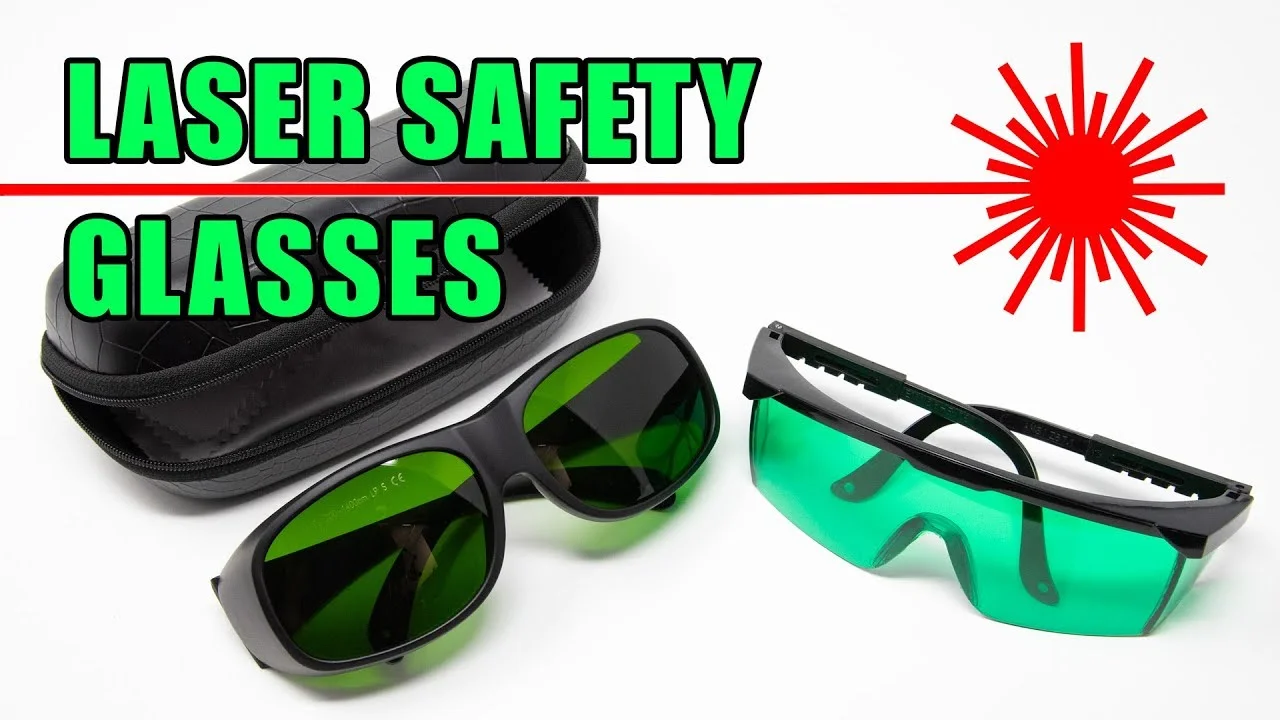
Laser goggles
You should take safety measures for class 4 laser products. To prevent operation of the laser system by unauthorized users, the key control (Key-operated power switch) should be managed by the Laser Safety Officer.
You have to connect the remote interlock (emergency stop) input terminal (remote interlock connector) of the laser system to the emergency stop switches or the like to prevent laser radiation in an emergency.
You have to post a warning sign at the entrance to the controlled area in which the laser product is installed to ensure that the workers and outsiders are informed about the dangers.
If the skin is exposed to the laser beam reflected on the marking target in the control area where the laser product is installed, it will cause the skin to burn, and the clothes may catch fire. During the laser operation, wear flame-resistant clothes and protect the skin as much as possible.
You have to protect your eyes with protective goggles in the controlled area in which the laser product is installed. You have to wear protective eye goggles, regardless of whether for normal use or maintenance, in case of accidental exposure to the laser emission.
You should select protective goggles that are appropriate for the laser light wavelength. Wear protective eye goggles whose optical density for the 10.6 μm wavelength is between 5 and 7. You should not wear the protective eye goggles with the optical density exceeding 7; the laser radiation emission indicator may not be visible.
The laser goggles can protect the eyes from the reflected or scattered laser light with the hazardous beam power, as well as from direct exposure to the laser beam. Even when wearing the protective eye goggles, avoid eye exposure to direct or scattered laser radiation.
The eyewear must be selected for the specific type of laser. to block or attenuate in the appropriate wavelength range. The eye-wear absorbing 532 nm typically has an orange appearance (although one should never rely solely on the lens color when selecting laser eye protection), transmitting wavelengths larger than 550 nm.
Eyewear is rated for the optical density (OD), which is the base-10 logarithm of the attenuation factor by which the optical filter reduces beam power. Eyewear with OD 3 will reduce the beam power in the specified wavelength range by a factor of 1000.
The acrylic filter can be attached to the monitoring window on the equipment to block the laser beams. If the poisonous gas is generated during the laser marking on the target object, identify the substances produced by the gas and provide a local ventilation system.
You should appoint the safety officer who has extensive knowledge and experience in handling the laser products to enforce safety management. The Laser Safety Officer can manage the key for the key-operated power switch. He can check the protective equipment and its use, and he can train the operators.
The Laser Safety Officer suggests the prevention measures related to the laser emission. He sets up the laser-controlled area ( The area in which there is a risk of exposure to the laser emission from the laser products).
You should establish a protective enclosure around the laser marker’s head using a material having the appropriate reflectance and heat characteristics to block the reflected light. It prevents the individuals from being exposed to careless reflected light when the laser marker is operating.
You must not put your eyes at the horizontal plane level where the beams are, in case of reflected beams that leave the optical table during the optical experiments, as exposing the eye to the laser radiation or diffuse reflection may cause blindness.
You must not expose the skin to the laser radiation or the diffuse reflection. You have to be careful that you do not insert your hand or any other body part into the marking area during the operation. The laser may cause damage to the skin, such as burns.
If you install the head, you have to terminate the laser beam path to avoid eye or skin exposure to direct or scattered laser radiation; the laser beam emitted by ML-Z9500 Series must be terminated at the end of its useful path by a diffusely reflecting material of appropriate reflectivity and thermal properties or by the absorbers.
You have to install the ML-Z9500 series so that the path of the laser beam is not the same height as that of the human eye. You should not disassemble the ML-Z9500 Series, as exposure to the laser radiation and the electric shock may result.
The ML-Z9500 Series is not under warranty and cannot be repaired if it has been disassembled. You have to be sure to turn off the MLZ9500 series before performing the maintenance tasks, such as cleaning the lens, and you should wear protective eye goggles during maintenance.
You should not use the ML-Z9500 Series near flammable materials. You should not place any flammable objects or gas (organic solvents) near the laser emission opening of the ML-Z9500 Series, as this may cause a fire.
You should not irradiate the laser beam onto mirrored metal materials. The CO2 laser cannot mark metal materials. Never attempt to mark highly reflective metal materials. All non-optical objects that are close to the optical plane should have a matte finish to prevent specular reflections, such as jewelry and watches.
ZnSe (zinc selenium) is used for the lens and the other optical parts. ZnSe is treated as a poison by law. Rely on the company that handles the industrial waste when disposing of the product.
You should turn off all power before connecting the controller power cable. Otherwise, It may cause an electric shock, High-intensity beams can cause the fire or the skin damage (mainly from class 4 and ultraviolet lasers) and which are not frequently modified should be guided through opaque tubes.
You have to eliminate the dust or the fumes occurring during marking using an appropriate dust/fume collector to prevent these particles from entering the human body. Depending on the marking target material, this may cause damage to the human body.
Bad effects of lasers on the human body
The denaturation of protein is due to the heat effect of the laser beam. The photochemical reactions in the cell tissues or the tissue destruction caused by the impact waves (the plasma flow and resulting pressure waves) may occur.
Many direct biological effects of lasers depend on the wavelength, output, and output waveform (continuous wave or pulse wave) of the laser beam, but it is more likely to cause serious, irreversible damage to the eyes rather than to the skin.
The argon laser, YAG laser, or CO2 laser, which all radiate continuous or long pulse waves, cause the following problems due to the heat effect or the photo-chemical reactions:
When the wavelength of laser beams is out of the range of perception (ultraviolet (200 to 400 nm) and near-infrared (1,400 to 106 nm), they are absorbed in the tissues of the cornea or lenses, causing cataract with corneal burns or visual degradation.
When the wavelength of the laser beam is within the range of perception (visible (400 to 780 nm) and near-infrared (780 to 1,400 nm), it is focused on the retina because of the eye’s optical systems (cornea and lens), and the density becomes approximately 105 times greater. This causes the following problems:
The laser beams, which produce continuous waves, are absorbed in the retina (center or vicinity) and mainly cause retinal burns due to the heat effect. The visual lasers with the wavelength of approximately 430 nm, which are absorbed in the visual pigments of retinal photoreceptors, mainly cause retinal problems due to the photochemical reactions.
YAG/YVO4 (Q-switch) lasers or CO2 lasers, which have a short pulse and high peak power, cause retinal burns or fundal hemorrhage, often resulting in severe visual degradation.
You can follow science online on YouTube from this link: Science online
Laser rays properties, Spontaneous emission, and stimulated emission
The importance of lasers in communication and advantages of fiber optics cables
Radiation pollution sources, radioactive wastes & how to protect yourself from radiation pollution






Hello. I am a dentist, thank you