Importance and uses of esters in our life
Esters are used in many food industries because they are characterized by pleasant smells and tastes, so they are used as flavours, Saponification is the hydrolysis of fats or oils (triglyceride ester) in the presence of strong alkali as NaOH, to produce glycerol and the sodium salt of the fatty acid (soap).
Esters
Esters are organic compounds formed when an acid reacts with an alcohol, with the elimination of water. Esters often have pleasant, fruity smells. They are commonly used in flavorings, perfumes, and solvents. Chemically, esters have the general formula:
R–COO–R’, where: R = alkyl or aryl group from the acid, and R’ = alkyl or aryl group from the alcohol.
Example: When ethanoic acid (CH₃COOH) reacts with ethanol (CH₃CH₂OH), the ester ethyl ethanoate (CH₃COOCH₂CH₃) is formed along with water.
General reaction: Acid + Alcohol → Ester + Water
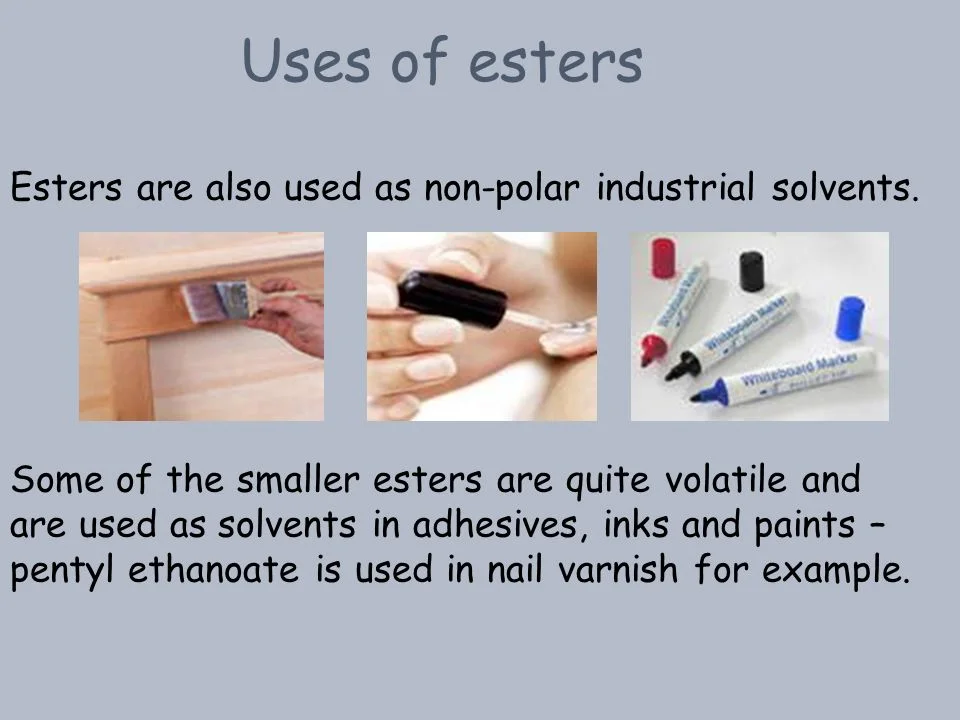
Uses of esters
Uses of esters
Fats and oils are esters produced from the reaction between fatty acids and glycerol; their molecules are called triglyceride esters because each molecule is formed from the reaction of one molecule of glycerol (trihydric alcohol) and three molecules of fatty acids. The acid molecules may be similar or different, saturated long-chain or unsaturated short-chain.
Esters are used in the manufacturing of soap, the hydrolysis of fats or oils (triglyceride ester) in the presence of a strong alkali, such as NaOH or KOH, to produce glycerol and (sodium or potassium salt of fatty acid, which is known as the saponification process, which is the main reaction in the manufacture of soap.
Esters as polymers (polyester): Polyesters are polymers produced from the condensation of two monomers, one of which is a dibasic acid and the other is a dihydric alcohol. The most common polyester is Dacron fibers, which are prepared by the reaction between terephthalic acid and ethylene glycol (ester formation reaction).
The condensation process proceeds continuously, where the alcohol end of the ester reacts with the carboxylic group of a new acid molecule, or the acid end of the molecule may be attached by a new alcohol molecule.
By the repetition of the condensation process, a very long molecule, which is called polyester, is formed. Since Dacron is an inert polymer, so, it is used to substitute for the spoiled arteries and in the manufacture of artificial heart valves.
Polyesters are the polymers produced from the condensation of two monomers, one of them is a dibasic acid and the other one is a dihydric alcohol, Dacron is the polymer produced by the reaction between terephthalic acid and ethylene glycol, Esters are used in the manufacturing of textiles because the esterification of terephthalic acid with ethylene glycol produces polyester which is used in dacron fibers industry.
Esters as medical drugs: Organic esters are used in the manufacture of many drugs such as Aspirin and Marookh oil, the most common and simplest one is aspirin, oil of wintergreen (Marookh oil) is used as a local oil absorbed by the skin to decrease the pains of rheumatism, The acid which is used in the manufacture of these two drugs is salicylic acid, its molecule contains both the carboxylic and hydroxyl groups, It reacts as an acid or as an alcohol.
Aspirin is an important drug that reduces headache pains and temperature; it also reduces blood clotting and prevents heart attacks. The active substance in aspirin is salicylic acid. However, the addition of an acetyl group (CH3CO–) to the acid decreases its acidic effect and makes it tasteless. Aspirin is hydrolyzed in the body to produce salicylic acid and acetic acid.
The produced acids cause the excitation of stomach walls and may cause a stomach ulcer. Therefore, many doctors advise crushing the aspirin tablet as a powder before swallowing it or taking it dissolved in water. There is a type of aspirin mixed with an alkaline substance like aluminum hydroxide to neutralize its acidity.
Salicylic acid acts as an amphoteric substance in chemical reactions because it behaves as an acid in some reactions due to the presence of a carboxylic group and behaves in other reactions as alcohol (phenol) due to the presence of a hydroxyl group.
Aspirin is mixed with an alkaline substance like aluminum hydroxide to neutralize the salicylic acid and acetic acid, which are produced from the hydrolysis of aspirin. Although the active substance in aspirin is salicylic acid, the acetyl group is added to it to decrease its acidic effect and to make it tasteless.
You can follow science online on YouTube from this link: Science online