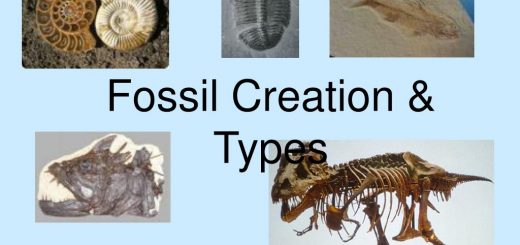
Importance of fossils and Suitable conditions for fossils formation, Do all organisms become fossils?
The organism’s body must be buried immediately after death in a medium that preserves it from decomposition. The organism must have a hard skeleton. A suitable medium must be found in which the mineral material replaces the organic material of the living organism. Fossils are the preserved remains or traces of ancient organisms, such as bones, shells, footprints, or even impressions of plants.
Importance of the fossils
The fossils help in studying the life that is known from the fossil record. The fossils exist in the rocks of different areas. and the fossil record indicates the extinction and the evolution of the organisms.
Studying the fossil record showed that life started first in the sea, then established on land. The organisms always developed from simple to complicated as:
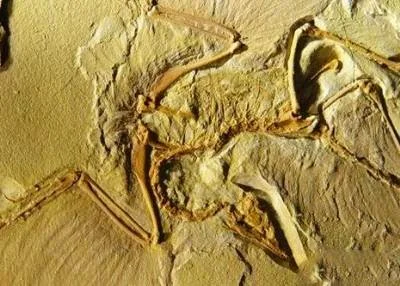 |
| The Archaeopteryx fossil is considered a link between the reptiles and the birds. |
The fish were the first vertebrates that appeared, followed by the amphibians, then the reptiles, and finally the birds and the mammals appeared together.
The invertebrates (such as the corals and the mollusks with shells) appeared before the vertebrates.
The algae appeared before the mosses and the ferns. The angiosperms appeared before the gymnosperms.
The fossils help in the age determination of the sedimentary rocks, and you know that the index fossils indicate the age of the sedimentary rocks because the age of the rocks is the same age of the fossils that existed in them.
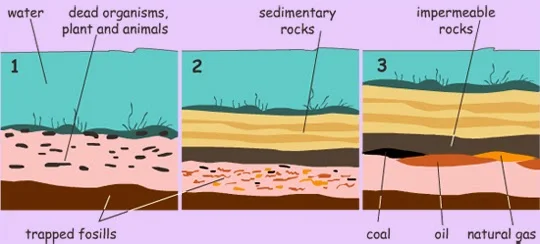 Formation of fossil fuels |
| The fossils help in the age determination of the sedimentary rocks. |
Index fossils are the fossils of organisms that lived for a short period in the past and had a wide geographic distribution, then became extinct.
The fossils help in petroleum exploration. You know that geologists take rock samples from exploratory wells when they search for petroleum.
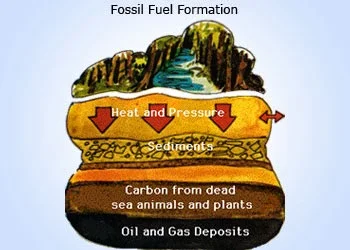 Fossil fuel formation |
| Fossils help in petroleum exploration. |
These samples are studied under the microscope, and if they contain microfossils like the foraminifera and the radiolaria, they will point to the age of the rocks that existed in the exploratory wells, and the suitable conditions for the petroleum formation.
The fossils help in figuring out the paleoenvironment. The fossils give an idea about the environment in which they lived during the old geological ages, and also indicate the climate of these ages.
The coral fossils indicate that the environment where they lived was clear, warm, shallow seas. The fern fossils indicate that the environment where they lived was a hot and rainy tropical environment.
The nummulites fossils are found in the limestone rocks of Gebel El-Mokattam and indicate that this area was a seafloor more than 35 million years ago.
FAQ about the Importance of Fossils
1. What are fossils?
Fossils are the preserved remains or traces of ancient organisms, such as bones, shells, footprints, or even impressions of plants.
2. Why are fossils important?
Fossils help scientists understand the history of life on Earth, including how organisms evolved and how environments have changed over millions of years.
3. How do fossils help in studying evolution?
Fossils provide evidence for Evolution by showing gradual changes in species over time and linking ancient organisms to modern ones.
4. What can fossils tell us about ancient environments?
They reveal information about past climates, habitats, and ecosystems, such as whether an area was once underwater or covered with forests.
5. How are fossils useful in determining the age of rocks?
Certain fossils, known as index fossils, help scientists date rock layers and understand the timeline of Earth’s history.
6. Do fossils have economic importance?
Yes, fossils help in locating natural resources like oil, coal, and natural gas by indicating the age and conditions of rock formations.
7. Can fossils show extinction events?
Yes, fossils provide evidence of mass extinction events, such as the one that wiped out dinosaurs.
FAQ about Suitable Conditions for Fossil Formation
1. What conditions are needed for fossils to form?
Fossils usually form when organisms are quickly buried by sediment, protecting them from decay and scavengers.
2. Why is rapid burial important?
Rapid burial prevents decomposition and allows preservation before the organism completely decays.
3. What types of environments favor fossil formation?
Environments like riverbeds, lakes, and seas are ideal because they accumulate sediments that cover remains quickly.
4. Do all organisms become fossils?
No, fossilization is rare. Organisms with hard parts like bones, shells, or teeth are more likely to become fossils.
5. What role does oxygen play in fossil formation?
Low-oxygen environments slow down decomposition, increasing the chances of fossil preservation.
6. How does time affect fossil formation?
Fossil formation takes thousands to millions of years as minerals gradually replace organic material in a process linked to Fossilization.
7. Can fossils form on land?
Yes, but it is less common. Most fossils form in water environments where sediment buildup is more consistent.
You can subscribe to Science Online on YouTube from this link: Science Online
Natural protectorates, Reasons of extinction, Extinct and endangered species
Fossil types, mold, cast, petrified wood and Fossil of a complete body
The types of fossils and the ways of formation
The extinction and using the fossils to indicate the extinction
The extinct species in recent times and the causes of the extinction