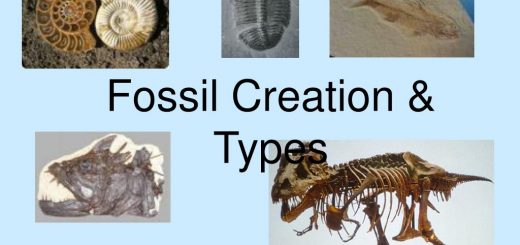
Types of fossils and ways of formation, Cast types, Mold and Petrified fossils
Fossils are the traces and the remains of living organisms that are preserved in the sedimentary rocks. The traces of once old living organisms indicate their activity during their life, and the remains are the traces that indicate the remains of once old living organisms after death.
Types of fossils and ways of formation
The fossils are classified according to the way of formation into several types, which are the fossils of the complete body, the cast, the mold, and the petrified fossils.
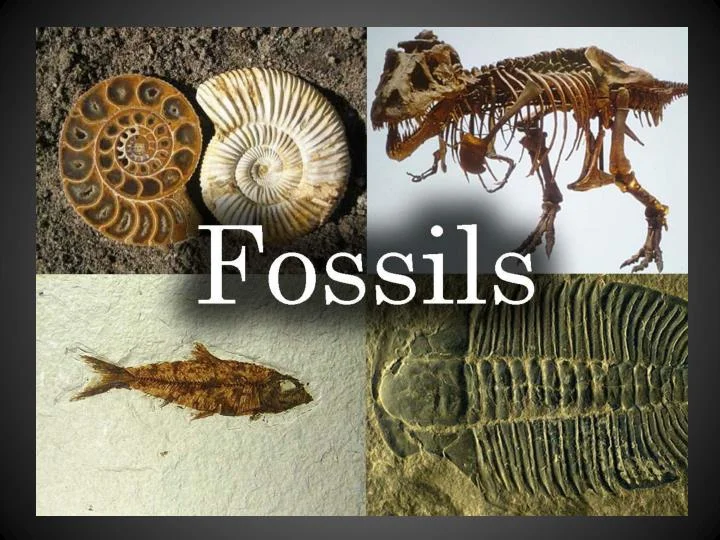
Fossils types
Fossil of a complete body
It keeps the whole shape and all the details. It is a type of fossil which was formed as a result of the rapid burying of the organism as soon as it died in a medium that preserves it from decomposition as snow and amber.
The amber is the solidified resinous matter that was secreted by the pine trees in the old geologic ages. The mammoth was extinct due to the snow avalanche that occurred in Siberia 25000 years ago. The mammoth fossil and the amber fossils are examples of the complete body fossil.
Cast types
There are the hollow cast and the solid cast. The hollow cast is the face mask that has the same external details of the face. The solid cast is the pieces of ice that have the same internal details as the ice cast.
The solid cast is a replica of the internal details of a skeleton of an old living organism. The ammonite fossil, the nummulite fossil, and the trilobite fossil are examples of the solid cast fossils.
The mold
The mold is a replica of the external details of a skeleton of an old living organism, leaving it in the sedimentary rocks after death. The mold of ferns and the fish mold are examples of mold fossils.
Petrified fossils
The petrified fossils are fossils in which the minerals replace the organic matter for the organism part by part to leave the shape without any change. The dinosaur’s tooth, the dinosaur’s eggs, and the petrified wood are examples of petrified fossils.
The petrified woods are fossils that are formed as a result of replacing the organic matter of the wood with silica, and they give us details about the life of an old plant.
Petrification is the process of replacing the wood material of the trees with silica to form the petrified wood part by part.
FAQ about Fossils
1. What are fossils?
Fossils are the preserved remains, impressions, or traces of organisms that lived in the past. They are usually found in sedimentary rocks and provide important information about ancient life and environments.
2. How are fossils formed?
Fossils form when plants or animals die and are quickly buried by sediments such as sand, mud, or volcanic ash. Over time, pressure and minerals preserve their shapes or remain in rocks.
3. What are the main types of fossils?
The main types of fossils include:
4. What is a mold fossil?
A mold fossil forms when an organism is buried in sediment and later dissolves or decays, leaving a hollow impression in the rock that shows the shape of the organism.
5. What is a cast fossil?
A cast fossil forms when minerals or sediments fill the hollow mold left behind by an organism. When the materials harden, they create a solid replica of the original organism.
6. What is a petrified fossil?
A petrified fossil forms when the original organic material of a plant or animal is gradually replaced by minerals such as silica. This process turns the remains into stone while preserving the structure of the organism.
7. What is the difference between mold and cast fossils?
A mold fossil is an empty impression left in rock after the organism decays, while a cast fossil is the solid form created when minerals fill that mold and harden.
8. What conditions help fossils form?
Fossils form best when:
- The organism is quickly buried by sediment.
- Oxygen is limited to slow decomposition.
- Hard parts such as bones, shells, or wood are present.
- Minerals are available to preserve the remains.
9. Where are fossils usually found?
Fossils are most commonly found in sedimentary rocks such as limestone, sandstone, and shale because these rocks form from layers of sediments that can bury and preserve organisms.
10. Why are fossils important?
Fossils help scientists:
- Understand the history of life on Earth.
- Study extinct organisms.
- Learn about ancient environments and climates.
- Support evidence for evolution.
11. What are examples of petrified fossils?
Examples include petrified wood, fossilized bones of dinosaurs, and fossilized shells where the original material has been replaced by minerals.
12. Can fossils form today?
Yes, fossil formation can still occur today, but it takes thousands or millions of years for fossils to fully develop and be discovered.
You can subscribe to Science Online on YouTube from this link: Science Online
Natural protectorates, Reasons of extinction, Extinct & endangered species
Fossil types, mold, cast, petrified wood and Fossil of a complete body
The extinction and using the fossils to indicate the extinction
The extinct species in recent times and the causes of the extinction
The importance of the fossils and the suitable conditions for the formation of the fossils