FlashBot Arm importance, Pudu Unveils Semi-Humanoid AI Service Robot – FlashBot Arm
FlashBot Arm is a programmable robotic arm designed for education, STEM learning, and beginners in robotics. It helps users understand the basics of robotics, motion control, automation, and coding through hands-on experimentation. It typically comes with servos or motors, multiple joints, and a gripper, supporting visual programming languages such as Python, Arduino (C++), or block-based coding.
What is FlashBot Arm?
FlashBot Arm is a semi-humanoid embodied AI service robot developed by Pudu Robotics, a Chinese leader in commercial service robots. It was officially unveiled in early 2025 and is designed primarily for commercial environments, such as hotels, offices, restaurants, retail spaces, and healthcare facilities.
Characteristics
- Semi-humanoid design: FlashBot Arm combines a wheeled mobile base with an upper body equipped with arms, giving it a humanoid-like capability to manipulate objects — hence “semi-humanoid.”
- AI and autonomy: It uses embodied AI and advanced perception to make decisions and navigate dynamic environments autonomously.
- Robotic arms: FlashBot Arm is equipped with articulated arms with multiple degrees of freedom; it can grasp, press buttons, lift items, and perform tasks like interacting with elevators and delivering objects.
- Perception & navigation: FlashBot Arm incorporates sensor suites like LiDAR, RGB-D cameras, and SLAM (Simultaneous Localization and Mapping) to build maps and avoid obstacles.
- Human interaction: FlashBot Arm supports natural interaction via voice, gestures, and possibly languages driven by large language models and onboard AI.
- Use cases: Typical scenarios include delivering items, welcoming or assisting guests, summoning elevators, and autonomously completing service tasks without human intervention.
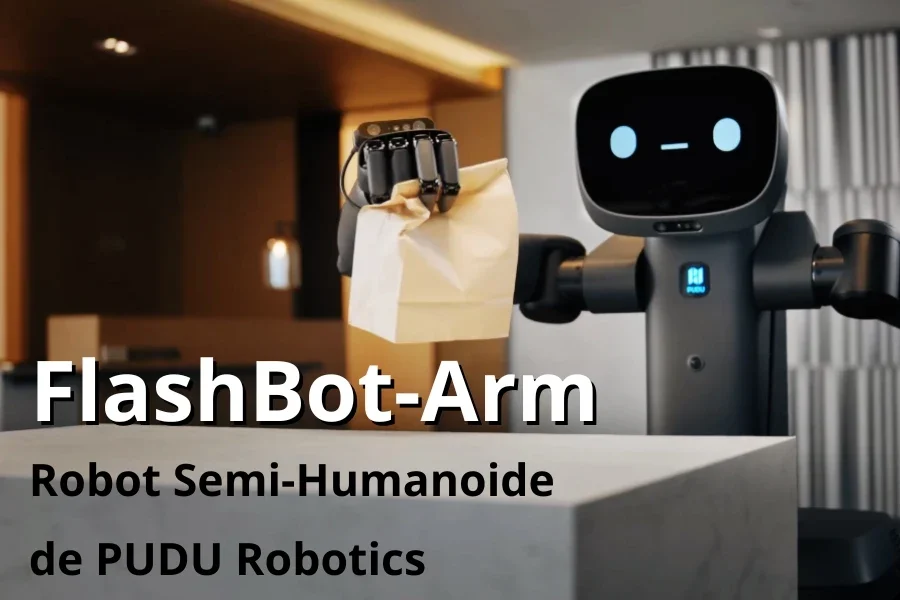
FlashBot Arm
Why It Matters
- Advance in service robotics: FlashBot Arm represents a step beyond simple delivery bots — by integrating manipulation and decision-making on a singular AI platform.
- Commercial deployment: Its design focuses on real-world use in everyday service environments like hospitality, retail, and healthcare, aiming to improve efficiency and augment human staff.
- Cutting-edge robotics features: The robot’s ability to interact with standard buildings (e.g., operate elevators and navigate busy corridors) makes it more practical than many traditional automation solutions.
About Pudu Robotics
Pudu Robotics is a Shenzhen-based company specializing in AI-driven service robots for commercial settings. Its product lineup includes delivery robots and interactive service robots widely used globally across the hospitality, retail, healthcare, and office sectors.
FlashBot Arm Features
- Multi-axis movement (commonly 4–6 DOF) for realistic robotic-arm motion.
- End-effector/Gripper for grabbing, sorting, and placing objects.
- Beginner-friendly programming using block coding, Python, Arduino, or mobile apps.
- Sensors support, such as vision modules, distance sensors, and color sensors (varies by model).
- Lightweight build for classroom and home learning.
- USB, Bluetooth, or Wi-Fi connectivity, depending on the version.
- Pre-made project modes like pick-and-place, line following with arm operations, or automation tasks.
- Rechargeable battery or external power adapter.
FlashBot Arm advantages
- FlashBot Arm is great for education (schools, universities, robotics clubs).
- Robotics is easy to assemble and use, even for beginners.
- Affordable compared to industrial robotic arms.
- Robotics supports multiple coding languages for different skill levels.
- Robotics is safe and lightweight, ideal for kids and beginners.
- Robotics encourages creativity through DIY automation projects.
FlashBot Arm disadvantages
- Limited load capacity—it can only lift light objects.
- FlashBot Arm is not suited for industrial or heavy-duty applications.
- Movement precision may be lower than that of professional robotic arms.
- Software and expansion options vary depending on the model or brand.
What Can FlashBot Arm Do?
- Pick and place objects.
- Sort items by color or size (if equipped with sensors).
- Write or draw using a pen holder.
- Perform repetitive automation tasks.
- Learn programming and robotics principles.
- Assist in science fair projects or engineering research.
- Demonstrate robotic motion: rotation, lifting, and gripping.
- Integrate with mobile apps or controllers for remote operation.
You can follow Science online on YouTube from this link: Science online
Miko Robot Features, importance, and drawbacks, Miko 2 vs Miko 3
Miko review, types, features advantages and disadvantages
Miko 2 vs Miko 3, Difference between Miko 2 and Miko 3
Loona robot review, advantages, disadvantages and what can Loona do?
Sophia robot review, features, use, advantages and disadvantages
Educational robotics, Robot teachers, Social robots review, features advantages & drawbacks
Humanoid robots use, risks, advantages and disadvantages