Google’s New Gemini Agent Is Huge 🤯 (Gemini at Work 2027: Workspace & Enterprise): 10 Powerful Features
Google’s new Gemini agent is transforming the future of artificial intelligence at work! Announced at Gemini at Work 2026, this powerful AI agent is designed to help businesses automate complex tasks, connect information across Google Workspace applications, create documents and presentations, analyze data, and even write code. Instead of simply answering questions, the new Gemini agent can plan tasks, use connected tools, coordinate multiple AI agents, and work toward completing an entire objective.
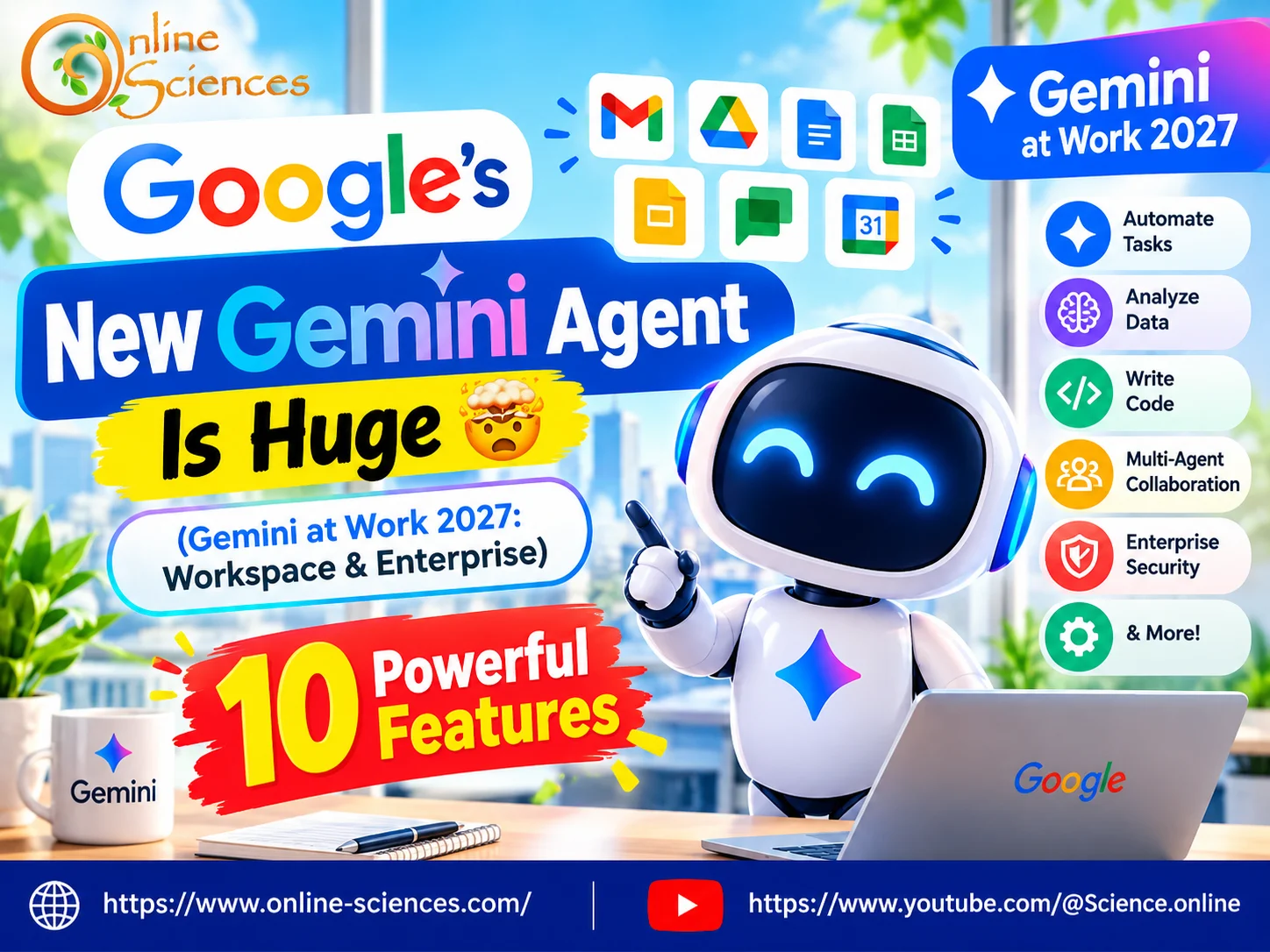
Google’s New Gemini Agent Is Huge
Google AI Agents
Google AI agents are transforming how people work by moving beyond traditional chatbots toward intelligent systems that can plan tasks, use tools, analyze information, and automate complex workflows. Powered by Google’s advanced Gemini AI models, these agents can help users conduct research, generate content, summarize documents, analyze data, write code, and manage business activities.
With integration into Google Workspace applications such as Gmail, Google Drive, Google Docs, Google Sheets, and Google Calendar, Google AI agents can connect information across different tools and reduce repetitive work. Businesses can also use AI agents to support customer service, improve productivity, streamline operations, and coordinate multiple tasks.
However, their effectiveness depends on the available features, data access, permissions, and human supervision. As agentic AI continues to develop, Google AI agents could become essential tools for individuals, developers, and enterprises seeking smarter and more efficient ways to work.
1. What is Google’s New Gemini Agent?
Google is taking workplace artificial intelligence to the next level with its new Gemini agent, introduced at Gemini at Work 2026 on October 8, 2026. Unlike a traditional chatbot that mainly responds to questions, this agent is designed to help users complete entire workflows by combining reasoning, planning, connected tools, and business information.
According to Google’s announcement, the Gemini agent can support knowledge work, answer questions, create content, generate media, and write and run code through a unified experience. Users can describe the outcome they want instead of manually specifying every step.
The technology is particularly important for organizations that want to move beyond basic AI assistance toward more automated business processes. Rather than switching between numerous applications and repeatedly explaining the same project, users can delegate tasks and allow Gemini to coordinate the necessary steps.
2. One AI Agent for Multiple Tasks
One of the most interesting features of the new Gemini agent is its unified approach. Instead of using separate AI assistants for research, writing, coding, and analysis, organizations can use a single agent to coordinate different types of work.
For example, a marketing professional could ask Gemini to research a new product category, summarize the most important findings, prepare a report, and develop a presentation for a business meeting. A software developer could use the agent to investigate a technical problem, generate code, and support a development workflow.
The agent can select appropriate tools and models for different tasks, helping users manage complicated projects through a more straightforward interface. However, the actual capabilities available to each user will depend on the applicable Google service, account, permissions, and product availability.
3. Gemini Works Directly Inside Google Workspace
One of the biggest developments is the integration of Gemini into Google’s productivity applications.
According to Google’s announcement, the Gemini agent is designed to work directly within:
- Gmail: Help users understand email conversations and coordinate communication.
- Google Drive: Find relevant files and use available documents as project context.
- Google Docs: Create and develop written reports.
- Google Sheets: Organize information and support data analysis.
- Google Slides: Prepare presentations based on research and business information.
- Google Chat: Support team collaboration and coordinate delegated work.
- Google Calendar: Assist with scheduling and meeting coordination.
The major advantage is the ability to connect information across applications. For example, a user could ask Gemini to research market trends, organize the findings in a spreadsheet, and prepare a presentation using the same project context.
This cross-application approach could reduce repetitive work and the need to copy information manually between different programs. The exact workflows available depend on the features enabled for the user’s account or organization.
4. Autonomous AI Task Execution
Traditional AI assistants usually require users to request each action. Agentic AI aims to change this approach by allowing users to delegate a broader objective. For example, instead of asking Gemini to write one paragraph, summarize a document, and prepare a separate presentation, a user might request a complete project report with supporting research and presentation materials.
The agent can then plan the work, select suitable tools, and coordinate the necessary steps. Google also describes persistent execution, meaning supported tasks can continue running in the cloud even when a user closes a laptop. This could be particularly useful for lengthy research, development projects, and workflows involving several stages.
However, autonomous execution does not mean that every task can be completed without supervision. Important business decisions, sensitive communications, and actions with financial or operational consequences may still require human approval.
5. Multiple AI Agents Can Work Together
Another powerful capability is multi-agent orchestration. Complex projects often involve several different responsibilities. A market research project, for example, might require collecting information, analyzing competitors, evaluating customer needs, and preparing recommendations.
A multi-agent system can coordinate specialized agents to handle different parts of the workflow. One agent might gather information, another could analyze the findings, and a third might help prepare a report. The main agent coordinates their work and combines the results.
Google also describes the concept of persistent coworker agents designed to perform defined roles within an organization. For example, a company could use an agent to support event coordination, prepare launch documents, or assist a project team with recurring administrative tasks.
These capabilities could make AI more useful for organizations managing complicated workflows. Nevertheless, businesses must establish appropriate permissions, monitoring, and review procedures before allowing agents to perform sensitive tasks.
6. Smarter Business Research and Data Analysis
Business decisions depend on accurate information, but collecting data from multiple systems can be time-consuming. Gemini at Work 2026 introduces a broader approach to AI-assisted data analysis, allowing users to interact with business information using natural language.
Instead of manually searching multiple databases or writing complex queries, a user could ask questions about sales performance, customer behavior, operational efficiency, or financial trends. For example, a manager might ask: “What factors contributed to the decline in sales last quarter, and what actions should we consider?”
Depending on the available data sources and permissions, an AI agent could help investigate relevant information, organize findings, and present potential explanations. Google also announced data-oriented capabilities involving business definitions, structured data, and information stored in different environments.
These tools could help technical teams and business professionals understand complex datasets more efficiently. However, AI-generated conclusions must be checked against reliable source data, especially when they influence important financial or operational decisions.
7. Personalized AI That Understands Your Work
Another important feature is contextual understanding. A useful workplace assistant needs more than general knowledge. It also needs access to relevant project documents, organizational information, approved tools, and the context necessary to complete a task. Google describes an approach that combines three major elements: tools, skills, and context.
Tools allow the agent to connect with supported applications and systems. Skills provide reusable instructions and workflows for performing particular tasks. Context helps the agent use relevant information about projects, documents, and business processes.
For example, a marketing team could develop reusable instructions for preparing campaign reports according to its preferred format. Instead of explaining the entire procedure every time, team members could use a defined workflow that helps the agent produce more consistent results.
This could be especially valuable for businesses with recurring tasks, although the quality of the results depends on the information and instructions available to the system.
8. Enterprise Security and Administrative Controls
AI automation introduces important security questions, particularly when agents can access business documents, databases, and communication systems. Companies need to know which information an agent can access, which actions it can perform, and how its activities are monitored.
Google’s Gemini agent announcement highlights several enterprise controls, including identity management, authorization, auditing, secure execution environments, and policy enforcement. These mechanisms are intended to help organizations manage AI agents according to their security requirements.
For example, an organization could restrict an agent’s access to confidential files or limit the systems it can use to perform a particular task. Auditing can also help administrators investigate actions performed by agents. These safeguards are essential because AI systems can make mistakes, misinterpret instructions, or produce incorrect information.
Organizations should therefore apply the principle of least privilege, grant only necessary permissions, and require human approval for high-risk activities. Security features and configuration options may differ depending on the Google Cloud product and organizational setup.
9. Flexible AI Models and Cost Management
Running AI agents at scale can become expensive, especially when a workflow includes repeated reasoning, large amounts of data, and numerous tool calls. Google’s Gemini at Work 2026 announcements address this challenge through model selection, intelligent routing, and spending controls. The general idea is that not every task requires the same level of computing power.
A simple classification task may be handled by a faster, less expensive model, while a complex reasoning task may benefit from a more capable model. Intelligent routing can help direct workloads toward suitable models, balancing performance and cost.
Google also describes spending limits that organizations can use to manage project-level AI expenditure. These controls could help businesses adopt AI agents without allowing uncontrolled usage to undermine their budgets.
However, actual costs will depend on the selected services, model usage, workload complexity, and applicable pricing terms. Businesses should review the relevant pricing documentation before deploying large-scale automation.
10. How Gemini at Work 2026 Could Change the Future
The new Gemini agent represents a broader shift in how people interact with artificial intelligence. Instead of treating AI as a tool for answering isolated questions, businesses can increasingly use it to coordinate workflows, connect applications, analyze information, and support entire projects.
Small businesses could use AI agents to organize research, prepare marketing materials, and streamline administrative tasks. Large organizations could explore more advanced applications involving data analysis, software development, customer support, and internal knowledge management. Developers could also benefit from AI-assisted coding and integrations with existing development tools.
Nevertheless, AI agents are not a complete replacement for human expertise. They can make mistakes, misunderstand business requirements, or produce unreliable conclusions when information is incomplete. The most effective approach is likely to combine AI automation with human judgment, clear permissions, reliable data, and careful quality checks.
The bottom line: Google’s new Gemini agent could make workplace AI more proactive, connected, and capable of completing multistep tasks. Its biggest potential advantage is not simply generating answers faster, but helping people move from an idea to a finished result with less repetitive work.
As these capabilities develop, Gemini at Work could become an important part of the future of AI-powered productivity. The impact will depend on how effectively organizations integrate the technology into their daily operations.
Frequently Asked Questions (FAQ)
1. What is Google’s new Gemini agent?
Google’s Gemini agent is an AI-powered system announced at Gemini at Work 2026. It is designed to help users complete complex tasks by planning workflows, using connected tools, accessing relevant business context, and coordinating different activities.
2. What is Gemini at Work 2026?
Gemini at Work 2026 is Google’s workplace AI initiative showcased on October 8, 2026. The announcements included a universal Gemini agent, deeper integration with Google Workspace, enterprise data capabilities, and additional security and cost-management controls.
3. Can Gemini work with Google Workspace?
Yes. Google’s announced capabilities include working directly with Gmail, Drive, Docs, Sheets, Slides, Chat, and Calendar. Availability and functionality depend on the relevant Workspace offering and account configuration.
4. Can Google’s Gemini agent complete tasks automatically?
The agent is designed to plan and execute multistep workflows, and supported tasks may continue running in the cloud. However, the level of autonomy depends on the tools, permissions, and features available. Human supervision remains important for sensitive or high-impact activities.
5. Can Gemini agents work together?
Yes. Google describes multi-agent orchestration, which allows an agent to coordinate specialized agents for different parts of a larger task. The goal is to manage complex workflows more efficiently.
6. Is Gemini at Work 2026 free?
There is no single price that applies to every Gemini at Work capability. Access may depend on the specific Google product, Workspace subscription, Google Cloud service, and enterprise agreement. Check the official product and pricing information before assuming that advanced agent features are free.
7. Is the new Gemini agent secure for businesses?
Google has announced enterprise security and governance mechanisms, including access controls, auditing, agent identities, and policy enforcement. However, security also depends on correct configuration, organizational policies, data quality, and appropriate supervision.
8. Can Gemini replace employees?
Gemini can automate or assist with some repetitive tasks, research, writing, data analysis, and coding. However, human expertise remains essential for judgment, accountability, creativity, relationship management, and risk-related decisions.
9. What makes an AI agent different from a chatbot?
A traditional chatbot primarily responds to prompts, while an AI agent can also plan tasks, use tools, coordinate multiple steps, and work toward a defined outcome. The exact distinction depends on the system’s capabilities.
10. Where can I learn more about Google’s new Gemini agent?
You can read Google’s official announcement, Google Cloud: Gemini at Work 2026, for details about the agent, Workspace integration, enterprise security, and business applications.
Explore more science and technology articles on Science Online: https://www.online-sciences.com/
Watch more technology videos on Science Online Channel: https://www.youtube.com/@Science.online
🔥 Google Flow Unlimited Free 2027: 7 Powerful Ways to Create AI Videos Without Paying 🚀
🔥 Google Flow Credits 2027: 7 Powerful Ways to Get More Free AI Credits 🚀
🔥 Google Flow AI Video Generator 2027: 15 Powerful Features & Free Credits 🚀
🔥 Google Flow AI Free in 2026: Create Amazing AI Videos Without Paying 🚀
🔥 Google Flow Unlimited Credits FREE 2027: 7 Powerful Ways to Create AI Videos 🚀
🔥 Google Flow Unlimited Credits FREE in 2026: Get 50 Daily Credits & Create Amazing AI Videos!
Google Veo 3 AI Video Generator: How to Create INSANE Videos in Gemini AI Ultra! 🚀
Goodbye Google Assistant? 10 Powerful Reasons Gemini AI Is the Future in 2026
Will Gemini AI Replace Google Assistant? The Ultimate Guide to Google’s Powerful AI Upgrade 2026
Google Assistant Review 2026: Features, Pros, Cons and What It Can Do