Powerful Difference Between Transverse Waves and Longitudinal Waves (Complete Guide 2026)
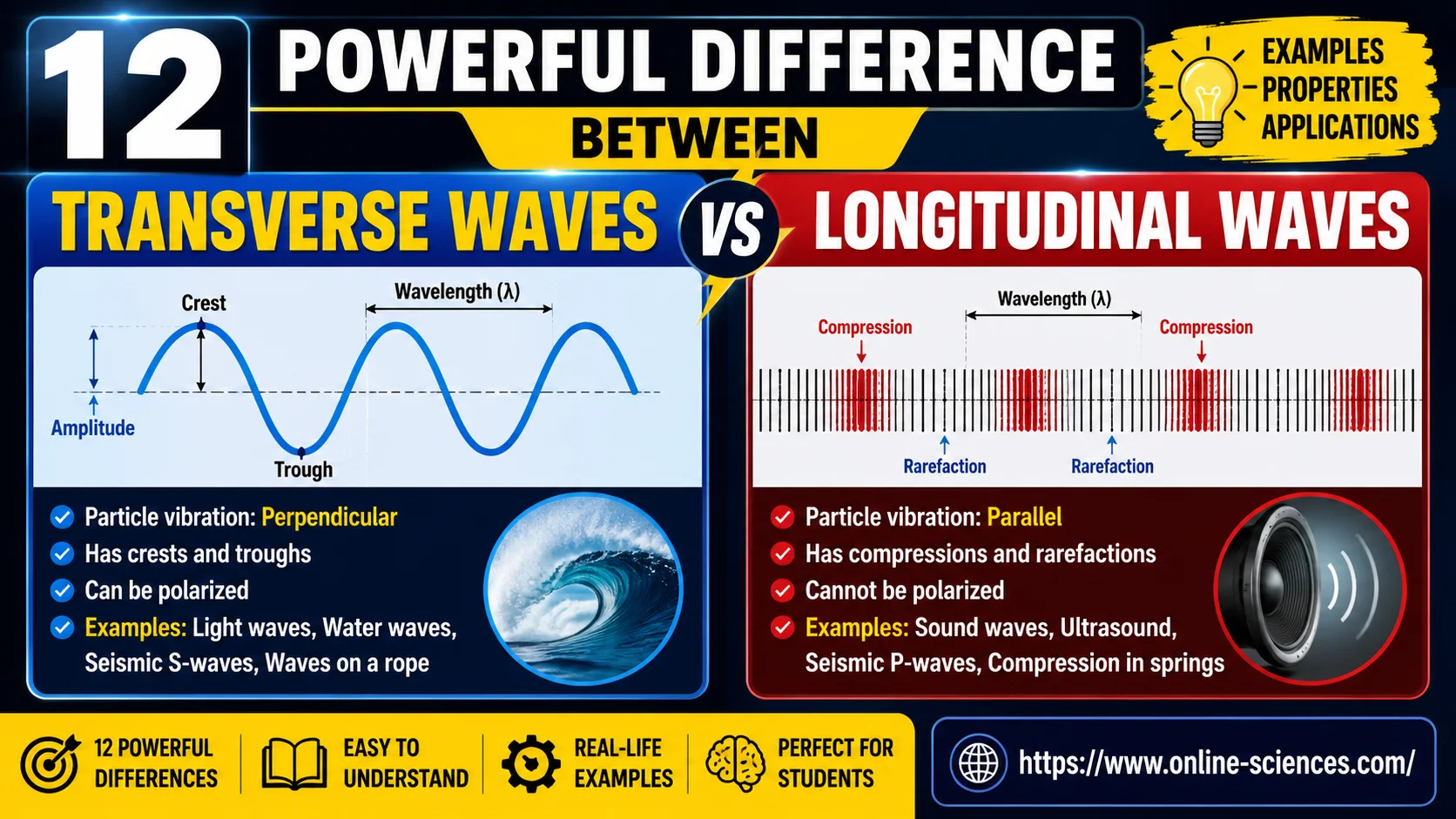
Difference between transverse waves and longitudinal waves is one of the most important topics in physics because it explains how energy travels through different media. In transverse waves, particles of the medium vibrate perpendicular to the direction of wave propagation, while in longitudinal waves, particles vibrate parallel to the direction of wave travel. Understanding these wave types helps students explain the behavior of sound, light, water waves, earthquakes, and many other natural phenomena.
Difference between transverse waves and longitudinal waves
What is a Wave?
A wave is a disturbance that transfers energy from one place to another without transporting matter permanently. Waves can travel through a medium such as solids, liquids, and gases, or through a vacuum in the case of electromagnetic waves.
The waves are classified according to the direction of vibration of the medium particles relative to the direction of propagation into the transverse waves and the longitudinal waves, and they are types of wave motion.
Transverse waves and longitudinal waves
What Are Transverse Waves?
Transverse waves are waves in which the particles of the medium move at right angles (perpendicular) to the direction of wave propagation.
Examples of Transverse Waves
- Light waves.
- Radio waves.
- X-rays.
- Water surface waves.
- Seismic S-waves.
- Waves on a stretched rope.
Characteristics of Transverse Waves
- Have crests and troughs.
- Particle motion is perpendicular to the wave direction.
- Can be polarized.
- Common in electromagnetic radiation.
Transverse waves
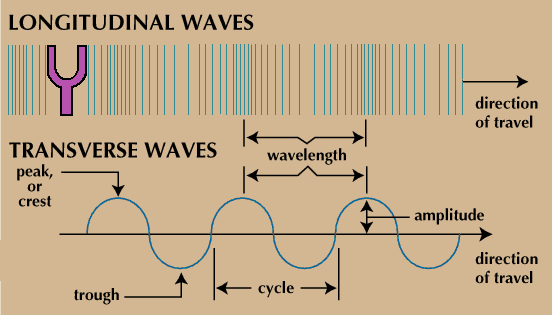
The transverse wave is formed of the crests and the troughs. During the wave propagation, the medium particles do not move from their positions, but they vibrate around their rest positions.
The disturbance in which the particles of the medium vibrate perpendicular to the direction of the wave propagation is known as a transverse wave. The crest is the highest point of the particles of the medium in the transverse wave.
The trough is the lowest point of the particles of the medium in the transverse wave. The water waves are transverse waves because the water particles vibrate in a direction perpendicular to the direction of the wave propagation.
What are Longitudinal Waves?
Longitudinal waves are waves in which the particles of the medium vibrate parallel to the direction of wave propagation.
Examples of Longitudinal Waves
- Sound waves in air.
- Ultrasound waves.
- Seismic P-waves.
- Compression waves in springs.
Characteristics of Longitudinal Waves
- Consists of compressions and rarefactions.
- Particle motion is parallel to the wave direction.
- Cannot be polarized.
- Require a medium in most cases.
Longitudinal waves
The longitudinal wave is formed of the compressions and the rarefactions. During the wave propagation, the medium particles don’t move from their rest positions, but they vibrate around their rest positions.
The disturbance in which the particles of the medium vibrate along the direction of the wave propagation is known as a longitudinal wave. The compression is the area in the longitudinal wave at which the particles of the medium are of the highest density and pressure.
The rarefaction is the area in the longitudinal wave at which the medium particles are of the lowest density and pressure. The sound waves are longitudinal waves because the medium particles vibrate along the direction of the waves propagation. The crest in the transverse wave is equivalent to the compression in the longitudinal wave, and similarly, the trough is equivalent to the rarefaction.
Similarities Between Transverse and Longitudinal Waves
- Both transfer energy without transferring matter permanently.
- Both have wavelength, frequency, amplitude, and velocity.
- Both can undergo reflection, refraction, and diffraction.
- Both obey the general principles of wave motion.
- Both are important in science, engineering, and communication technologies.
Real-Life Applications
Applications of Transverse Waves
- Wireless communication.
- Television broadcasting.
- Fiber-optic communication.
- Medical imaging using electromagnetic radiation.
Applications of Longitudinal Waves
- Ultrasound scanning.
- SONAR systems.
- Sound transmission.
- Seismic exploration.
Why is it Important to Understand These Waves?
Understanding the difference between transverse and longitudinal waves helps explain many physical phenomena, including sound transmission, light propagation, earthquake detection, and modern communication systems. It also forms a foundation for studying advanced topics in physics, engineering, medicine, and telecommunications.
Difference Between Transverse Waves and Longitudinal Waves
The difference between transverse waves and longitudinal waves is based mainly on the direction in which the particles of the medium vibrate relative to the direction of wave propagation. In transverse waves, particles move perpendicular to the direction the wave travels, while in longitudinal waves, particles move parallel to the direction of wave travel. Both types of waves transfer energy from one place to another, but they do so through different patterns of particle motion.
In a transverse wave, the particles of the medium oscillate up and down or side to side at right angles to the movement of the wave. This motion produces characteristic crests (high points) and troughs (low points). Examples of transverse waves include light waves, radio waves, waves on a stretched rope, and seismic S-waves. Because the vibrations occur perpendicular to the direction of propagation, transverse waves can be polarized.
In a longitudinal wave, the particles vibrate back and forth in the same direction as the wave travels. This creates alternating regions of compression, where particles are crowded together, and rarefaction, where particles are spread farther apart. Sound waves in air, ultrasound waves, and seismic P-waves are common examples of longitudinal waves. Unlike transverse waves, longitudinal waves cannot be polarized because the particle motion is parallel to the direction of propagation.
Another important difference is that many transverse waves, especially electromagnetic waves such as light, can travel through a vacuum and do not require a material medium. In contrast, longitudinal mechanical waves, such as sound waves, require a medium like air, water, or a solid substance to transmit energy. The speed of both wave types depends on the properties of the medium through which they travel.
Although transverse and longitudinal waves differ in particle motion and wave structure, they share several common properties. Both possess wavelength, frequency, amplitude, and velocity, and both can undergo reflection, refraction, diffraction, and interference. Understanding these differences and similarities is essential for studying physics, communication systems, acoustics, earthquake science, and many other fields of science and technology.
FAQ about transverse waves and longitudinal waves
1. What is the main difference between transverse waves and longitudinal waves?
The main difference is the direction of particle vibration. In transverse waves, particles vibrate perpendicular to the direction of wave travel, whereas in longitudinal waves, particles vibrate parallel to it.
2. What are examples of transverse waves?
Examples include light waves, radio waves, water surface waves, and seismic S-waves.
3. What are examples of longitudinal waves?
Examples include sound waves, ultrasound waves, compression waves in springs, and seismic P-waves.
4. Can transverse waves travel through a vacuum?
Yes. Electromagnetic transverse waves such as light and radio waves can travel through a vacuum.
5. Can longitudinal waves travel through a vacuum?
No. Most longitudinal waves, such as sound waves, require a material medium to propagate.
6. Which wave can be polarized?
Transverse waves can be polarized because their vibrations occur perpendicular to the direction of propagation.
7. Why can’t longitudinal waves be polarized?
Longitudinal waves cannot be polarized because particle vibrations occur in the same direction as wave propagation.
8. Are sound waves transverse or longitudinal?
Sound waves in air are longitudinal waves because air particles vibrate back and forth parallel to the direction of wave travel.
9. What are compressions and rarefactions?
Compressions are regions where particles are close together, while rarefactions are regions where particles are spread apart in a longitudinal wave.
10. Are water waves transverse waves?
Water surface waves are often treated as transverse waves, although they actually exhibit both transverse and longitudinal motion.
Conclusion
The difference between transverse waves and longitudinal waves lies primarily in the direction of particle vibration relative to wave propagation. Transverse waves feature perpendicular motion and crests and troughs, while longitudinal waves involve parallel motion with compressions and rarefactions. Understanding these powerful differences provides a strong foundation for learning physics and appreciating how energy travels through the world around us.
You can follow Science Online on YouTube from this link: Science Online
The wave motion and the types of waves
Properties of electromagnetic waves and Light reflection
Mechanical waves and some technological applications of sound mechanical waves