7 Powerful Uses and Laws of Reflection of Sound Waves You Should Know
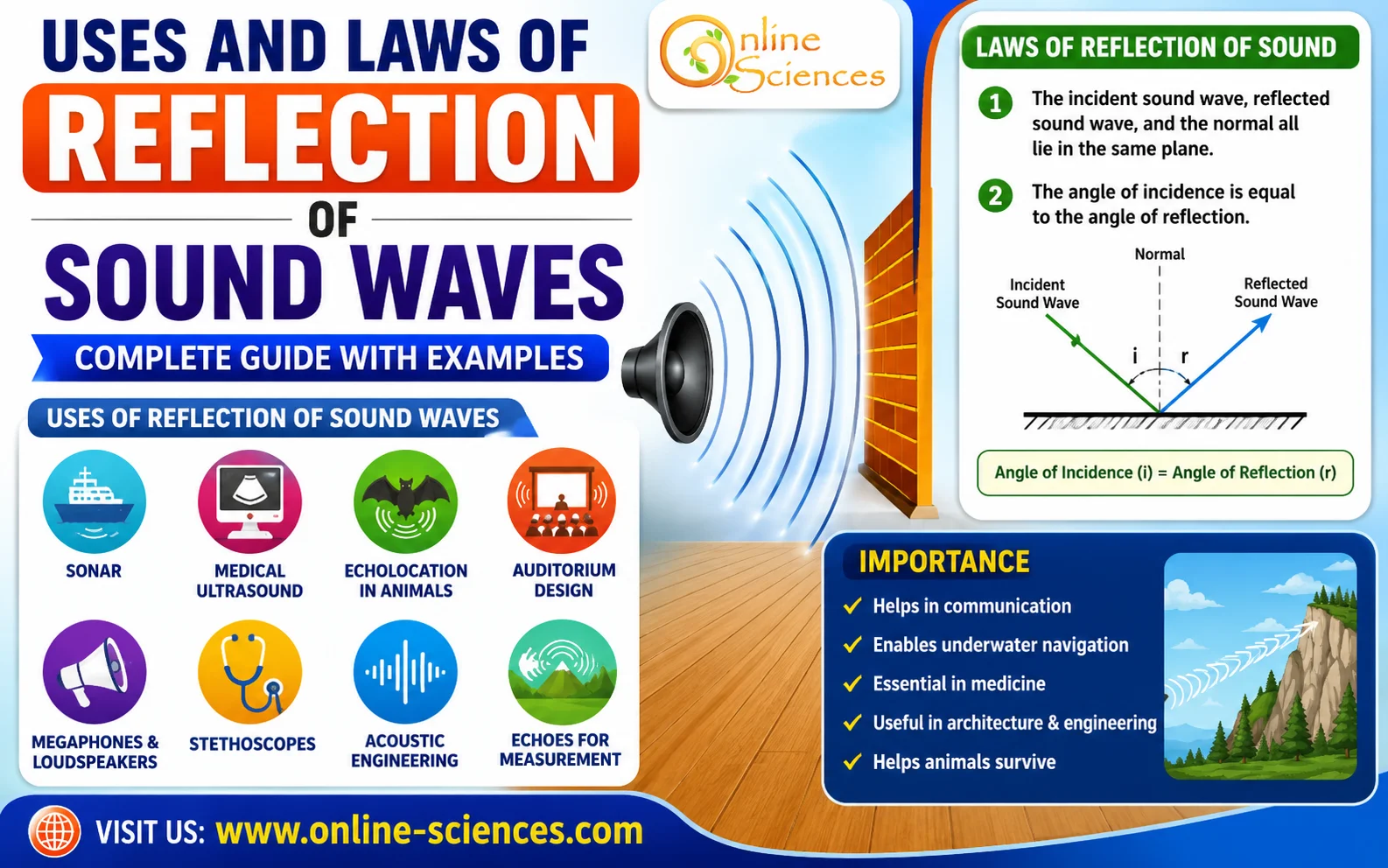
Uses and laws of reflection of sound waves are among the most important concepts in physics because they explain how sound travels, bounces off surfaces, and is applied in medicine, engineering, navigation, and everyday life. Understanding these principles helps students and professionals see how sound reflection improves communication, measurement, and modern technology.
Uses and Laws of Reflection of Sound Waves
Reflection
The reflection is the change in the direction of a wavefront at an interface between two different media so that the wavefront returns into the medium from which it originated, such as the reflection of light, sound, and water waves.
Sound waves can be reflected by large, hard, smooth, vertical, and faraway surfaces such as the walls, the buildings, and the cliffs, where the echoes are produced by the reflections of sound from these surfaces.
Reflection of sound
The sound reflection is the return of the sound waves in the same direction due to hitting a reflecting surface (such as a wall).
What are the laws of reflection of sound?
Laws of reflection of sound
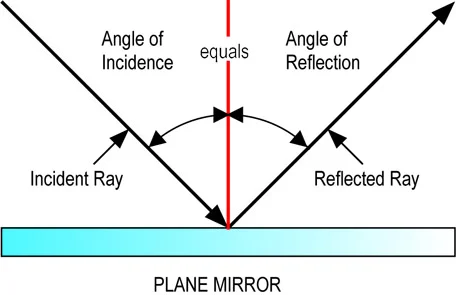
The reflection of sound waves is governed by two laws known as the laws of sound reflection. The first law of reflection of sound waves is that the angle of incidence = the angle of reflection.
The incident sound ray, the reflected sound ray, and the perpendicular line from the point of incidence on the reflecting surface. all lie on the same plane, perpendicular to the reflecting surface.
The sound ray is the direction of the line propagation of the sound wave. The angle of incidence of the sound ray is the angle between the incident sound ray and the line perpendicular to the reflecting surface at the point of incidence.
The angle of reflection of the sound ray is the angle between the reflected sound ray and the line perpendicular to the reflecting surface at the point of incidence. When a sound ray is incident perpendicular to a reflecting surface, it reflects on itself because the angle of incidence = the angle of reflection = 0.
It is very important to put a piece of moquette or rubber under the vibrating washing machine while getting rid of water to absorb the noise produced due to vibration instead of its reflection from the glistening surfaces of walls. The ceilings and the walls of broadcast studios are covered with rubber or felt to absorb the sound and prevent its reflection.
Uses of the reflection of sound
The reflection of sound is used in many devices, such as megaphones, horns, musical instruments like the trumpet, the shehnais, etc, The ceilings of the cinema halls and the auditoriums are curved so that the sound after multiple reflections reaches all parts of the hall.
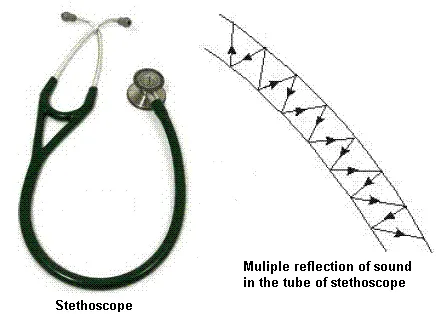
The stethoscope
Doctors listen to the sounds from the human body through a stethoscope, which is used to hear the sounds of internal organs of a patient for diagnostic purposes.
Uses and Laws of Reflection of Sound Waves
Reflection of sound occurs when sound waves strike a hard surface and bounce back into the same medium. Just like light, sound follows specific reflection laws that make many practical applications possible, from medical imaging to underwater exploration.
What is the Reflection of Sound?
Reflection of sound is the phenomenon in which sound waves return after hitting a solid, liquid, or large obstacle instead of passing through it. Hard and smooth surfaces reflect sound efficiently, while soft and porous materials absorb much of the sound energy.
Laws of Reflection of Sound Waves
The reflection of sound follows two fundamental laws.
- The Incident Sound Wave, Reflected Sound Wave, and Normal Lie in the Same Plane: The incoming sound wave (incident wave), the reflected sound wave, and the normal (an imaginary line perpendicular to the reflecting surface) all lie in the same plane.
- Angle of Incidence Equals Angle of Reflection: The angle between the incident sound wave and the normal is always equal to the angle between the reflected sound wave and the normal.
Angle of Incidence = Angle of Reflection
These laws remain valid regardless of the frequency of the sound wave, provided the reflecting surface is sufficiently large compared to the wavelength.
Conditions for Good Sound Reflection
For effective reflection:
- The reflecting surface should be hard and smooth.
- The dimensions of the reflecting surface should be much larger than the wavelength of the sound.
- Soft materials such as curtains, carpets, and foam absorb sound instead of reflecting it.
- The surface should not have excessive irregularities that scatter sound in multiple directions.
Uses of Reflection of Sound Waves
1. Echo Formation
An echo is produced when reflected sound reaches the listener after a noticeable time delay. Echoes are useful for measuring distances and studying the surrounding environment.
Applications:
- Measuring the distance of mountains and cliffs.
- Studying caves.
- Wildlife observation.
2. SONAR (Sound Navigation and Ranging)
Ships and submarines use reflected ultrasonic waves to determine:
- Ocean depth.
- Distance to underwater objects.
- Location of submarines.
- Detection of schools of fish.
SONAR works by measuring the time taken for ultrasonic waves to travel to an object and return.
3. Medical Ultrasonography
Doctors use reflected ultrasound waves to create images of internal organs.
Applications include:
4. Echolocation in Animals
Animals naturally use reflected sound to navigate.
Examples include:
- Bats.
- Dolphins.
- Some species of whales.
They emit high-frequency sounds and interpret the returning echoes to locate food and avoid obstacles.
5. Designing Auditoriums and Concert Halls
Architects carefully design walls and ceilings to control sound reflection so that speech and music can be heard clearly throughout the room.
Proper sound reflection improves:
- Speech intelligibility.
- Music quality.
- Audience experience.
6. Megaphones and Loudspeakers
Megaphones use sound reflection to direct sound energy forward, making voices louder and clearer over long distances.
7. Stethoscopes
A stethoscope guides reflected and transmitted sound from the body efficiently toward the doctor’s ears, helping detect heartbeats and breathing sounds.
8. Acoustic Engineering
Engineers use sound reflection principles when designing:
- Recording studios.
- Cinemas.
- Lecture halls.
- Conference rooms.
- Broadcasting facilities.
Acoustic panels are strategically placed to balance reflection and absorption.
Advantages of Sound Reflection
- Improves communication in large halls.
- Enables underwater navigation.
- Supports medical diagnosis.
- Helps animals navigate naturally.
- Assists engineers in acoustic design.
- Makes distance measurement possible.
- Enhances audio quality.
Reflection vs Absorption of Sound
Reflection of sound occurs when sound waves strike a hard, smooth surface and bounce back into the same medium. Materials such as concrete, brick, metal, and glass are excellent reflectors because they absorb very little sound energy. Sound reflection produces echoes and is widely used in applications such as SONAR, medical ultrasound, auditorium design, and echolocation in animals like bats and dolphins.
Absorption of sound, on the other hand, occurs when sound waves are taken in by a material rather than reflected. Soft and porous materials such as carpets, curtains, acoustic foam, fiberglass, and upholstered furniture convert part of the sound energy into heat, reducing the intensity of the reflected sound. Sound absorption helps minimize echoes, reverberation, and unwanted noise, making it essential for recording studios, theaters, classrooms, offices, and soundproof rooms.
The main difference between reflection and absorption lies in how the surface interacts with sound waves. Reflection sends sound back into the surrounding space, improving sound projection in some environments, while absorption reduces sound reflections to create a quieter and clearer acoustic environment. A well-designed room often uses a balance of both reflection and absorption to achieve the best sound quality, ensuring speech and music remain clear without excessive echoes.
Everyday Examples of Reflection of Sound
- Hearing an echo in a large empty hall.
- Shouting near a mountain.
- Sonar systems on ships.
- Medical ultrasound scans.
- Dolphins locating fish.
- Bats flying in the darkness.
- Public address systems.
Importance of Reflection of Sound Waves
The reflection of sound is essential in physics, medicine, architecture, engineering, underwater exploration, and wildlife research. Without sound reflection, technologies like SONAR and ultrasound imaging would not exist, and many modern acoustic systems would be ineffective.
Conclusion
The laws of reflection of sound waves state that the angle of incidence equals the angle of reflection, and both the incident and reflected waves lie in the same plane. These simple principles have numerous practical applications, including medical imaging, underwater navigation, acoustic engineering, and natural echolocation. Understanding sound reflection helps explain many technologies and phenomena encountered in everyday life.
FAQ about the reflection of sound waves
1. What is the reflection of sound waves?
Reflection of sound waves is the bouncing back of sound after it strikes a hard surface, allowing the sound to return through the same medium.
2. What are the two laws of reflection of sound?
The angle of incidence equals the angle of reflection, and the incident wave, reflected wave, and normal all lie in the same plane.
3. What materials reflect sound best?
Hard, smooth surfaces such as concrete, metal, brick, and glass reflect sound effectively, while soft materials absorb it.
4. What is an example of sound reflection in daily life?
Hearing your voice echo after shouting in a large empty room or near a mountain is a common example.
5. How does SONAR use sound reflection?
SONAR sends ultrasonic waves into water and measures the returning echoes to determine the distance, depth, and position of underwater objects.
6. Why is the reflection of sound important in architecture?
Architects use sound reflection principles to ensure clear speech and high-quality music in theaters, classrooms, auditoriums, and concert halls.
You can follow science online on YouTube from this link: Science online
Audible sounds, Doppler’s effect, Savart’s wheel importance, Sound properties & velocity
Sound intensity, Factors affecting Sound intensity & Applications of ultrasonic waves
Mechanical waves and some technological applications of sound mechanical waves
The advantages and disadvantages of ultrasonic waves in detecting industrial defects