China’s AI Robot MOYA Feels Too Real: The amazing Humanoid Robot With a 92% Human-Like Gait
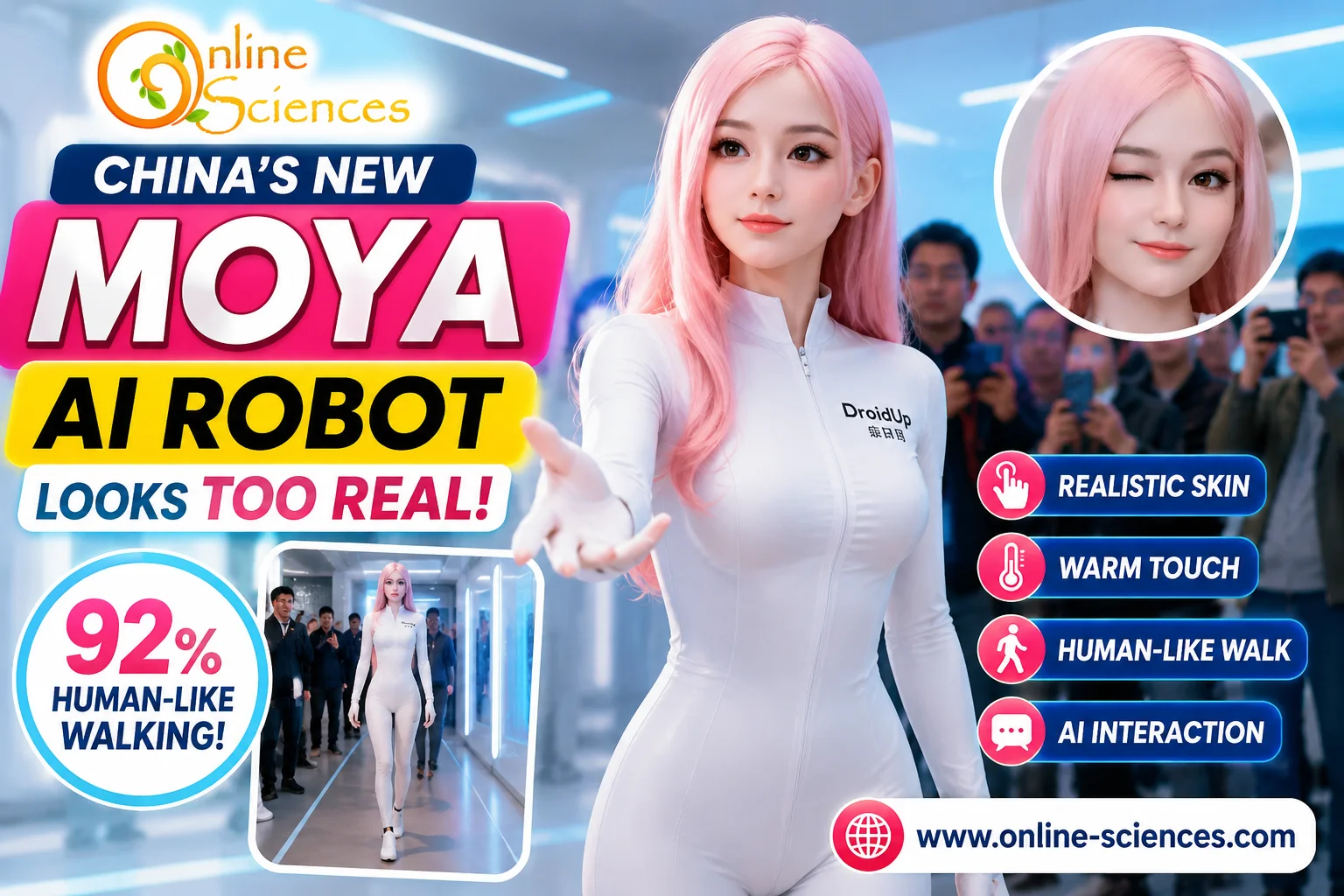
China’s AI robot MOYA is attracting global attention because it looks and moves remarkably like a human. Developed by Shanghai-based robotics company DroidUp, MOYA combines a biomimetic body, warm skin, realistic facial expressions, eye contact, and AI-powered interaction. Its developers say its walking pattern reaches 92% human-like accuracy, although this figure is a company claim rather than an independently established scientific benchmark.
China’s AI Robot MOYA Feels Too Real
China’s MOYA Robot
Humanoid robots have traditionally looked unmistakably robotic, with exposed mechanical joints, metal frames, and artificial movements. MOYA takes a very different approach. Its developers designed the robot around biomimicry—the idea of reproducing selected characteristics of the human body and behavior.
DroidUp, a Shanghai robotics company, unveiled MOYA in early 2026. The robot stands approximately 1.65 meters tall and weighs about 32 kilograms, giving it proportions closer to an adult human than many industrial humanoids.
What makes MOYA particularly unusual is that realism is not limited to its appearance. The robot is designed to reproduce aspects of human movement, facial behavior, body warmth, and social interaction. That combination is what has caused many people watching demonstrations to describe MOYA as both fascinating and slightly unsettling.
What Makes MOYA So Realistic?
Several technologies contribute to MOYA‘s human-like appearance and behavior.
1. Human-Like Walking
One of MOYA‘s most frequently reported features is its 92% human-like gait. DroidUp says the robot‘s walking posture and movement patterns can reach approximately 92% similarity to human walking. The company has positioned this capability as an important part of its biomimetic design. However, it is important to understand what the number means.
The 92% figure should not be interpreted as saying MOYA is 92% human. It refers specifically to the similarity or accuracy of its walking behavior according to the developer’s description. There is currently no reason to interpret this number as a general measurement of human intelligence, consciousness, or overall human similarity.
This distinction is important because headlines can make the robot sound much more advanced than the available evidence demonstrates.
2. Warm, Human-Like Skin
Perhaps one of MOYA‘s strangest features is its ability to maintain a warm surface temperature. Reports say the robot‘s skin can be maintained around 32–36°C, approximately within the range associated with human body temperature.
Why would a robot need warm skin?
The goal is not simply cosmetic. Temperature can influence how people perceive and interact with a machine. A cold mechanical surface immediately feels artificial, while a warm, soft surface can create a stronger sense of physical realism. MOYA therefore represents a shift from making robots merely look human toward making interactions with them feel more human.
3. Facial Expressions and Eye Contact
MOYA can also reproduce facial expressions and behaviors such as smiling, nodding, and maintaining eye contact. The robot‘s head is designed with multiple actuators that allow subtle facial movements. Its appearance can also be customized through a modular head design. Eye contact is particularly important.
Humans naturally use eye direction and facial expressions when communicating. A robot that simply speaks without looking at a person can feel like a machine. MOYA‘s ability to look toward people and combine eye contact with facial movements makes its interactions appear considerably more natural.
4. Biomimetic Body Design
MOYA reportedly goes beyond silicone skin. Its internal construction is intended to reproduce aspects of human anatomy, including structures resembling a rib cage, along with soft padding designed to create a more natural body shape. This is a significant design philosophy.
Instead of putting a conventional robot underneath a human-shaped exterior, the developers are attempting to make the entire physical structure contribute to the illusion of a human body. The result is a robot designed to move, look, and physically present itself in a way that is closer to humans than traditional machines.
MOYA and Embodied AI
Another major part of MOYA’s technology is embodied AI. Traditional AI systems primarily exist in digital environments. They can analyze text, recognize images, generate content, or answer questions, but they do not necessarily have a physical body. Embodied AI connects intelligence with a physical machine.
The robot can potentially:
- perceive its surroundings;
- interpret information from sensors;
- interact with people;
- plan physical movements;
- navigate environments;
- respond to verbal communication;
- perform actions in the real world.
This is one reason humanoid robotics has become such an important area of AI development. The goal is no longer simply to create an AI that can talk like a person. The bigger challenge is creating AI that can understand and act in the physical world.
Why Does MOYA Feel “Too Real”?
MOYA‘s realism also creates a psychological phenomenon known as the uncanny valley. The uncanny valley describes the uncomfortable feeling people can experience when an artificial character becomes extremely similar to a human—but not quite human.
A cartoon robot may look friendly because everyone knows it is artificial. A conventional industrial robot can also feel comfortable because its mechanical nature is obvious.
But a machine with realistic skin, human-like eyes, facial expressions, body temperature, and natural movement can create a strange contradiction: your brain recognizes something that looks human while simultaneously noticing that it is not actually human.
That appears to be one reason MOYA has generated such strong reactions online. Reports of demonstrations describe people as both impressed and unsettled by its appearance.
What Can MOYA Actually Do?
It is important not to confuse human-like appearance with human-level intelligence. MOYA’s demonstrations emphasize walking, facial expressions, eye contact, and embodied interaction. Its developers have discussed potential applications in areas such as healthcare, education, and public-facing services.
However, the broader humanoid-robot industry still faces major challenges. Recent reporting on China’s humanoid robotics sector shows that many robots can perform impressive demonstrations but struggle with unpredictable real-world tasks, dexterity, autonomy, and reliable industrial work.
So MOYA should currently be viewed as an impressive biomimetic humanoid robotics platform, rather than an artificial human capable of doing everything a person can do.
Potential Applications of MOYA
If the technology becomes sufficiently reliable and affordable, a robot with MOYA’s characteristics could have several potential applications.
Healthcare
A highly expressive humanoid could potentially assist with communication, guidance, rehabilitation environments, or social interaction. For elderly people, for example, a socially engaging robot could potentially provide reminders and basic assistance while communicating in a more natural way.
Education
Humanoid robots could also become interactive educational assistants. Instead of communicating through a computer screen, students could interact with an embodied AI that can look at them, respond verbally, demonstrate movements, and react to their behavior.
Customer Service
MOYA’s realistic appearance could also be useful in reception areas, exhibitions, hotels, museums, and other public-facing environments. A humanoid robot could greet visitors, answer questions, provide directions, and communicate information.
Research
Perhaps the most important application is research itself. MOYA provides researchers with a platform for studying how humans respond to increasingly realistic machines. As robots become more lifelike, understanding human-robot interaction will become just as important as improving motors and artificial intelligence.
MOYA vs Traditional Humanoid Robots
MOYA represents a different philosophy from many famous humanoid robots. Traditional platforms often prioritize:
- strength;
- speed;
- balance;
- industrial automation;
- manipulation;
- navigation.
MOYA places unusually strong emphasis on:
- appearance;
- facial expressions;
- body temperature;
- human-like movement;
- eye contact;
- social interaction.
This does not necessarily make MOYA more capable than industrial humanoids. Instead, it makes the robot interesting for a different reason. It is attempting to make the interaction itself feel more human.
Is MOYA Really 92% Human?
No. This is one of the most important points to clarify. MOYA is not 92% human, and its artificial intelligence is not claimed to be 92% equivalent to human intelligence. The 92% number relates to human-like walking/gait accuracy according to DroidUp‘s claims. There is a huge difference between reproducing a human walking pattern and reproducing the full capabilities of a human being.
Human intelligence includes reasoning, emotional understanding, common sense, creativity, consciousness, memory, social knowledge, physical dexterity, and the ability to adapt to thousands of unexpected situations. MOYA is nowhere near demonstrating all of those capabilities.
How Much Does MOYA Cost?
Pricing information surrounding MOYA has been inconsistent across reports, and DroidUp has not established a widely available consumer price. One technology report has estimated a potential cost of around $173,000, but this should be treated as a reported estimate rather than a confirmed retail price.
This makes sense for a sophisticated humanoid platform containing specialized actuators, sensors, AI hardware, thermal systems, custom materials, and a complex mechanical structure. For now, MOYA appears much closer to an advanced commercial/research platform than a robot that the average household can simply purchase.
The Bigger Picture: China’s Humanoid Robot Race
MOYA arrives at a time when China is investing heavily in humanoid robotics and embodied AI. China has become a major force in robotics manufacturing, with companies developing humanoids for factories, logistics, public services, research, and consumer applications.
Recent events have demonstrated both the remarkable progress and the remaining limitations of Chinese humanoid robots. Robots can now run, dance, box, navigate courses, and perform increasingly sophisticated demonstrations, but real-world autonomy and dexterity remain difficult problems.
MOYA therefore represents an interesting branch of this larger race: instead of simply building stronger robots, engineers are trying to build robots that people can emotionally and socially relate to.
The Future of Human-Like AI Robots
The most interesting question about MOYA is not whether it can fool someone into thinking it is human. The real question is whether increasingly realistic robots will become useful enough to justify their complexity. A robot does not necessarily need human-like skin or facial expressions to move boxes in a warehouse.
But a robot working with patients, children, customers, or elderly people could benefit from natural communication and social cues. That creates a potentially important future market for biomimetic robots. However, greater realism also creates ethical questions.
Should robots clearly identify themselves as machines? How should they handle personal information? What happens when people become emotionally attached to them? Could realistic facial expressions make users believe that a robot has emotions or consciousness when it does not?
These questions will become increasingly important as AI robots become more convincing.
Final Verdict
China’s MOYA is one of the most visually striking humanoid robots to emerge in 2026. Its combination of warm skin, realistic facial expressions, eye contact, human-like body structure, and a developer-reported 92% human-like gait makes it very different from conventional industrial robots.
But the phrase “92% human” should be used carefully. MOYA is not 92% human and does not possess human-level intelligence. The 92% figure refers to the reported similarity of its walking gait.
Nevertheless, MOYA demonstrates where humanoid robotics may be heading: machines that are not only capable of performing physical tasks, but are deliberately designed to look, move, and interact more like people. And that may be exactly why MOYA feels so fascinating—and, for some people, a little too real.
Frequently Asked Questions about MOYA
What is MOYA?
MOYA is a biomimetic humanoid AI robot developed by Chinese robotics company DroidUp in Shanghai.
Who developed MOYA?
MOYA was developed by DroidUp, also referred to in some reports as Zhuoyide.
Is MOYA really 92% human?
No. The 92% figure refers to the developer-reported similarity of MOYA‘s walking gait to human walking, not to its overall similarity to humans.
Does MOYA have real human skin?
No. MOYA uses artificial, silicone-based skin designed to reproduce some of the softness and warmth associated with human skin.
Does MOYA have body temperature?
MOYA is designed to maintain a warm surface temperature of approximately 32–36°C.
Can MOYA make facial expressions?
Yes. Its biomimetic head is designed to reproduce facial movements and expressions such as smiling and other subtle gestures.
Can MOYA talk to people?
MOYA is designed around embodied AI and social interaction, although the robot‘s demonstrated capabilities should not be confused with unrestricted human-level conversation or reasoning.
Is MOYA available to buy?
There is no broadly established consumer retail availability or universally confirmed public price. Reports have suggested a very high potential cost, making it primarily a commercial or institutional technology at present.
Why does MOYA look creepy to some people?
Its extremely realistic appearance can trigger the uncanny valley, where an artificial character becomes almost human-looking but still contains subtle differences that make people uncomfortable.
Is MOYA the most intelligent humanoid robot?
Not necessarily. MOYA’s major innovation is its biomimetic appearance and social realism. Other humanoids may be considerably stronger or better suited to industrial tasks.
What could MOYA be used for?
Potential applications include healthcare, education, public services, customer interaction, research, and social companionship.
You can follow Science Online on YouTube at this link: Science Online
Gemini Takes Over: The End of Google Assistant in 2026! 🚀
Goodbye Google Assistant: Can Your Android Phone Actually Run Gemini? 🚀
Loona robot review, advantages, disadvantages and what can Loona do?
Sophia robot review, features, use, advantages and disadvantages
Educational robotics, Robot teachers, Social robots review, features advantages and drawbacks
Humanoid robots use, risks, advantages, and disadvantages