
Powerful Oscillatory Motion Examples 2026: Definition, Types, and Real-Life Applications
Oscillatory motion examples can be found everywhere, from the swinging motion of a pendulum to the vibration of a guitar string and the movement of a mass attached to a spring. Oscillatory motion describes a repeated back-and-forth movement around a stable or equilibrium position. It is an important concept in physics because many mechanical, acoustic, electrical, and natural systems involve oscillations.
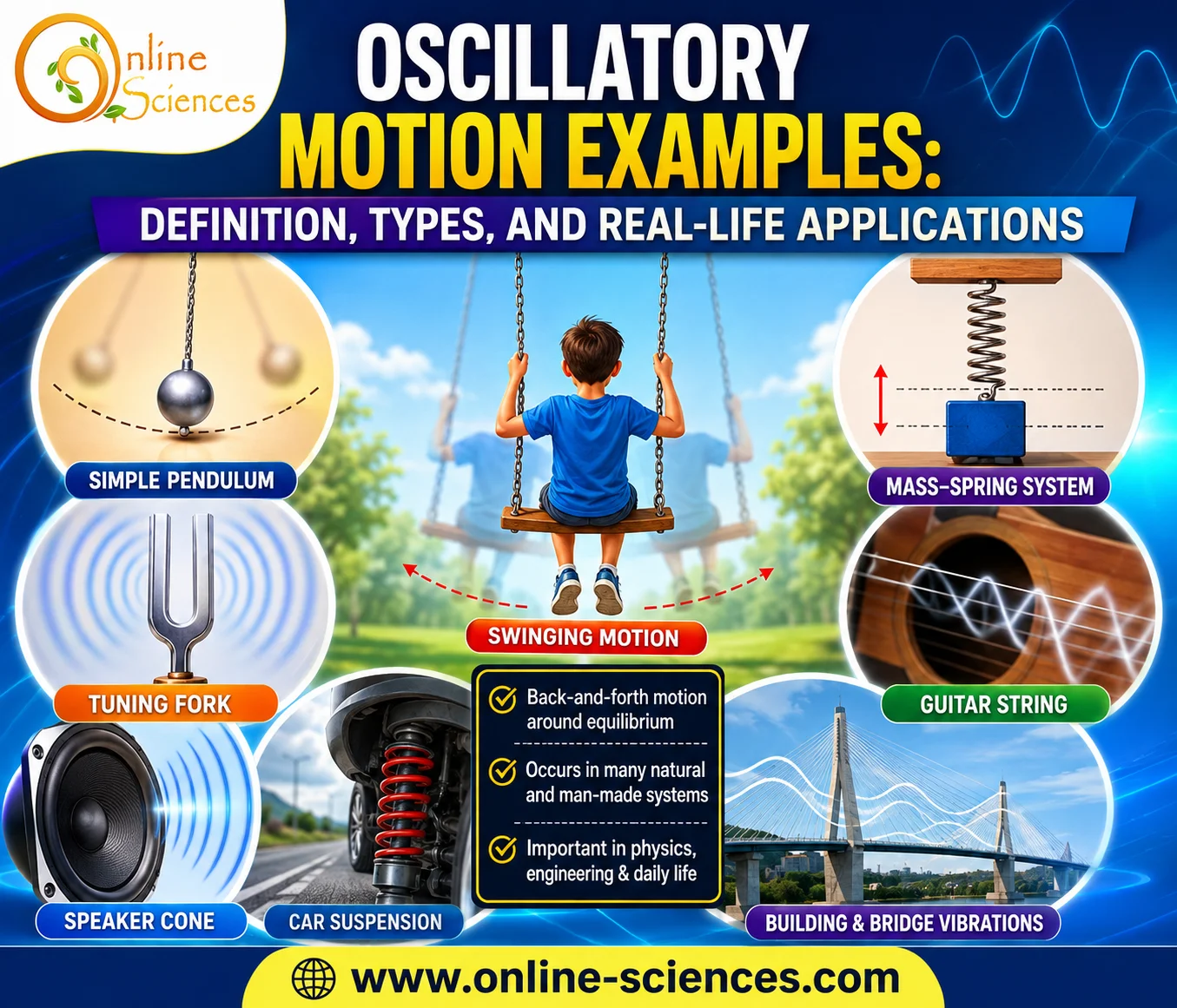
Oscillatory Motion Examples
Oscillatory motion
Understanding oscillatory motion helps explain how pendulum clocks work, why musical instruments produce sound, how suspension systems absorb vibrations, and how many engineering systems respond to external forces. Some oscillations can be modeled as simple harmonic motion (SHM), a special form in which the restoring force is proportional to displacement from equilibrium and directed toward that equilibrium position.
What is Oscillatory Motion?
Oscillatory motion is the repetitive back-and-forth motion of an object around an equilibrium or mean position. When an object is displaced from its equilibrium position, a restoring force tends to move it back toward that position. If the object has sufficient momentum, it passes through equilibrium and moves toward the opposite side, producing repeated oscillations.
For example, consider a child sitting on a swing. When the swing is pulled away from its central position and released, it moves forward, passes through its equilibrium position, reaches the other side, and then returns. This repeated movement is an example of oscillatory motion.
Oscillatory motion is generally a form of periodic motion, because an ideal oscillator repeats its motion after equal intervals of time. However, not every periodic motion is oscillatory. For example, the orbital motion of a planet is periodic but does not move back and forth around a single equilibrium position in the same way a pendulum does.
Main Characteristics of Oscillatory Motion
Several important quantities are used to describe an oscillating system:
- Equilibrium Position: The equilibrium position is the central position around which the object oscillates. At equilibrium, the net force on the system is zero under static conditions. For a pendulum, the equilibrium position is the lowest point of its swing. For a spring-mass system, it is the position where the forces acting on the mass balance.
- Amplitude: The amplitude is the maximum displacement of the object from its equilibrium position. If a mass moves 5 cm to either side of its equilibrium position, its amplitude is 5 cm.
- Time Period: The time period (T) is the time required for one complete oscillation. One complete oscillation means that the object returns to its starting position with the same direction of motion.
- Frequency: Frequency represents the number of complete oscillations performed per second. It is measured in hertz (Hz). The relationship between frequency and period is: f = 1/T, where: f = frequency, T = time period.
- Restoring Force: The restoring force acts toward the equilibrium position and is responsible for returning a displaced object toward its central position. In a spring, for example, Hooke’s law describes the restoring force as: F = −kx, where k is the spring constant and x is displacement from equilibrium.
Common Oscillatory Motion Examples
1. Simple Pendulum
A simple pendulum is one of the most familiar examples of oscillatory motion. When a pendulum bob is displaced from its equilibrium position and released, gravity provides a restoring effect that causes it to move back and forth.
For sufficiently small angular displacements, a simple pendulum can be approximated as performing simple harmonic motion. Pendulums have historically been used in clocks and are also important in physics experiments for studying periodic motion.
2. Mass Attached to a Spring
A mass attached to a spring provides a classic example of simple harmonic motion. If the mass is pulled away from equilibrium and released, the spring produces a restoring force that pulls the mass back.
The mass then passes through equilibrium and continues toward the opposite side. Assuming an ideal spring and negligible friction, the process repeats continuously. The spring-mass system is particularly important because its motion can be described mathematically using Hooke’s law and Newton’s second law.
3. Swinging Motion
A child on a playground swing demonstrates oscillatory motion. The swing moves forward and backward around an equilibrium position. Although a real swing experiences air resistance and friction, its motion can often be approximated using the principles of pendulum motion for appropriate conditions.
4. Vibrating Guitar String
When a guitar string is plucked, the string moves rapidly back and forth around its equilibrium position. This vibration produces disturbances in the surrounding air, creating sound waves. The oscillation of strings is therefore an important connection between mechanical oscillation and sound. Musical instruments such as guitars, violins, and pianos rely on vibrating components to generate sound.
5. Tuning Fork
A tuning fork consists of two metal prongs that vibrate after the fork is struck. The prongs move back and forth around their equilibrium positions. Because the vibration has a relatively stable frequency, tuning forks are useful for producing reference musical notes and demonstrating sound generation.
6. Vibrating Speaker Cone
A loudspeaker converts electrical signals into mechanical vibrations. Its cone moves backward and forward, causing the surrounding air to vibrate and producing sound. This is another practical example in which oscillatory motion is directly connected to wave production.
7. Earth’s Crust During an Earthquake
During an earthquake, the ground can experience complex vibrations and oscillations. These movements can occur in different directions and frequencies and are associated with seismic waves. Earthquake vibrations demonstrate how oscillations can occur in large natural systems rather than only in small mechanical objects.
8. Vibrations in Buildings and Bridges
Buildings, bridges, and other structures can vibrate when exposed to wind, traffic, machinery, or earthquakes. Engineers study these oscillations carefully because excessive vibration can cause discomfort, structural damage, or resonance problems. Understanding natural frequencies and damping is therefore an important part of structural engineering.
9. Automobile Suspension
A vehicle’s suspension system contains springs and damping components that can oscillate when the vehicle travels over an uneven road. The springs help absorb and store mechanical energy, while dampers reduce excessive oscillations. This allows the vehicle to return toward a stable position without continuing to bounce indefinitely.
10. Vibrations of Atoms in Solids
Atoms in solid materials can vibrate around their equilibrium positions. These microscopic oscillations are important in understanding thermal properties and other physical behavior of materials. At the microscopic level, oscillatory behavior is therefore fundamental to the physics of matter.
Oscillatory Motion vs. Simple Harmonic Motion
It is important to understand that simple harmonic motion is a special type of oscillatory motion. In general oscillatory motion, an object moves back and forth around an equilibrium position. However, for simple harmonic motion, the restoring force has a specific relationship with displacement:
F = −kx
The negative sign indicates that the force acts in the direction opposite to the displacement. In SHM, acceleration is also proportional to displacement and points toward equilibrium. This makes the motion mathematically predictable and allows it to be represented using sine and cosine functions.
A mass on an ideal spring is one of the clearest examples of SHM. A simple pendulum behaves approximately as SHM when its angular displacement is sufficiently small.
Energy in Oscillatory Motion
Energy continuously changes form during an oscillation. Consider a mass attached to a spring. At the maximum displacement, the mass momentarily stops before reversing direction. Its velocity is zero, so its kinetic energy is zero at that instant, while the system’s potential energy is greatest.
As the mass moves toward equilibrium, potential energy is converted into kinetic energy. At equilibrium, the speed is greatest in the idealized system, so kinetic energy reaches its maximum. The process then reverses as the mass moves toward the opposite extreme position.
In real systems, friction and air resistance gradually remove mechanical energy. As a result, the amplitude decreases over time. This type of motion is known as damped oscillation.
Why is Oscillatory Motion Important?
Oscillatory motion is important because it provides a basic model for many physical systems. It is used to understand:
- Vibrations in machines and vehicles.
- Sound production and musical instruments.
- Pendulum clocks.
- Mechanical springs.
- Building and bridge vibrations.
- Earthquake and seismic behavior.
- Electrical oscillators.
- Vibrations at the atomic and molecular scale.
- Engineering systems involving resonance and damping.
Oscillations also provide an important foundation for understanding waves. Many waves originate from oscillating sources; for example, a vibrating guitar string produces sound waves in the surrounding air.
Frequently Asked Questions About Oscillatory Motion
What is oscillatory motion?
Oscillatory motion is the repeated back-and-forth movement of an object around an equilibrium or mean position.
What are five examples of oscillatory motion?
Five common examples are a simple pendulum, a mass attached to a spring, a playground swing, a vibrating guitar string, and a tuning fork.
Is oscillatory motion periodic?
Yes, ideal oscillatory motion is periodic because the motion repeats at regular intervals. However, real oscillations can lose energy because of friction and air resistance.
What is the difference between oscillatory and periodic motion?
Periodic motion is any motion that repeats after a regular time interval. Oscillatory motion is a particular type of periodic motion involving repeated movement about an equilibrium position.
Is every oscillatory motion simple harmonic motion?
No. Simple harmonic motion is a special type of oscillatory motion in which the restoring force is proportional to displacement and directed toward equilibrium.
What is the amplitude of oscillatory motion?
Amplitude is the maximum displacement of the oscillating object from its equilibrium position.
What is the time period?
The time period is the time required for an object to complete one full oscillation.
What is frequency?
Frequency is the number of complete oscillations performed per second. Its SI unit is hertz (Hz).
What causes oscillatory motion?
Oscillatory motion usually occurs when a system is displaced from a stable equilibrium and a restoring force acts to return it toward equilibrium.
What are examples of oscillatory motion in everyday life?
Everyday examples include playground swings, clock pendulums, vibrating guitar strings, speaker cones, vehicle suspension systems, and vibrating structures.
Conclusion
Oscillatory motion examples range from simple classroom demonstrations to complex natural and engineering systems. A pendulum, spring, swing, guitar string, tuning fork, speaker cone, and vehicle suspension all demonstrate the fundamental idea of movement around an equilibrium position.
The study of oscillatory motion also provides the foundation for understanding simple harmonic motion, vibrations, resonance, damping, and waves. By learning concepts such as amplitude, frequency, period, equilibrium position, and restoring force, students can better understand many phenomena encountered in physics and everyday life.
You can subscribe to Science Online on YouTube from this link: Science Online
Gemini Takes Over: The End of Google Assistant in 2026! 🚀
Goodbye Google Assistant: Can Your Android Phone Actually Run Gemini? 🚀
Properties of Mechanical waves and Electromagnetic waves
Properties of electromagnetic waves and Light reflection
Mechanical waves and some technological applications of sound mechanical waves
Role of waves in transferring energy, Wave Motion, Transverse waves & Longitudinal waves
Oscillatory Motion definition, examples, applications & properties