
🔥 Top 6 AI Trends That Will Define 2026: Powerful Breakthroughs Backed by Data
Artificial intelligence is transforming the world faster than ever, and 2026 is becoming a defining year for technological innovation. From autonomous AI agents and advanced robotics to multimodal models, AI-powered healthcare, and intelligent cybersecurity, new developments are changing how people work, communicate, learn, and solve complex problems. But which technologies will have the biggest impact? Here are the top six AI trends that will define 2026, supported by industry research, adoption statistics, and emerging technological breakthroughs.
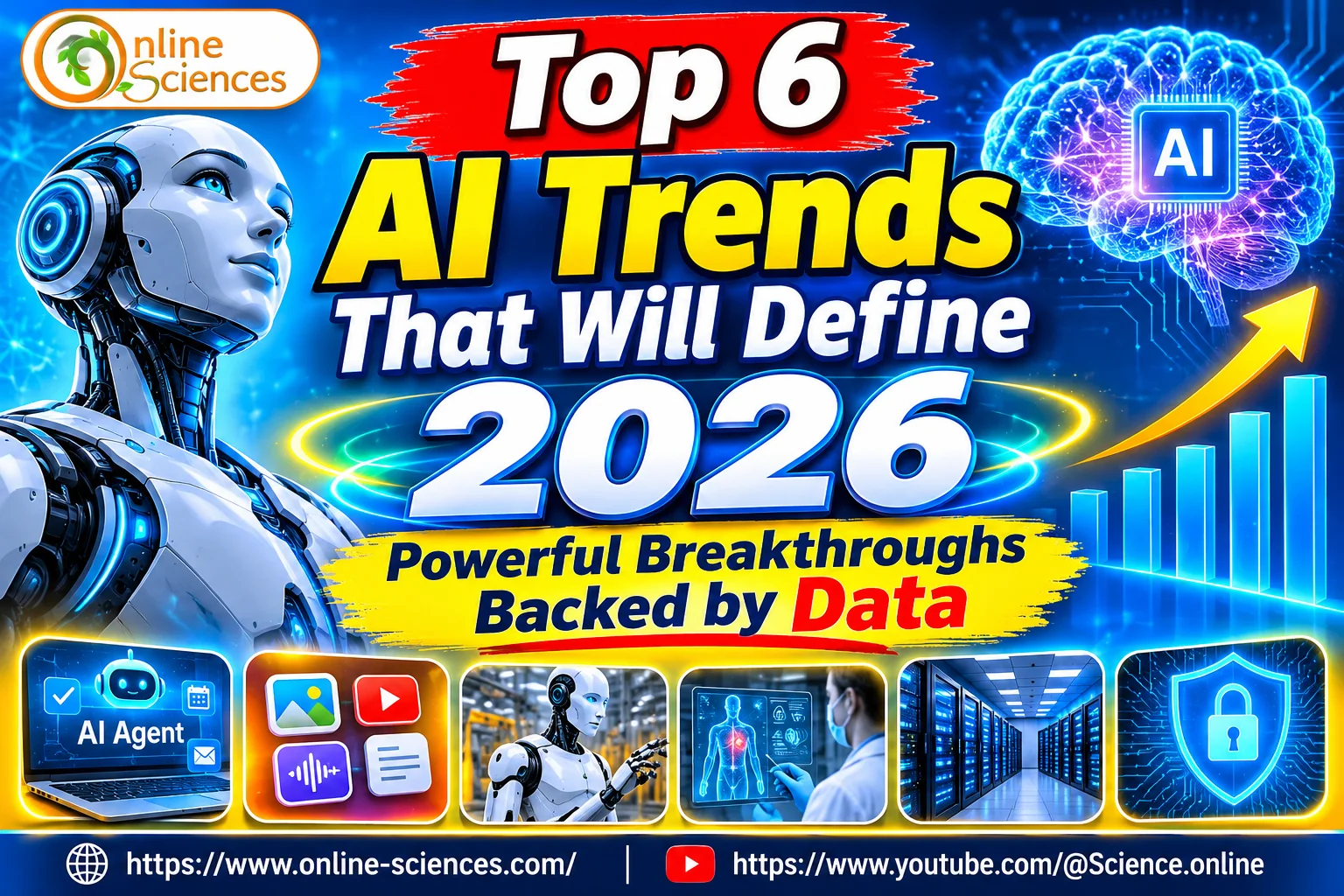
Top 6 AI Trends That Will Define 2026
Top 6 AI Trends That Will Define 2026
1. Agentic AI: Artificial Intelligence That Can Work Independently
One of the biggest AI trends in 2026 is the rise of Agentic AI, which moves beyond answering questions and generating content. AI agents can plan tasks, use digital tools, analyze information, make decisions, and complete multi-step workflows with limited human supervision.
For example, an AI agent could research a topic, organize information, prepare a report, schedule meetings, and communicate with other software systems. Multi-agent systems take this technology further by allowing several specialized AI agents to collaborate on complicated projects.
According to McKinsey’s 2025 State of AI survey, 62% of respondents said their organizations were at least experimenting with AI agents. However, widespread deployment remains an ongoing challenge. Gartner also identifies multiagent systems as a major strategic technology trend for 2026.
This means businesses are increasingly exploring AI systems that do more than generate answers: they want intelligent digital workers that can execute tasks and improve productivity.
2. Multimodal AI: Understanding Text, Images, Video, and Voice
Multimodal AI is another powerful development shaping 2026. Traditional AI systems often focused on one type of information, such as text or images. Modern multimodal models can process and combine different forms of data, including written language, photographs, audio, video, and visual information.
This technology makes AI assistants more useful because users can communicate naturally by speaking, uploading images, sharing videos, or combining several types of information in one request.
For example, users can upload a picture of a machine and ask AI to explain how it works, analyze a video, summarize a recorded meeting, or generate a video from a written description.
Multimodal AI is also transforming education, customer service, content creation, scientific research, and accessibility. As models become more capable of understanding the world through different inputs, AI will increasingly become a natural interface between humans and computers.
3. Physical AI and Humanoid Robots
In 2026, artificial intelligence is moving beyond computer screens and entering the physical world through Physical AI. This technology combines AI models, sensors, cameras, robotics, and advanced computing to help machines understand their surroundings and perform real-world actions.
Humanoid robots are among the most exciting examples. Companies are developing robots that can walk, recognize objects, pick up items, manipulate tools, and perform repetitive tasks in factories, warehouses, and potentially homes.
Physical AI can also improve autonomous vehicles, agricultural robots, delivery systems, and intelligent industrial equipment. Gartner includes Physical AI among its strategic technology trends for 2026, highlighting the growing importance of machines that can sense, decide, and act in real environments.
However, challenges remain, including battery life, manufacturing costs, safety, reliability, and the ability to handle unexpected situations. The next generation of robots will not simply follow preprogrammed instructions. They will increasingly use AI to understand changing environments and adapt their behavior.
4. AI-Powered Healthcare and Scientific Discovery
Artificial intelligence is becoming an important tool in medicine and scientific research. In 2026, AI systems are helping researchers analyze enormous datasets, identify patterns, support medical imaging, and accelerate the discovery of potential treatments.
In healthcare, AI can assist doctors in examining medical images, identifying suspicious abnormalities, organizing patient information, and supporting clinical decision-making. These applications are particularly valuable when they help medical professionals process complex information more efficiently.
AI is also transforming pharmaceutical research. Machine learning models can help scientists study proteins, predict molecular interactions, identify potential drug candidates, and prioritize laboratory experiments.
The Stanford 2026 AI Index includes dedicated coverage of AI in medicine and scientific discovery, demonstrating how these applications are becoming important areas of technological progress. Nevertheless, AI should support qualified healthcare professionals rather than replace medical judgment. Patient privacy, accuracy, clinical validation, and responsible use remain essential.
5. Smaller AI Models, Faster Computing, and AI Infrastructure
Another defining AI trend in 2026 is the development of more efficient AI models and increasingly powerful computing infrastructure.
Although large language models require enormous computing resources, smaller specialized models are becoming increasingly useful. These models can perform specific tasks with lower computational requirements, making them suitable for smartphones, laptops, industrial devices, and applications that need faster responses.
This development is closely connected to edge AI, where data is processed locally instead of always being sent to distant cloud servers. Edge AI can reduce latency, improve privacy, and support applications that need to operate without continuous internet connectivity.
Meanwhile, AI infrastructure investment is growing rapidly. According to the Stanford 2026 AI Index, global corporate AI investment reached approximately $581.7 billion in 2025, more than doubling from the previous year.
The International Energy Agency also reports that data center electricity demand increased by 17% in 2025. This highlights an important challenge: the expansion of AI requires more advanced chips, computing facilities, cooling systems, and reliable electricity supplies. Consequently, efficient models and energy-saving computing technologies will become increasingly important.
6. AI Cybersecurity, Privacy, and Responsible AI
As AI becomes more powerful, protecting digital systems and personal information becomes a major priority. AI-powered cybersecurity tools can monitor network activity, identify unusual behavior, detect suspicious transactions, and help security teams respond to potential attacks more quickly.
However, cybercriminals can also use AI to create convincing phishing messages, automate attacks, generate deceptive content, and exploit weaknesses in digital systems. Another challenge involves AI agents that can access company databases, applications, and sensitive information. Without appropriate restrictions, these systems may expose private data or perform unauthorized actions.
Gartner identifies AI security platforms and preemptive cybersecurity as important technology trends for 2026. These approaches emphasize monitoring AI applications, controlling access, protecting sensitive information, and identifying threats before they cause serious damage.
Responsible AI also requires transparency, fairness, human oversight, and reliable methods for evaluating AI-generated information. In the future, successful AI development will depend not only on making systems more intelligent but also on making them secure, trustworthy, and accountable.
Why These Six AI Trends Matter in 2026
These six developments are connected. Agentic AI makes software more autonomous, multimodal AI improves how machines understand information, and Physical AI brings intelligence into the real world. Healthcare and scientific discovery create new opportunities, while improved computing infrastructure makes advanced AI more accessible. Finally, cybersecurity and responsible AI help ensure that technological progress does not come at the expense of privacy and safety.
The biggest change is that AI is evolving from a tool that responds to instructions into technology that can understand, create, coordinate, and increasingly take action. Companies, educators, engineers, content creators, and governments that understand these changes will be better prepared for the next stage of digital transformation.
Frequently Asked Questions (FAQ)
1. What are the top 6 AI trends that will define 2026?
The six major trends are Agentic AI, Multimodal AI, Physical AI and humanoid robots, AI-powered healthcare and scientific discovery, smaller AI models and advanced computing infrastructure, and AI cybersecurity and responsible AI.
2. Why is Agentic AI important in 2026?
Agentic AI can perform complex tasks, make decisions, use software tools, and coordinate multiple operations with limited human intervention. It can improve productivity in businesses, education, and many other industries.
3. Will humanoid robots become more common in 2026?
Yes, humanoid robots are receiving increasing attention from robotics companies and researchers. They are being developed for industrial automation, logistics, research, and potentially household assistance, although large-scale adoption still faces technical and economic challenges.
4. How is AI changing healthcare in 2026?
AI is helping medical professionals analyze medical images, organize patient information, discover potential medicines, and support research. It can improve healthcare workflows, but important decisions still require professional medical judgment.
5. What is the difference between traditional AI and Agentic AI?
Traditional AI usually responds to individual instructions, while Agentic AI can plan and execute multiple connected tasks. It can use tools, gather information, evaluate results, and adjust its actions to achieve a specific goal.
6. Will AI replace human jobs in 2026?
AI will automate some repetitive tasks and change many professional roles. However, it will also create opportunities in AI development, robotics, cybersecurity, data science, and other technology fields. Learning new skills will become increasingly important.
7. Why is AI cybersecurity becoming important?
AI creates new security risks, including automated cyberattacks, sophisticated phishing, data leaks, and misuse of autonomous agents. AI-powered security tools can help organizations identify threats and protect their digital systems.
8. What is the future of artificial intelligence after 2026?
AI is expected to become more autonomous, multimodal, efficient, and integrated into everyday activities. Advances in robotics, scientific research, healthcare, and intelligent computing could reshape industries and human-machine interaction.
Explore more science and technology articles on Science Online: https://www.online-sciences.com/
Watch more technology videos on Science Online Channel: https://www.youtube.com/@Science.online
🔥 Learn Cybersecurity Fundamentals from Google Experts: 7 Shocking Skills for Beginners 🚀
Cybersecurity Today 2026: AI Threats, Ransomware, Zero Trust, Security Trends & How to Stay Safe
Gemini Takes Over: The End of Google Assistant in 2026! 🚀
Goodbye Google Assistant: Can Your Android Phone Actually Run Gemini? 🚀
Artificial Intelligence in Cybersecurity, How is AI used in cybersecurity?, Types of Cybersecurity
Computer security, cybersecurity or information technology security importance, types, pros and cons
Simple rules for emailing and How to protect yourself against spam emails
Software firewalls and hardware firewalls advantages and disadvantages
DDoS Attacks risks, How to protect your website from DDoS Attacks