Observing space and invention of Telescopes, Hubble telescope and Satellites
Who was the first scientist to make the astronomical telescope?
Galileo was the first scientist to make an astronomical telescope in 1609. It was made from lenses to collect the light in his telescope. He managed to see the mountains of the moon through his telescope.
Modern telescopes
Telescopes differ according to the type of rays that they receive, such as visual light rays, infrared rays & ultraviolet rays.
Astronomers keep their telescopes in the observatories. These observatories have dome-shaped ceilings that are opened at night to direct the telescope towards any part of the sky.
In the observatories, astronomers can work, and telescopes are kept. The observatories are located in high mountains to obtain a clear vision of space and monitor it accurately.
Hubble telescope
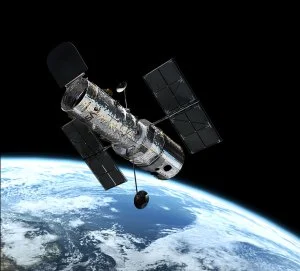
Hubble telescopes
It is the most famous space monitoring telescope that revolves around the Earth in an orbit of 593 km above the surface of the sea.
Its length is 16 meters, and it uses mirrors to collect light and electromagnetic waves. It was launched in a space shuttle in 1990 after 10 years of designing and building it.
It is expected that the Hubble telescope will expire by 2014, after 24 years of being operated; the Hubble telescope will fall to Earth in one of its oceans for its final destination.
It provided us with the best photos of Earth and space since 1990, and the new James Webb telescope will replace it.
Satellites
The Satellites study the stars and Galaxies from their location outside the Earth’s atmosphere. They are the astronomical observatories that are provided with cameras and telescopes.
Sputnik was the first satellite to be successfully launched into orbit around the Earth in 1957. Several satellites and space stations were launched into orbit around the Earth. They regularly send their photos of the Earth and the spacious universe.
FAQ about Telescopes, Hubble Telescope, and Satellites
Observing Space & The Invention of Telescopes
1. How did humans observe space before telescopes?
Before telescopes, people used their naked eyes to observe stars, planets, and constellations. Ancient civilizations like the Egyptians and Babylonians tracked celestial movements for calendars, agriculture, and navigation.
2. Who invented the first telescope?
The first practical telescope was invented in 1608 by Dutch lens maker Hans Lippershey. Soon after, Galileo Galilei improved the design in 1609 and used it to observe:
- The Moon’s craters.
- Jupiter’s moons.
- The phases of Venus.
3. What are the main types of telescopes?
- Refracting telescopes – Use lenses to bend light.
- Reflecting telescopes – Use mirrors (improved by Isaac Newton).
- Radio telescopes – Detect radio waves from space.
- Space telescopes – Operate outside Earth’s atmosphere.
4. Why are telescopes important?
Telescopes allow scientists to:
- See distant planets and galaxies.
- Study black holes and nebulae.
- Understand the origin of the universe.
The Hubble Space Telescope
5. What is the Hubble Telescope?
The Hubble Space Telescope is a space telescope launched in 1990 by NASA and ESA. It orbits Earth above the atmosphere, giving it a clear view of space.
6. Why is Hubble special?
Because it:
- Avoids atmospheric distortion.
- Captures extremely sharp images.
- Helped determine the age of the universe.
- Discovered evidence of dark energy.
7. What problems did Hubble face?
After launch, a flaw in its mirror caused blurry images. NASA astronauts repaired it during a space shuttle mission in 1993.
8. What are Hubble’s major discoveries?
- The Hubble Deep Field image.
- More accurate measurement of the universe’s expansion.
- Observations of distant galaxies and nebulae.
Satellites and Space Observation
9. What is a satellite?
A satellite is an object that orbits another object.
There are:
- Natural satellites (like the Moon).
- Artificial satellites (man-made).
10. When was the first artificial satellite launched?
The first artificial satellite was Sputnik 1, launched by the Soviet Union in 1957.
11. What are satellites used for?
Satellites help with:
- Weather forecasting.
- GPS navigation.
- Television and internet communication.
- Scientific research.
- Space observation.
12. How do satellites help astronomers?
Space satellites:
- Detect X-rays and gamma rays.
- Monitor solar activity.
- Study cosmic radiation.
- Observe distant galaxies.
13. Why do space telescopes give clearer images than ground telescopes?
Because they are above Earth’s atmosphere, which distorts light.
14. What is the future of space observation?
Modern telescopes like the James Webb Space Telescope observe infrared light and look deeper into space than ever before.
15. Why is observing space important?
It helps us:
- Understand our origin.
- Study climate and Earth changes.
- Search for life on other planets.
- Improve scientific and technological development.
You can follow science online on YouTube from this link: Science online
The reflecting telescopes and their advantages and disadvantages
What are the advantages and disadvantages of Refracting Telescopes?