The solar system and milky way galaxy, How many planets are in the Solar System?
The galaxy that our solar system belongs to is known as “The Way of Chopped Hay galaxy” or “The Milky Way galaxy.” It takes an oval shape with coiled spiral arms extending from it, and the Sun lies on one of these spiral arms. The solar system consists of the Sun, the Planets, the Moons, the Asteroids, the Meteors, the Meteorites and the Comets.
The solar system
The Sun is the star of our solar system. It is the biggest body in the solar system. It lies in the center of the solar system, and the other bodies of the solar system revolve around it.
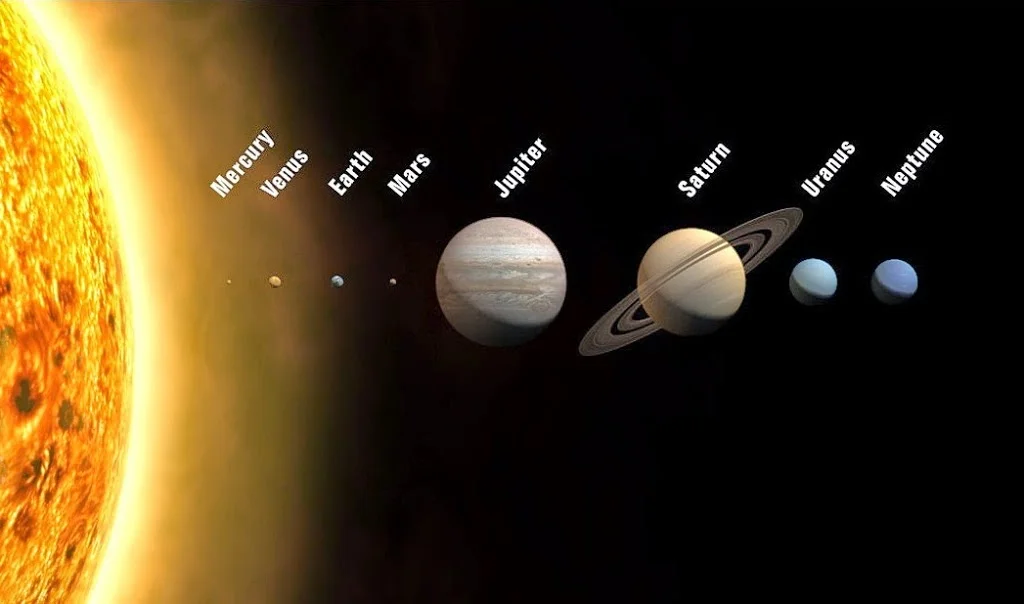
Jupiter is the biggest planet in the solar system, while Mercury is the smallest one. Mercury is the nearest planet to the Sun, while Neptune is the farthest one from the Sun.
The planets are eight spherical opaque bodies that revolve around the Sun in one direction (counterclockwise), They are arranged according to the distances from the Sun as follows: Mercury, Venus, Earth, Mars, Jupiter, Saturn, Uranus, Neptune. They revolve around the Sun in semi-circular or elliptical (oval) orbits. The orbits of the planets lie in one plane perpendicular to the Sun’s axis of rotation around itself.
Solar system
Mercury and Venus have no Moons revolving around them. Earth has one moon. Mars has two moons. Jupiter has 62 moons. Saturn has 60 moons. Uranus has 27 moons. Neptune has 12 moons.
The Moons which are the small planets (the satellites) that are affected by the gravity of the larger planets and rotate around them.
The Asteroids are the celestial bodies that rotate around the Sun in the region of “the belt of the wanderer asteroids,” which lies between the orbits of Mars and Jupiter. The belt of the wanderer asteroids separates the group of the inner planets from the group of the outer planets.
When the small rocky masses fall within the atmosphere of the Earth, these masses could burn up completely as a result of the heat produced from their friction with the air. leading to the formation of luminous arrows in the sky. These objects are called ” Meteors”.
The Meteors are luminous arrows that can be seen in the sky due to the complete burning of small rocky masses in the Earth’s atmosphere. Meteors can be seen with the naked eye on clear nights.
The Meteorites are the remaining part of the rocky masses without burning that fall on the surface of the Earth. The biggest meteorites till now have a mass of 80 tons and exist in the southwest of Africa.
The comet consists of two parts, which are: The head, which contains icy spheres that are a mixture of solidified gases, rocky parts, dust, and water molecules. The Tail which is considered a gaseous cloud.
Comets, which are masses of rocks, ice, and solidified gases that revolve around the Sun in more elongated elliptical orbits intersecting with the orbits of the planets.
FAQ About the Solar System and the Milky Way Galaxy
1. What is the Solar System?
The Solar System is a group of planets, moons, asteroids, comets, and other objects that orbit the Sun.
2. How many planets are in the Solar System?
There are 8 planets: Mercury, Venus, Earth, Mars, Jupiter, Saturn, Uranus, and Neptune.
3. What is at the center of the Solar System?
The Sun is at the center. It contains about 99.8% of the system’s total mass.
4. What are the inner and outer planets?
- Inner planets (rocky): Mercury, Venus, Earth, Mars
- Outer planets (gas/ice giants): Jupiter, Saturn, Uranus, Neptune
5. What is the asteroid belt?
It is a region between Mars and Jupiter filled with rocky objects called asteroids.
6. What is the largest planet?
Jupiter is the largest planet in the Solar System.
7. How old is the Solar System?
It is about 4.6 billion years old.
8. Does everything orbit the Sun?
Yes. All planets and most objects in the Solar System orbit the Sun due to gravity.
9. What is the Milky Way Galaxy?
The Milky Way is the galaxy that contains our Solar System. It is a massive collection of stars, gas, dust, and dark matter.
10. What type of galaxy is the Milky Way?
It is a spiral galaxy with curved arms.
11. How many stars are in the Milky Way?
Scientists estimate it contains 100–400 billion stars.
12. Where is our Solar System located in the Milky Way?
It is located in one of the spiral arms called the Orion Arm, far from the galaxy’s center.
13. What is at the center of the Milky Way?
A supermassive black hole called Sagittarius A* is at the center.
14. How big is the Milky Way?
It is about 100,000 light-years wide.
15. Does the Solar System move inside the galaxy?
Yes. The Solar System orbits the center of the Milky Way and takes about 225–250 million years to complete one orbit.
Key Difference
- The Solar System is a small system centered around the Sun.
- The Milky Way is a huge galaxy containing billions of solar systems, including ours.
You can subscribe to Science Online on YouTube from this link: Science Online
Universe, Galaxies, Milky Way galaxy, Solar System, Origin of Universe & Stages of Big Bang
Nebular theory, Crossing star theory, Modern theory, Solar telescope & Hubble telescope