Cyberone robot features, advantages, disadvantages, What can CyberOne do?
CyberOne robot is Xiaomi’s humanoid robot prototype that can walk, perceive its surroundings, recognize human emotions and sounds, and interact empathetically with people, serving as a platform for research and future smart robotics applications.
CyberOne robot
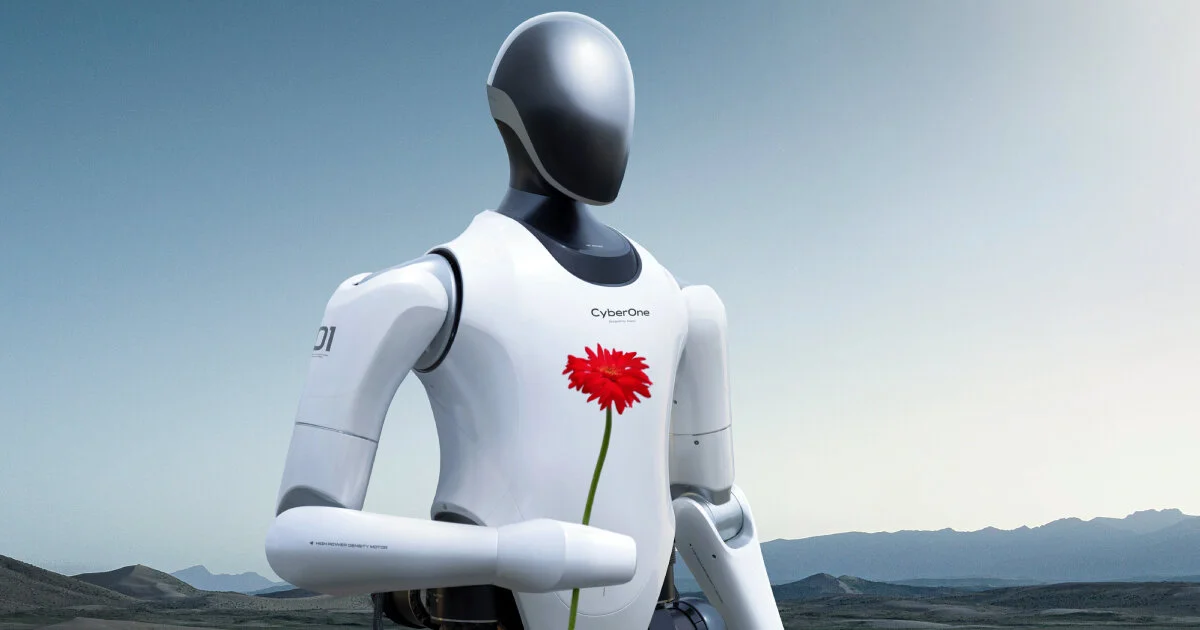
The CyberOne robot is a full-sized humanoid robot developed by Xiaomi Robotics Lab, first unveiled in August 2022. It is designed to mimic human movement and interaction by combining mechanical agility, advanced perception, and emotional AI. Standing 177 cm tall and weighing 52 kg, CyberOne features 21 degrees of freedom, allowing it to walk, gesture, and interact in a human-like way.
Its Mi-Sense depth vision system provides 3D environmental awareness, while its MiAI engines enable recognition of faces, gestures, sounds, and human emotions. A curved OLED display “face” allows it to express status and communicate visually.
Cyberone robot
CyberOne is a full-size humanoid robot by Xiaomi that blends mechanical innovation with emotionally intelligent AI:
- Agile physical design: 21 joints, swift actuation, strong torque, and a human-like form.
- Perception-rich tech: 3D vision, sound, and emotion recognition, and dynamic display feedback.
- Emotionally aware and interactive: The CyberOne robot is designed to perceive human mood and respond empathetically.
- Broad future potential: Conceptualized as a research platform with real-world companion and support capabilities.
What can the Cyberone robot do?
The CyberOne robot, developed by Xiaomi Robotics Lab, is designed as a full-size humanoid that blends mobility, perception, and emotional AI. While it is still a prototype and not commercially available:
- Move Like a Human: CyberOne robot walks upright on two legs with a stable bipedal gait. It balances itself while walking at around 3.6 km/h and can run up to 7.2 km/h. It moves arms and hands with 21 degrees of freedom, enabling gestures and basic object interaction. It lifts and manipulates objects weighing up to 1.5 kg per hand.
- 2. See and Understand the Environment: The CyberOne robot uses the Mi-Sense depth vision module for 3D mapping of surroundings. It recognizes faces, gestures, and body postures. It detects obstacles and navigates around them.
- Hear, Recognize, and Respond: The CyberOne robot is equipped with a MiAI vocal emotion identification engine that can recognize 45 different human emotions (e.g., happiness, sadness, anger) and identify 85 types of environmental sounds (like clapping, breaking glass, or alarms). It responds interactively through voice and expressions.
- Express and Communicate: The CyberOne robot has a curved OLED face display that shows icons, moods, or real-time expressions. It communicates with people using voice, gestures, and facial cues. It can perform demo interactions, like detecting sadness and offering comfort.
- Act as a Research & Development Platform: CyberOne robot is designed to test and improve AI-driven human–robot interaction. It serves as a platform for future use in companionship, education, industrial assistance, or smart ecosystems. It is fully developed in-house by Xiaomi, showcasing their robotics and AI ecosystem.
CyberOne can walk, balance, perceive its environment in 3D, recognize sounds and emotions, and interact with people empathetically. But: Its movements are still relatively slow and scripted, and it’s more of a research and marketing prototype than a practical assistant right now.
Cyberone robot features
CyberOne is Xiaomi’s humanoid robot. It is built to combine agility, perception, and emotional interaction; it embodies Xiaomi’s ambitions in robotics.
1. Formidable Mechanics & Mobility:
- Dimensions: Stands 177 cm tall, weighs 52 kg, and has an arm span of 168 cm.
- Degrees of Freedom: CyberOne robot offers 21 DoF (including arm, leg, neck, and gripper movements) for lifelike human articulation with a rapid 0.5 ms response per joint.
- Motors & Torque: Upper limb motors weigh 500 g and generate 30 Nm of torque; hip joints can spike up to 300 Nm, enabling stable bipedal walking and even running.
- Payload Capacity: Each hand can hold or manipulate up to 1.5 kg.
2. Advanced Sensory Perception & AI:
- Vision System: CyberOne robot is equipped with the in-house Mi-Sense depth vision module plus gesture and facial expression recognition algorithms for 3D spatial understanding.
- Auditory & Emotional Awareness: MiAI vocal emotion identification engine: CyberOne robot recognizes 45 types of human emotions. MiAI environment semantics recognition engine: CyberOne robot can discern 85 types of environmental sounds. Demo includes behavior like detecting happiness and offering comfort to someone feeling sad.
- Interactive Display: CyberOne robot features a curved OLED module that communicates real-time status and expressions.
3. Control & Architecture:
CyberOne robot is fully developed in-house by Xiaomi Robotics Lab, from hardware to algorithms, including the humanoid bipedal control algorithm. CyberOne robot is designed to produce a natural, stable bipedal posture during walking and object handling.
4. Intended Use Cases:
- Human–Robot Interaction: Emotional engagement through gesture and voice—acting as a companion or assistant.
- Emotional Support: CyberOne robot can detect and respond empathetically—comforting users, for instance.
- Industrial & R&D Platform: CyberOne robot is equipped for future applications spanning manufacturing, logistics, education, and personal robotics.
Cyberone robot advantages
1. Advanced Mechanical Design & Control:
- With 21 degrees of freedom, CyberOne enables expressive and human-like movements. Each joint boasts a 0.5 ms response time for fluid articulation.
- It features lightweight, high-torque actuators: 500 g motors delivering 30 Nm in the arms, and hip joints peaking at 300 Nm, enabling stable locomotion and dynamic movement.
- Its bipedal locomotion allows walking at up to 3.6 km/h, with a running mode reaching 7.2 km/h, demonstrating impressive mobility for a prototype.
2. Rich Sensing & AI Capabilities:
- CyberOne robot is equipped with the Mi-Sense depth vision module, it can perceive 3D environments, recognize humans, objects, gestures, and expressions.
- CyberOne’s AI stacks include: MiAI vocal emotion engine: Recognizes 45 human emotions. MiAI environment semantics engine: Detects 85 types of environmental sounds. A curved OLED display serves as an expressive “face” for real-time feedback.
- These capabilities enable empathetic interaction—such as recognizing sadness and offering comfort.
3. Holistic R&D Platform:
- CyberOne is a fully in-house creation by Xiaomi Robotics Lab—from hardware to software, including the control algorithms.
- CyberOne is positioned as a symbol of Xiaomi’s technological ambition; it serves more as a research and ecosystem-building platform than a consumer product.
4. Human-Like Proportions & Expressiveness:
- Its humanoid form (177 cm tall, ~52 kg, 168 cm arm span) enhances intuitive presence and relatability.
- The expressive OLED face and responsive gestures help it connect more naturally with people.
Disadvantages of the CyberOne robot
- Prototype-Level Limitations: CyberOne robot observers note stiff, slow, and scripted movements; the robot looks less advanced than existing benchmarks like Boston Dynamics’ models. Community feedback includes remarks such as: “It looks like 30-year-old tech compared to things like Boston Dynamics…”. “Shitty unoptimized walking gait, pre-programmed motion…”.
- High Cost & Uncertain Commercial Availability: At around 600,000–700,000 RMB (~USD $89,000–105,000), CyberOne is extremely expensive and currently unavailable for sale. The lack of a specified battery life or release timeline limits its practical appeal.
- Limited Practical Use Cases: Experts view CyberOne more as a marketing and research showcase than a functional assistant or industrial robot. Its deep integration with Xiaomi’s ecosystem may limit adaptability in environments using different tech stacks.
- Unresolved Ethical Concerns: The robot’s emotion recognition relies on AI systems that many consider unscientific or ethically questionable, as similar technologies have been discontinued by major tech firms.
You can follow Science Online on YouTube from this link: Science online
Sophia robot review, features, use, advantages and disadvantages
Robot teachers use, types, advantages and disadvantages
Advantages and disadvantages of using robots in our life
Automation in manufacturing use, advantages and disadvantages
Humanoid robots use, types, risks, advantages and disadvantages
Pepper robot review, features, and What can Pepper do for your business?
Boston Dynamics Atlas review, advantages and features, How does Atlas robot work?