FEDOR robot features, advantages and disadvantages, What can FEDOR Robot do?
The FEDOR robot (Final Experimental Demonstration Object Research), also known as Skybot F-850, is a Russian humanoid robot developed for space missions, rescue operations, and hazardous environments.
What is FEDOR?
FEDOR is a humanoid robot that is approximately 1.80 m tall (~5′11″), weighing approximately 106 kg (~160 kg in some later sources), with 48 brushless high-torque motors and sensors, enabling tasks under operator control or semi-autonomous mode. It can operate up to ~1 hour per task cycle.
First Russian humanoid in space: On 22 August 2019, FEDOR launched aboard Soyuz MS‑14 from Baikonur Cosmodrome and docked with the ISS a few days later. It remained on board for around 10 days, performing experiments and manual tasks such as plugging cables, using tools, and testing dexterity in microgravity.
During the flight, it performed tasks such as connecting electrical cables, opening bottles, and responding with the phrase “Let’s go, let’s go” — echoing Yuri Gagarin.
FEDOR Robot
Dexterity tests: FEDOR demonstrated surprising motor skills: it performed both front-to-back and side splits, wielded pistols in both hands (a controlled demonstration of coordination—not weaponization), and operated drills, vehicles, and everyday tools.
FEDOR can mimic human operator movements via “avatar mode,” using a control suit that translates user motion into robot action—ideal for remote or hazardous environments.
FEDOR is equipped with cameras, lasers, thermographic sensors, microphones, GNSS, and inertial sensors; it’s capable of environment-mapping and modest autonomous decision-making.
FEDOR has proven the feasibility of a humanoid form factor for tasks in human-centric environments—particularly in space and rescue operations designed for anthropomorphic interaction. From fine motor coordination (doing splits, shooting dual pistols) to real-time remote control and semi-autonomy, FEDOR balanced advanced robotics with accessible interaction models.
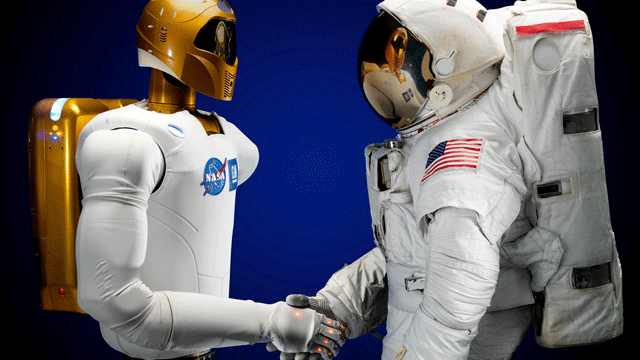
Unlike NASA’s Robonaut 2 (sent to ISS in 2011) and Japan’s conversational robot Kirobo, FEDOR focused on physical tasks and space operation support rather than social interaction. FEDOR is a humanoid capable, and flown to space. Its mission demonstrated that robots can assist humans in complex environments, but limitations prevented it from replacing astronauts on extravehicular missions.
What can FEDOR Robot do?
- FEDOR mimics human motion with high precision. It can walk, balance, squat, and do splits for flexibility testing. It uses 48 joints powered by electric motors for realistic movement.
- Remote Operation (Avatar Mode): FEDOR is controlled by a human wearing a special exoskeleton suit. It moves in real time to mimic the human operator’s gestures and actions. It is ideal for tasks in dangerous or inaccessible places (e.g., fires, radiation zones).
- FEDOR operates electric drills, hammers, fire extinguishers, and other hand tools. It can drive vehicles, open doors, connect cables, and manipulate switches or levers. Demonstrated shooting pistols with both hands in a test (to show coordination, not as a combat feature).
- In 2019, FEDOR was sent to the International Space Station (ISS) aboard Soyuz MS-14. Conducted tasks in microgravity like: plugging/unplugging cables, operating control panels, handling tools in zero-G, and helped test humanoid interaction with ISS systems.
- FEDOR is equipped with: Cameras (including stereo vision), Motion sensors, Microphones, Gyroscopes, and accelerometers. It uses these to detect obstacles and monitor the environmental status.
- FEDOR can perform simple tasks autonomously, like gripping or walking. Most complex actions (like vehicle driving or space tasks) require human control. Focus is on telepresence and task execution, not general decision-making.
- FEDOR has: Driven a car on rough terrain. Connected wiring and mechanical systems. Used rescue tools like hydraulic cutters. Shown advanced coordination (e.g., dual-hand tasks). Operated in both terrestrial and space environments.
FEDOR robot advantages
FEDOR (Final Experimental Demonstration Object Research) humanoid robot: can perform complex tasks such as driving, using tools, connecting cables, and opening doors. It is useful in environments designed for humans (like the ISS or disaster zones).
Operators can control FEDOR using a special suit that mirrors their movements, allowing for safe operation in hazardous or unreachable environments. FEDOR is built to function in low-gravity environments. FEDOR humanoid robots can assist astronauts in space.
FEDOR is equipped with cameras, motion sensors, and gyroscopes, and it can perceive and react to its environment with a degree of autonomy. FEDOR is capable of lifting weights, doing splits, and precise movement coordination, making it versatile for both rescue and industrial tasks.
FEDOR is designed to be adaptable to different cases: space missions, emergency response, and possibly military or engineering support.
Disadvantages of FEDOR Robot
FEDOR mostly relies on teleoperation; its AI was not advanced enough for fully independent decision-making in dynamic environments. Battery life allows only around 1 hour of active work, limiting its use in long-duration missions or emergencies without recharge support.
At over 100 kg and nearly 6 feet tall, it is not easily portable, especially in confined spaces or during transport. Advanced robotics with human-like precision requires substantial investment for development, testing, and deployment. It is large and heavy; it is not ideal for cramped or lightweight operations.
Despite its success in demonstrations, it hasn’t seen wide operational use beyond experimental missions like the ISS test. After its space flight, further development of FEDOR for lunar or other missions was reportedly paused or canceled, limiting its long-term impact. It is not fully autonomous; it relies on remote human operators for most tasks.
You can follow Science Online on YouTube from this link: Science online
Sophia robot review, features, use, advantages and disadvantages
Robot teachers use, types, advantages and disadvantages
Advantages and disadvantages of using robots in our life
Automation in manufacturing use, advantages and disadvantages
Humanoid robots use, types, risks, advantages and disadvantages
Pepper robot review, features and What can Pepper do for your business?
Boston Dynamics Atlas review, advantages and features, How does Atlas robot work?