Meet Microduck, the Powerful $399 Tiny Robot You Can Teach New Tricks
Meet Microduck, a tiny open-source robot from Pollen Robotics and Hugging Face that puts robot learning into a surprisingly small package. Standing about 25 cm tall, Microduck can walk, grab objects, recover after falling, and even roller-skate. More importantly, it is designed to let users train and program new behaviors, making it much more than a cute robotic companion.
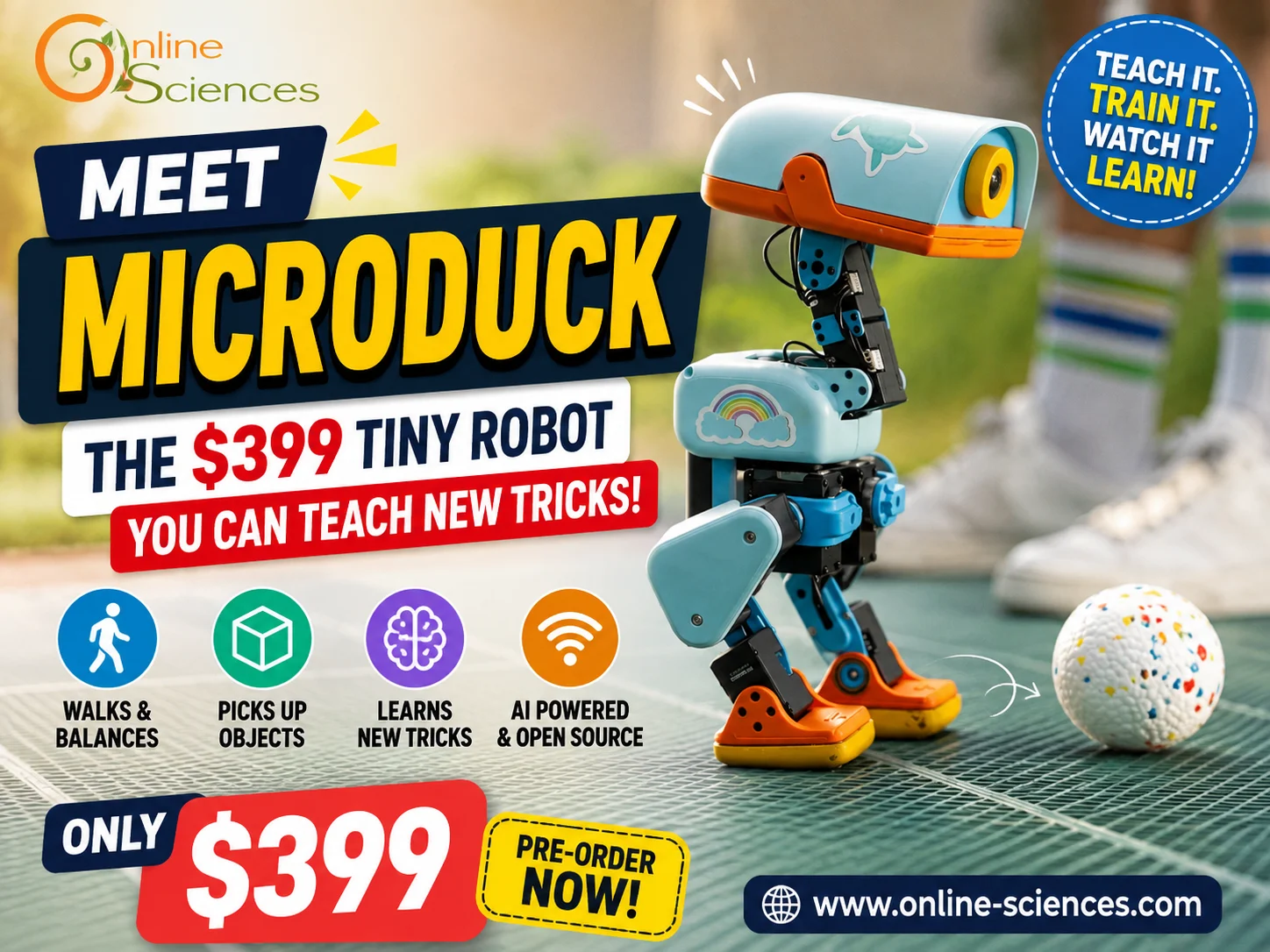
Meet Microduck, the $399 Tiny Robot
What is Microduck?
Microduck is a small, duck-shaped bipedal robot developed by Pollen Robotics, the robotics company acquired by Hugging Face. It was unveiled in August 2026 as an affordable platform intended to make physical AI and robot learning more accessible to developers, students, researchers, and robotics enthusiasts.
The robot stands approximately 25 cm (10 inches) tall and weighs around 800 grams. Instead of traditional arms and hands, it uses an articulated beak-like mechanism that can act as a gripper for picking up small objects.
Its unusual duck design is not simply about appearance. Microduck was created as a practical platform for experimenting with robot behavior, reinforcement learning, simulation, and physical AI.
Microduck Price: How Much Does It Cost?
One of the biggest surprises is the price. Microduck is available for pre-order at an introductory price of $399, before taxes and shipping. Pollen Robotics says the first deliveries are targeted for before Christmas 2026 in North America, Europe, and the UK.
The robot is offered in four colors:
- Cream.
- Graphite.
- Lavender.
- Sky.
The $399 package includes the robot, battery, USB-C cable, and a game controller. Additional accessories are available separately.
Optional Microduck Accessories
Pollen Robotics also lists several accessory packs:
- Charger Pack – $39: Includes a dual charger and two additional batteries.
- Developer Pack – $119: Includes spare motors, motor cables, batteries, a charger, NFC tags, a screwdriver, and replacement screws.
- Accessory Pack – $39: Includes a laser pointer, NFC items, roller attachments, a ball, and additional NFC tags.
What Can Microduck Do?
Despite its tiny size, Microduck is designed to perform a surprisingly wide range of movements. The company says it ships with seven trained movements, so users can start experimenting immediately. These behaviors include walking, sitting, kicking, grabbing, roller-skating, and recovering after a fall.
Microduck can also:
- Walk and waddle.
- Pick up small objects.
- Kick a ball.
- Recover after falling.
- Follow a laser pointer.
- Respond to its environment.
- Move using roller attachments.
- Be controlled with a game controller.
- Learn and run newly trained behaviors.
This combination makes Microduck feel more like a programmable robotic pet and research platform than a conventional toy.
The Most Exciting Feature: You Can Teach Microduck New Tricks
The biggest reason Microduck has attracted attention is not its appearance. It is the fact that users can train it to perform new behaviors.
Microduck uses reinforcement learning, a machine-learning approach in which an agent learns through repeated attempts and feedback. Instead of manually programming every movement, developers can train a robotic policy in simulation and then transfer the resulting behavior to the physical robot.
Pollen Robotics provides an SDK, simulation environment, and reinforcement-learning training stack as part of its open development approach. This could allow users to experiment with questions such as:
- Can I teach Microduck to dance?
- Can it learn a new way to kick a ball?
- Can I create a custom walking style?
- Can I train it to perform a completely new movement?
These are exactly the kinds of experiments Microduck is designed to encourage.
How Does Microduck Learn?
The basic idea involves simulation and reinforcement learning. Instead of making a small robot repeatedly fail in the real world while learning a new skill, developers can first create and train behaviors in a simulated environment. The trained policy can then be transferred to the physical Microduck.
Pollen Robotics says its simulation and reinforcement-learning tools are available openly, allowing developers to inspect, modify, and retrain the software. This is an important part of Microduck‘s concept because it lowers the barrier for people who want to understand how AI can control a physical machine.
Microduck Specifications
Microduck combines a compact mechanical design with several sensors and onboard electronics.
- Height: 25 cm.
- Weight: About 800 g.
- Price: $399 introductory price.
- Motors: 15.
- Camera: Yes.
- LiDAR: Yes.
- IMUs: 2.
- NFC: Yes.
- Wi-Fi: Yes.
- Bluetooth: Yes.
- Pre-trained behaviors: 7.
- Pickup capability: Up to 800 g.
- Battery operation: About 1 hour.
- Software: Open-source SDK and RL stack.
Pollen Robotics lists 15 motors, a camera, LiDAR, two IMUs, and the ability to pick up objects up to 800 grams. Other reports also describe microphones, speakers, Wi-Fi, Bluetooth, and NFC connectivity.
Why Does Microduck Have LiDAR?
LiDAR gives Microduck another way to perceive its surroundings. While its camera can provide visual information, LiDAR can help the robot understand distances and detect obstacles. Combined with its motion sensors, this helps Microduck navigate and maintain its balance.
That is particularly important for a small two-legged robot. Walking robots constantly need to estimate their movement and adjust their position to avoid falling.
Microduck Can Even Roller-Skate
One of the most entertaining features is the robot‘s ability to use roller attachments. The accessory pack includes two rollers, allowing Microduck to demonstrate a different type of movement. Videos and demonstrations have shown the little robot moving around on its rollers, adding another example of how its hardware can be combined with learned behaviors.
It is a fun feature, but it also demonstrates an important robotics principle: the same robot can potentially use different hardware configurations to develop new behaviors.
Is Microduck an AI Robot?
Yes, but it is important to understand what that means. Microduck is primarily an embodied AI and robotics platform rather than a general-purpose conversational assistant.
Its intelligence is focused on physical behavior—how the robot moves, balances, reacts, and performs learned actions. That makes it particularly interesting for people who want to explore physical AI, reinforcement learning, robot control, and simulation-to-real-world training.
Is Microduck Open Source?
Microduck is built around an open software philosophy. Pollen Robotics says its SDK, simulation environment, and full reinforcement-learning training stack are available openly, allowing developers to inspect the code, modify it, and train new behaviors.
This is potentially one of Microduck‘s biggest advantages. Instead of buying a robot that can only perform the functions provided by its manufacturer, developers can experiment with the underlying software and create their own behaviors.
Who is Microduck For?
Microduck could appeal to several different groups.
- Robotics Students: Students can use it to explore robot movement, sensors, reinforcement learning, and control systems without needing a large industrial robot.
- AI Developers: AI developers can experiment with taking machine-learning models from simulation into a physical machine.
- Robotics Researchers: Researchers can use the platform to explore locomotion, robot learning, simulation, and physical AI.
- Makers and Hobbyists: The relatively low price makes Microduck particularly interesting for hobbyists who want a programmable robot they can modify and experiment with.
- Families and Curious Users: Its friendly design could also make robotics more approachable for people who simply want an interactive robot at home.
However, Microduck should not be viewed as a household humanoid capable of performing complex chores. Its small size and specialized design make it much better suited to education, experimentation, entertainment, and robotics development.
Microduck vs Traditional Robot Toys
Traditional robot toys generally arrive with a fixed set of behaviors. You may control them, activate different modes, or interact with them, but the underlying behavior is often closed.
Microduck takes a different approach. Its major selling point is that the owner can become part of the development process.
Instead of simply asking: “What can this robot do?”
Microduck encourages another question: “What can I teach this robot to do?”
That distinction could make it particularly attractive to people interested in the future of AI robotics.
Why Microduck Is Important
The most interesting thing about Microduck may not be the robot itself. It is the idea behind it. For years, advanced robotics has largely been restricted to universities, research laboratories, major technology companies, and well-funded startups. Expensive hardware and complicated software have made experimentation difficult for ordinary developers.
A $399 robot that provides access to reinforcement-learning tools could help bring some of that experimentation to a much wider audience. Microduck therefore represents an interesting step toward more accessible physical AI.
What are the Limitations?
Microduck is exciting, but it is important not to confuse it with a fully autonomous humanoid robot. Its small size limits what it can physically accomplish. It cannot carry out major household chores, manipulate large objects, or replace a human worker.
Training new behaviors may also require technical knowledge. Although the software is designed to be accessible, reinforcement learning, simulation, robotics control, and deployment still involve a learning curve. The robot is best understood as an experimental AI robot platform, rather than a futuristic home assistant.
Final Verdict: Is the $399 Microduck Worth It?
Microduck is one of the most unusual affordable robots to appear in 2026. For $399, buyers get a tiny two-legged robot with multiple sensors, 15 motors, a camera, LiDAR, a gripper-like beak, a game controller, and access to an open software ecosystem. More importantly, Microduck is designed to be trained and reprogrammed, allowing users to create new robotic behaviors.
If you are looking for a powerful household robot, Microduck is probably not the right choice. But if you are interested in AI, robotics, programming, reinforcement learning, or educational technology, this tiny duck could be an exceptionally interesting platform. At $399, Microduck‘s real appeal is simple: you don’t just buy a robot—you get the opportunity to teach one.
Microduck FAQ
What is Microduck?
Microduck is a 25-cm open-source bipedal robot developed by Pollen Robotics and Hugging Face. It is designed for robotics experimentation and can be trained to perform new behaviors.
How much does Microduck cost?
The introductory pre-order price is $399 before taxes and shipping.
When will Microduck ship?
Pollen Robotics is targeting first deliveries before Christmas 2026.
Can Microduck learn new tricks?
Yes. Its open software ecosystem allows users to train and retrain behaviors using reinforcement learning.
Can Microduck pick up objects?
Yes. Its articulated beak functions as a gripper, and the manufacturer lists a pickup capacity of up to 800 grams.
Can Microduck walk?
Yes. Walking is one of its pre-trained behaviors.
Can Microduck roller-skate?
Yes. Roller attachments are available as part of the optional accessory pack.
Does Microduck have a camera?
Yes. It includes a camera along with LiDAR and two IMUs.
Is Microduck suitable for children?
It can be an interesting educational platform, but because it is a programmable robotics system rather than simply a toy, younger children may need adult supervision and help with programming.
Is Microduck a humanoid robot?
No. It is a tiny duck-shaped bipedal robot with two legs and a beak-like gripper rather than a human-shaped body.
You can follow Science Online on YouTube at this link: Science Online
🔥 Meet Microduck: The Powerful $399 Tiny Robot You Can Teach New Tricks 🚀
Gemini Takes Over: The End of Google Assistant in 2026! 🚀
Goodbye Google Assistant: Can Your Android Phone Actually Run Gemini? 🚀
Loona robot review, advantages, disadvantages and what can Loona do?
Sophia robot review, features, use, advantages and disadvantages
Educational robotics, Robot teachers, Social robots review, features advantages and drawbacks
Humanoid robots use, risks, advantages, and disadvantages