Pophie Robot 2026: The AI Companion That Can See, Talk, Remember & Feel Alive
Pophie robot is a new type of AI companion designed to make artificial intelligence feel more natural, emotional, and present in the physical world. Developed by InsBotics Technology Pte. Ltd., Pophie combines artificial intelligence, cameras, microphones, touch sensors, expressive eyes, body movement, memory, and voice interaction to behave more like a companion than a traditional chatbot or smart speaker.
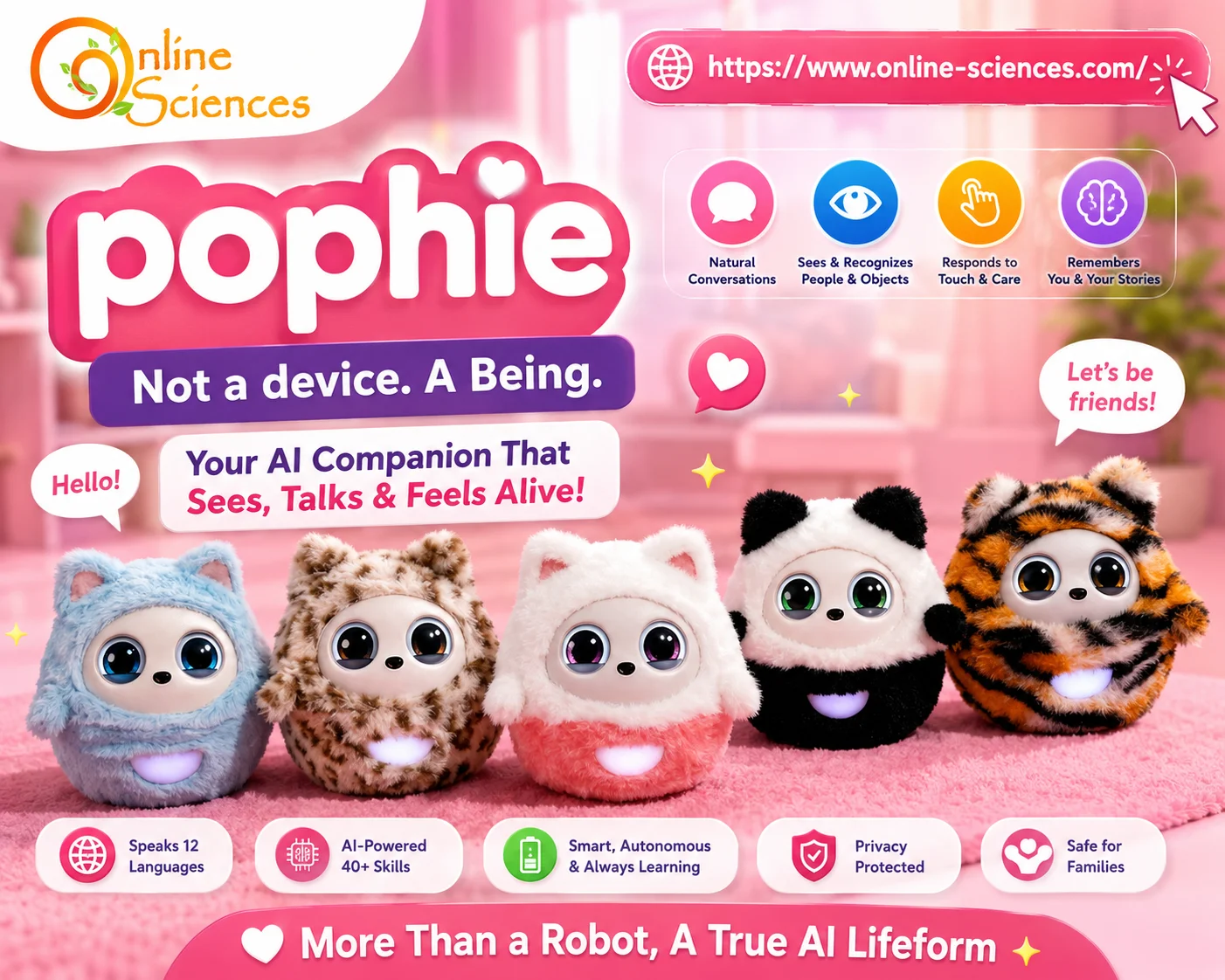
Pophie Robot
What is Pophie Robot?
Pophie is an AI companion lifeform developed by InsBotics. It has a soft plush exterior rather than the hard plastic or metallic appearance associated with many conventional robots.
The company describes Pophie as an AI Lifeform rather than simply a chatbot or toy. Its goal is to combine perception, artificial intelligence, memory, emotion, and physical expression into one interactive system.
Unlike conventional AI assistants that mainly respond through a screen or speaker, Pophie is designed to see, hear, remember, react, move, and express emotions through its body and eyes. This makes it an interesting example of how AI companions and social robots could evolve in 2026.
Pophie can interact with people using:
- Voice conversations.
- Vision and environmental awareness.
- Touch sensing.
- Facial and gaze-like expressions through its eyes.
- Body movements.
- Sounds.
- Memory of people and conversations.
- Autonomous reactions.
- AI-powered skills.
This combination is intended to make interaction feel less like giving commands to a machine and more like communicating with a physical companion.
Who Developed Pophie?
Pophie was developed by InsBotics Technology Pte. Ltd., a robotics and AI company headquartered in Singapore, with an R&D center in Beijing, China. The company’s CEO is listed as Tang Qi. Pophie’s development reflects a growing trend toward embodied AI—artificial intelligence that does not exist only inside software but can perceive and respond to the physical world through a body.
How Does Pophie Work?
Pophie‘s operation combines several technologies that work together.
- Vision: Pophie uses a super-wide-angle camera and can rotate its body to achieve a 360-degree view of its surroundings. This allows it to recognize people, objects, and situations around it. The company’s technology platform also emphasizes face tracking and gaze interaction, allowing Pophie to look toward people and respond to what is happening around her.
- Voice Recognition: Pophie has a dual-microphone array with voice-direction sensing. This helps the robot determine where a sound or speaker is coming from and respond more naturally. It supports 12 languages, including English, Mandarin, German, French, Italian, Spanish, Portuguese, Dutch, Polish, Arabic, Japanese, and Korean.
- Touch Interaction: Pophie includes eight touch sensors, allowing her to respond when users pet, tap, or pick her up. Her reactions can include sounds, expressions, and changes in body posture. This is important because physical touch gives an AI companion another communication channel beyond voice and text.
- Movement and Expressive Motion: Pophie uses five degrees of freedom (5-DOF) for expressive movement. Her body can rotate through 360 degrees, while her eyes and body coordinate their movements to create more lifelike reactions. The goal is not simply to make the robot move mechanically. Instead, movements are designed to communicate attention, mood, curiosity, surprise, and other behavioral cues.
- Artificial Intelligence and Memory: Pophie uses AI to understand conversations and context. Depending on the service plan, she can remember names, preferences, stories, and previous interactions. This memory capability is one of the features that differentiates an AI companion from a conventional voice assistant.
What Can Pophie Robot Do?
Pophie has a wide range of interactive capabilities. According to the company’s information, Pophie can:
- Hold natural voice conversations.
- Recognize people.
- Recognize everyday objects.
- Remember names and preferences.
- Respond to touch.
- Tell stories.
- Sing songs.
- Read picture books.
- Express different moods.
- Follow people with her gaze.
- React to sounds.
- Take photos.
- Provide reminders.
- Perform various AI-powered skills.
- Interact in multiple languages.
The company says Pophie has more than 40 skills, covering functions such as reminders, stories, music, and other activities.
Pophie Robot and Emotional Interaction
One of Pophie‘s most interesting characteristics is its attempt to create emotional and behavioral interaction. For example, Pophie can make eye contact, turn toward a person, react to touch, move her body, and use sounds and visual expressions. The company says her system combines perception, cognition, emotion, memory, and expression rather than relying only on predefined robotic movements.
This does not mean Pophie has human emotions or consciousness. Rather, its AI system is designed to simulate emotionally appropriate behavior to make interactions feel more natural.
Pophie vs Traditional AI Assistants
Traditional AI assistants generally work through smartphones, computers, smart speakers, or other screens and speakers. Pophie takes a different approach by giving AI a physical body. This is why Pophie is better described as an embodied AI companion rather than simply another chatbot.
Pophie vs Traditional AI Assistants represents the difference between software-based artificial intelligence and embodied AI. Traditional AI assistants such as chatbots and smart speakers mainly interact through text or voice, while Pophie adds a physical body that can see, hear, move, respond to touch, make eye contact, remember interactions, and express emotions through movement and sounds.
This physical presence makes Pophie feel more like an interactive companion, whereas traditional AI assistants are generally more focused on answering questions, controlling smart devices, searching for information, and completing digital tasks. In short, Pophie brings AI into the physical world, creating a more personal and engaging experience than conventional screen- or voice-based assistants.
Pophie Robot Technical Specifications
According to Pophie‘s official specifications, the robot measures approximately 130 × 145 × 155 mm and weighs about 865 grams.
Main specifications
- Dimensions: 130 × 145 × 155 mm.
- Weight: 865 g.
- Camera: Super-wide-angle camera.
- Microphones: Dual-microphone array.
- Touch: 8 touch sensors.
- Motion: 5-DOF.
- Body rotation: 360°.
- Eyes: Two TFT LCD eyes.
- Lighting: Two RGB LEDs.
- Battery: 4000 mAh lithium-ion.
- Charging time: Approximately 2 hours.
- Operating time: About 1 hour away from the dock.
- Languages: 12.
- Exterior: Washable plush shell.
Pophie’s AI Architecture
Pophie‘s technology is designed around the idea of embodied intelligence. Instead of treating AI as a system that waits for a question, Pophie is designed to perceive its environment and decide how to respond continuously. The company’s architecture emphasizes:
- Perception – understanding what is happening around the robot.
- Cognition – interpreting people, objects, conversations, and situations.
- Memory – retaining relevant information about interactions.
- Emotion – generating appropriate emotional-style states and reactions.
- Expression – communicating through voice, eyes, movement, and light.
- Agency – allowing the robot to initiate certain behaviors rather than simply waiting for commands.
This approach is part of a broader movement toward agentic and embodied AI, where AI systems can perceive their surroundings, make decisions, and take actions.
Pophie Robot Privacy
Privacy is an important consideration for any AI companion equipped with cameras and microphones. Pophie‘s company says the system uses a hybrid architecture. Some immediate sensing and processing, such as motion and gaze tracking, can occur locally on the device, while more complex AI reasoning can use cloud services. The company also states that cloud communication is encrypted.
Pophie also includes a physical sleep mode. According to the company, when Pophie is sleeping, she is not watching. Users should nevertheless review the manufacturer’s privacy policy and understand what information is processed locally and what information may be transmitted to cloud services.
Pophie Subscription
Pophie has different service levels. The company currently lists a free tier and paid Standard and Pro plans. The free experience includes Pophie‘s physical interaction, basic behavior, and a limited amount of daily conversation, while paid plans provide more extensive AI conversation, vision, and memory capabilities. This means the purchase price of the robot is not necessarily the only cost users may encounter if they want its complete AI capabilities.
How Much Does Pophie Cost?
The official Pophie store currently lists the standard Pophie set at US$399, with a two-month Pro subscription trial included. Pricing and availability can change, and regional availability may differ.
Is Pophie a Robot or an AI Companion?
Pophie can technically be described as a robot because it has sensors, processors, motors, a battery, cameras, microphones, and physical movement. However, it is designed primarily as an AI companion, rather than an industrial or humanoid robot.
Its purpose is not to manufacture products, carry heavy objects, or perform complex physical labor. Instead, Pophie focuses on communication, companionship, entertainment, emotional-style interaction, and everyday assistance.
Advantages of Pophie Robot
- Natural Interaction: Pophie can communicate through voice, vision, touch, movement, and expressions instead of relying exclusively on text.
- Physical Presence: Unlike a chatbot on a phone, Pophie occupies a physical space and can react to what is happening around her.
- Emotional-Style Behavior: Eye movement, body movement, sounds, and touch responses are designed to make interactions more engaging.
- Memory: Pophie can retain certain information about users, depending on the available service plan.
- Multilingual Support: Support for 12 languages makes Pophie potentially useful for users from different linguistic backgrounds.
- Family-Friendly Design: The soft plush exterior and interactive design are intended to make Pophie approachable for homes and families.
Disadvantages and Limitations
Pophie also has limitations that potential buyers should consider.
- Subscription Costs: Some of the more advanced AI capabilities require a paid subscription.
- Limited Battery Operation: The company lists approximately one hour of operation away from the charging dock, so Pophie is primarily designed to spend much of its time on or near the dock.
- Cloud Dependence: Some advanced AI functions depend on cloud processing, meaning internet connectivity and cloud-service availability can affect the experience.
- Not a Human: Pophie‘s emotional reactions are AI-generated behaviors. She should not be confused with a conscious being or a substitute for human relationships.
- Regional Availability: Availability can vary by country and region.
Who is Pophie Designed For?
Pophie is aimed at people who want a more physical and interactive form of AI companionship.
Potential users include:
- Families.
- Children under appropriate adult supervision.
- Adults interested in AI companions.
- Older users interested in interactive technology.
- Robotics enthusiasts.
- AI researchers and technology enthusiasts.
- People who enjoy smart toys and social robots.
The manufacturer specifically positions Pophie for families, couples, solo adults, and older users looking for a calm physical companion.
Pophie and the Future of Social Robots
Pophie represents an important direction in the evolution of consumer robotics. For many years, robots were primarily associated with factories, laboratories, warehouses, and industrial automation. More recently, advances in artificial intelligence have enabled robots to communicate, recognize objects, understand speech, and adapt their behavior.
Pophie takes this development one step further by focusing on presence and companionship. The future may include AI robots that can understand the environment, remember users, anticipate needs, communicate naturally, and perform useful tasks while maintaining a recognizable personality. Pophie demonstrates how the boundary between AI assistant, smart device, social robot, and digital companion is becoming increasingly blurred.
Frequently Asked Questions About Pophie Robot
- What is Pophie robot?
Pophie is an AI companion designed to interact with people through voice, vision, touch, memory, body movement, and expressive eyes.
- Is Pophie a humanoid robot?
No. Pophie is not a traditional humanoid robot. It has a compact, plush companion design intended for home and desktop interaction.
- Can Pophie talk?
Yes. Pophie supports voice conversations and can communicate in 12 languages, including Arabic.
- Can Pophie recognize people?
Yes. Pophie‘s vision system can recognize people and interact based on visual information.
- Does Pophie have emotions?
Pophie does not have human emotions or consciousness. However, its AI is designed to generate emotional-style responses and expressions through voice, eyes, movement, and behavior.
- Can Pophie remember users?
Yes. Pophie can remember names, preferences, stories, and conversational context, with the extent of memory depending on the service level.
Advanced cloud-based AI capabilities require connectivity, while some sensing and on-device interactions can operate locally.
- How much does Pophie cost?
The official store currently lists Pophie at US$399 for the standard set.
- Does Pophie require a subscription?
Pophie can provide basic capabilities without a paid subscription, while advanced conversational, vision, and memory features are available through paid plans.
- How long does Pophie‘s battery last?
The manufacturer’s specifications indicate about one hour of operation away from the charging dock, with approximately two hours required for charging.
- Can Pophie understand Arabic?
Yes. Arabic is among the 12 languages listed for Pophie.
- Is Pophie safe for children?
Pophie is designed as a family-friendly companion, but parents should supervise children’s interactions and review the device’s privacy and AI features before allowing regular use.
They serve different purposes. ChatGPT is primarily an AI software assistant, while Pophie adds a physical body, sensors, movement, touch, and visual expressions. Pophie is therefore more focused on embodied companionship, while ChatGPT is more versatile for text, research, writing, coding, and general AI assistance.
- Is Pophie the future of AI companions?
Pophie is an interesting example of where AI companions may be heading: combining conversational AI with perception, memory, physical movement, and social interaction. Whether this becomes the dominant model for consumer AI remains to be seen.
Final Verdict
Pophie robot is an intriguing example of the next generation of consumer AI. Instead of keeping artificial intelligence inside a smartphone, computer, or smart speaker, Pophie gives AI a physical presence that can look, listen, move, remember, and react.
Its combination of AI conversation, vision, touch sensing, memory, expressive movement, and emotional-style behavior makes it substantially different from traditional voice assistants and smart toys. For people interested in the future of social robotics, embodied AI, and AI companionship, Pophie is one of the more interesting consumer robots to watch in 2026.
You can follow Science Online on YouTube from this link: Science Online
Telepresence robots use, advantages & disadvantages
Robot teachers use, advantages and disadvantages
Artificial intelligence in education, AI tutors features, advantages & disadvantages
The importance and uses of educational robotics for students
Humanoid robots use, risks, advantages and disadvantages
Pros and cons of technology in education and Can technology replace teachers?
Educational robotics, Robot teachers, Social robots review, features, advantages, and drawbacks