7 Amazing Facts About the Importance of Root Hairs in Absorption of Water and Mineral Salts
Root hairs play a vital role in helping plants absorb water and mineral salts from the soil. These tiny hair-like extensions increase the surface area of the roots, allowing plants to take in more nutrients efficiently. Without root hairs, plants would struggle to obtain the essential minerals and moisture needed for healthy growth and survival.
Structure of the root hairs
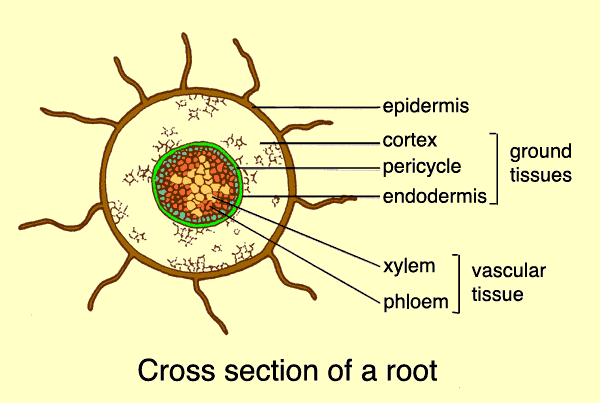
Structure of the root hair.
The root hairs extend from the epidermis cells of the root; they are lined from inside with a thin layer of cytoplasm, and each root hair has a big vacuole that contains the salt solution. The age of the root hair does not exceed a few days because, during the extension of the root through the soil, the epidermis cells are lost from time to time by the resistance of the soil particles. So, they are replaced by new ones continuously.
The suitability of root hair for the absorption of water and mineral salts
The root hair has a thin membrane that allows the penetration of water and the salts through it, The number of root hairs is large to increase the surface area for absorption of the water and the salts from the soil.
The root hair secretes a sticky substance that helps the root to penetrate the soil particles. So the hairs draw the water, forming a water membrane that facilitates the absorption process. The plasma membrane is the boundary that separates the living cell from its nonliving surroundings. The plasma membrane exhibits selective permeability.
The cell membrane of the root hair has the selective permeability property to allow some types of salts to pass according to the plant’s need, and the energy needed for this process is obtained from the respiration process. The selective permeability is a process by which the cell membrane of the root hair allows some types of salts to pass according to the plant’s need.
The concentration of the salt solution inside its vacuole is higher than the concentration of the salt solution in the soil to help the water be transported from the soil to the root hairs by the osmosis feature.
The osmosis feature is the transmission of water molecules through a semipermeable membrane from an area with a high concentration of water to an area with a low concentration of water.
The high concentration of salt solution means that it contains a small amount of water, so this solution has a low concentration of water. The low concentration of the salt solution means that it contains a large amount of water, so this solution has a high concentration of water.
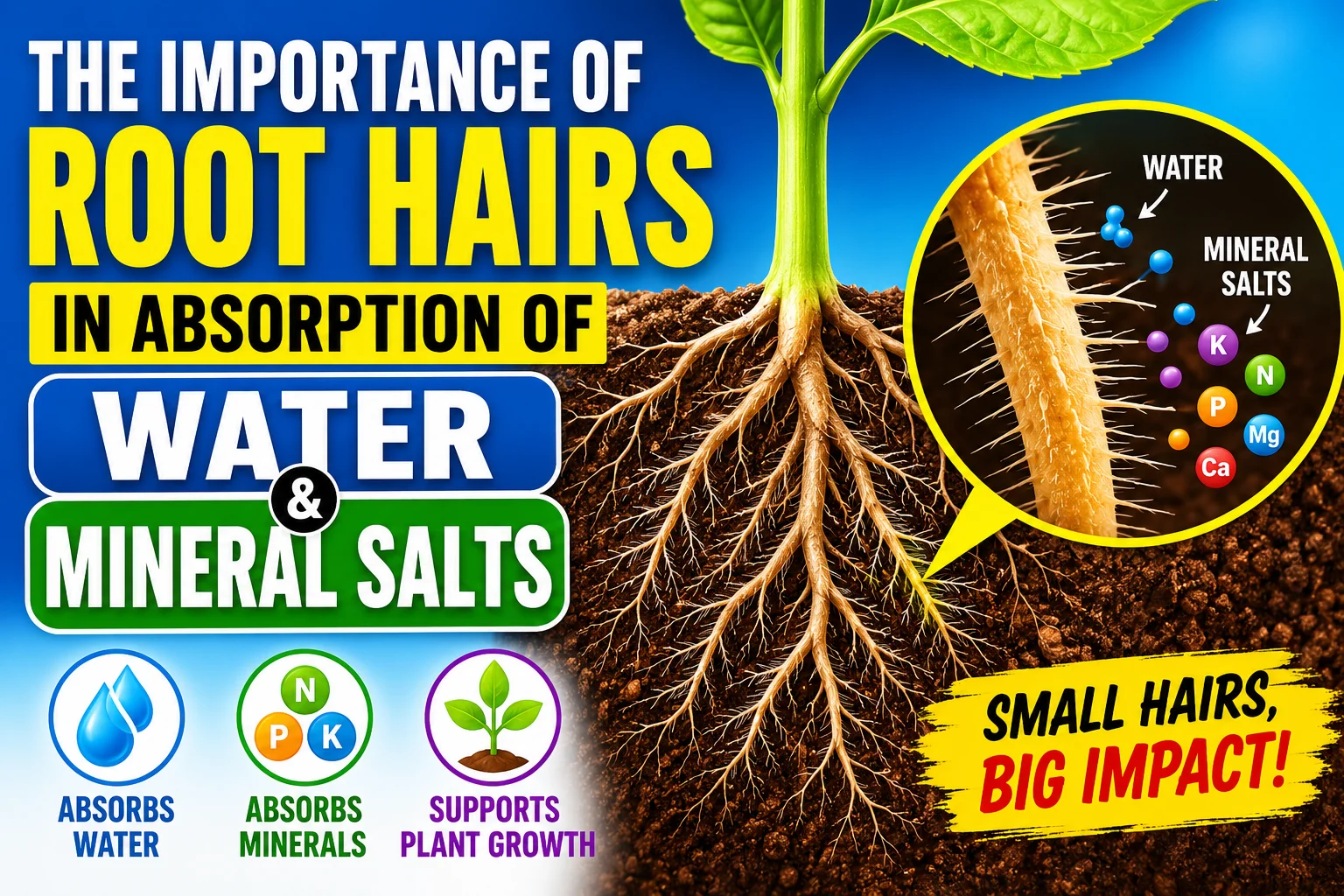
Root hairs
Importance of Root Hairs
Root hairs are thin extensions that grow from the outer layer of plant roots. Their main function is to absorb water and mineral salts from the soil. Because root hairs are very numerous and tiny, they greatly increase the surface area available for absorption. This helps plants collect enough water to carry out important biological processes such as photosynthesis, respiration, and food transport. Root hairs also absorb important minerals like nitrogen, potassium, magnesium, and phosphorus, which are necessary for plant growth and development.
Another important advantage of root hairs is that they allow plants to absorb nutrients more effectively from different soil layers. Their thin walls make it easy for water to move into the root cells through osmosis. Healthy root hairs improve plant strength, leaf production, flowering, and fruit formation. In dry conditions, efficient root hairs help plants survive by maximizing water uptake from the soil. This makes root hairs one of the most essential parts of the plant root system.
The importance of root hairs in the absorption of water and mineral salts cannot be ignored because they help plants obtain the nutrients and moisture necessary for survival, growth, and food production.
FAQ about root hairs
1. What are root hairs?
Root hairs are tiny hair-like structures found on plant roots that help absorb water and mineral salts from the soil.
2. Why are root hairs important?
Root hairs increase the surface area of roots, allowing plants to absorb more water and nutrients efficiently.
3. How do root hairs absorb water?
Root hairs absorb water through osmosis, where water moves from the soil into the root cells.
4. Which mineral salts do root hairs absorb?
Root hairs absorb essential minerals such as nitrogen, potassium, calcium, magnesium, and phosphorus.
5. What happens if root hairs are damaged?
If root hairs are damaged, plants may not absorb enough water and nutrients, leading to weak growth and poor health.
6. How do root hairs help plants survive drought?
Root hairs maximize water absorption from the soil, helping plants survive during dry conditions.
7. Are root hairs found in all plants?
Most land plants have root hairs because they are essential for nutrient and water absorption.
You can subscribe to Science Online on YouTube from this link: Science Online
Mechanism of the transport in higher plants, Theories explain the ascent of water in the plant
Transportation in plant, Structure & role of the plant stem in the process of transportation
Support in plant (Physiological support & Structural support)