Structure of the Sperm in the Male Reproductive System: 10 powerful Facts You Must Know
Structure of the sperm in the male reproductive system is one of the most important topics in human biology because sperm cells are specialized reproductive cells responsible for fertilizing the ovum and passing genetic information to the next generation. Understanding the anatomy and function of each part of the sperm helps explain how successful fertilization occurs and why healthy sperm are essential for reproduction.
Structure of the sperm in the male reproductive system
Sperms
The testes of the adult human male produce about 2 billion sperm per day. The lifetime of a single sperm inside the female vagina ranges from 2 to 6 hours; this period can extend to reach up to 3 days if the sperm manages to break through the cervix and enter the uterus, where it feeds on uterine secretions.
Human sperm cell
The male reproductive system produces, maintains, and transports the sperm (the male reproductive cells) and the protective fluid (semen). Men who have fewer than 20 million sperm per milliliter of semen may be at risk for having infertility issues.
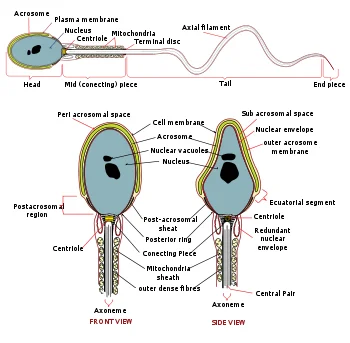
The sperm
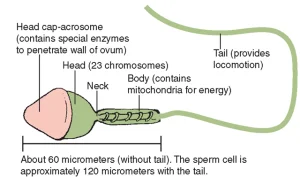
Only one sperm fertilizes the ovum and achieves a pregnancy. The average ejaculation contains close to 100 million sperm, according to the World Health Organization. The sperm is considered very small when compared with the ovum. It is mobile and consists of the head, midpiece & the tail.
The tail is thin and long, and it is responsible for the movement of the sperm until it reaches the ovum. The head contains one half of the genetic material (the chromosomes), and the midpiece contains the mitochondria, which are responsible for the energy production needed for sperm movement.
Reproductive cells in humans and plants
The testis is the reproductive organ in animals which produce the sperms, while the anther is the reproductive organ in plants that produces pollen grains. The gametes in humans and plants are small in size, and they are produced in large numbers. The sperm and the pollen grains contain half the number of chromosomes that are found in male body cells.
Structure of the Sperm in the Male Reproductive System
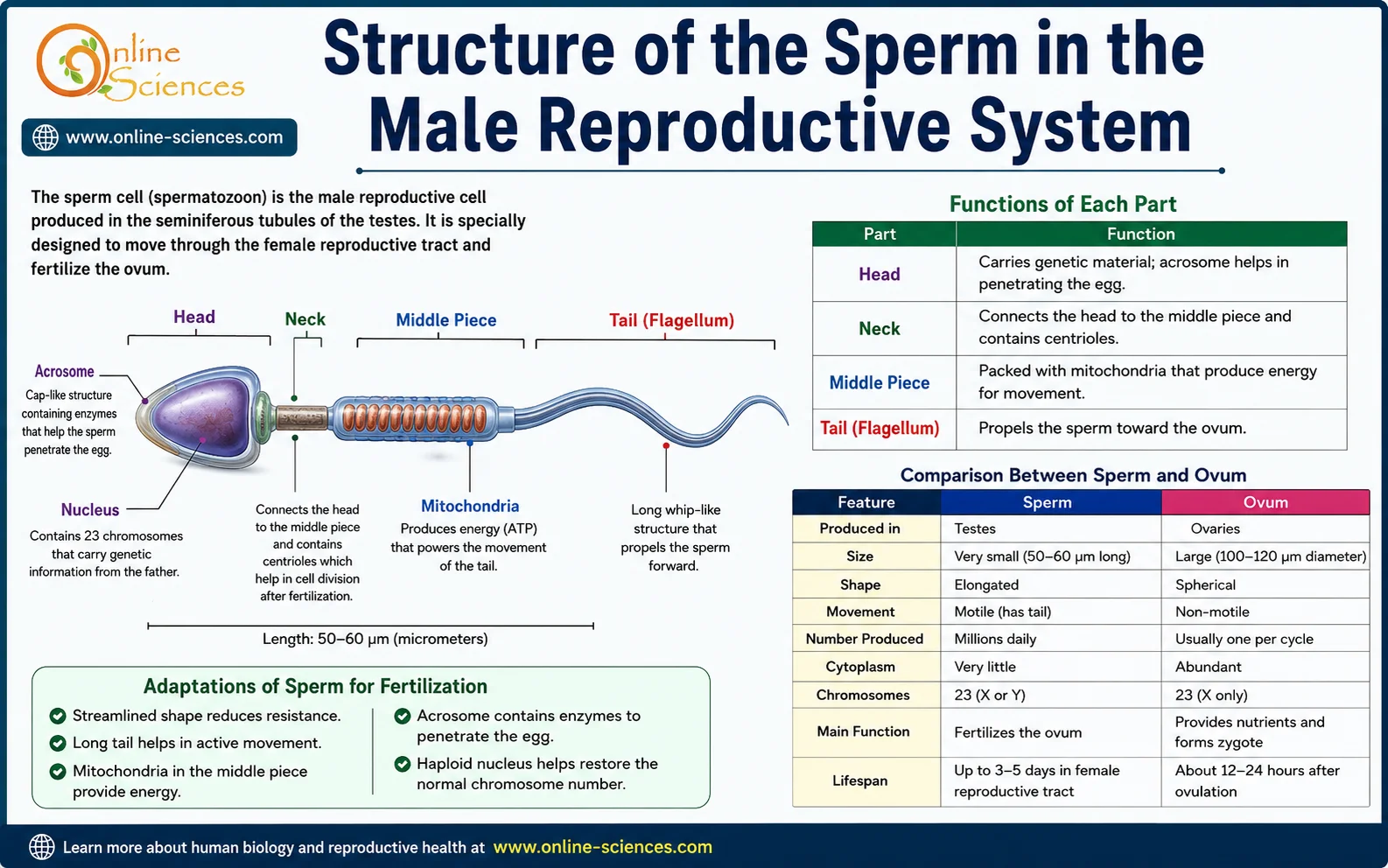
The sperm cell (Spermatozoon) is the male reproductive cell produced in the seminiferous tubules of the testes. It is highly specialized for movement and fertilization, allowing it to travel through the female reproductive tract and penetrate the ovum. A mature sperm measures approximately 50–60 micrometers in length and consists of four main regions:
- Head.
- Neck.
- Middle piece.
- Tail.
1. Head
The head is the front portion of the sperm and contains the genetic material needed for fertilization.
It consists of:
Nucleus
- Contains 23 chromosomes.
- Carries half of the father’s genetic information.
- Combines with the ovum nucleus during fertilization.
Acrosome
- Cap-like structure covering the nucleus.
- Contains digestive enzymes.
- Helps the sperm penetrate the outer layers of the egg.
2. Neck
The neck is a short connecting region between the head and the middle piece.
Functions:
- Connects the head to the tail.
- Contains centrioles involved in cell division after fertilization.
- Provides structural support.
3. Middle Piece
The middle piece supplies energy for sperm movement.
Features:
- Packed with mitochondria.
- Produces ATP through cellular respiration.
- Powers the beating movement of the tail.
Without the middle piece, the sperm cannot swim effectively toward the egg.
4. Tail (Flagellum)
The tail is the longest part of the sperm.
Functions:
- Propels the sperm forward.
- Enables swimming through the female reproductive tract.
- Increases the chances of reaching the ovum.
The tail moves in a whip-like motion to generate forward movement.
Diagram of Sperm Structure
The sperm is organized into four major parts:
- Head: Acrosome, Nucleus.
- Neck.
- Middle piece: Mitochondria.
- Tail (Flagellum).
Functions of Each Part
- Head: carries genetic material.
- The acrosome: releases enzymes to penetrate the egg.
- The neck connects the head and the middle piece.
- Middle Piece produces energy using mitochondria.
- The tail moves the sperm toward the ovum.
Adaptations of Sperm for Fertilization
Sperm cells possess several adaptations that improve their ability to fertilize the egg:
- Streamlined shape reduces resistance.
- Long tail enables rapid swimming.
- Numerous mitochondria generate sufficient energy.
- The acrosome contains enzymes for egg penetration.
- Small size allows faster movement.
- A haploid nucleus restores the normal chromosome number after fertilization.
Where are Sperm Produced?
Sperm cells are produced inside the seminiferous tubules of the testes. They mature in the epididymis. During ejaculation, sperm travel through:
- Vas deferens.
- Ejaculatory duct.
- Urethra.
Importance of Healthy Sperm
Healthy sperm are essential for successful reproduction because they:
- Carry the father’s DNA.
- Fertilize the ovum.
- Contribute to embryo formation.
- Influence fertility.
- Help maintain healthy pregnancy outcomes.
Comparison Between Sperm and Ovum
- Sperm is the smallest, motile reproductive cell, specialized for delivering genetic material to the ovum.
- Ovum is the largest human cell, specialized for nourishing the developing embryo after fertilization.
- Both sperm and ovum are haploid cells, each containing 23 chromosomes.
- Fertilization occurs when one sperm successfully fuses with the ovum, producing a diploid zygote with 46 chromosomes.
- The tail of the sperm enables movement, while the ovum lacks a tail and depends on the female reproductive tract for transport.
- The acrosome of the sperm releases enzymes that help it penetrate the ovum‘s protective layers.
- Only one sperm normally fertilizes one ovum, preventing multiple fertilizations under normal conditions.
Interesting Facts About Sperm
- A healthy ejaculation may contain hundreds of millions of sperm cells.
- Only one sperm normally fertilizes the ovum.
- The sperm head contains the father’s DNA.
- The mitochondria in the middle piece provide energy for swimming.
- The acrosome is essential for penetrating the egg.
- Sperm cells are among the smallest cells in the human body.
- Sperm production continues throughout most of a man’s adult life.
Conclusion
The structure of the sperm in the male reproductive system is perfectly adapted for fertilization. Each region—the head, neck, middle piece, and tail—performs a specialized function that enables the sperm to travel efficiently, deliver genetic material, and successfully fertilize the ovum. Understanding sperm anatomy provides valuable insight into human reproduction, fertility, and the remarkable adaptations of reproductive cells.
Frequently Asked Questions (FAQs)
1. What is the structure of the sperm in the male reproductive system?
A sperm cell consists of four main parts: the head, neck, middle piece, and tail, each specialized for fertilization and movement.
2. What is the function of the sperm head?
The head contains the nucleus with 23 chromosomes and the acrosome, which releases enzymes that help the sperm penetrate the egg.
3. Why is the middle piece important?
The middle piece contains numerous mitochondria that generate ATP, providing the energy required for sperm motility.
4. What is the role of the sperm tail?
The tail acts as a flagellum, propelling the sperm through the female reproductive tract toward the ovum.
5. Where are sperm cells produced?
Sperm cells are produced in the seminiferous tubules of the testes and mature in the epididymis before ejaculation.
6. How many chromosomes does a sperm cell contain?
A mature sperm cell contains 23 chromosomes, which combine with the 23 chromosomes of the ovum during fertilization.
7. What is the acrosome?
The acrosome is a cap-like structure on the head of the sperm that contains enzymes necessary for penetrating the outer layers of the egg.
8. Why are mitochondria concentrated in the middle piece?
They produce the ATP needed to power the tail’s movement, allowing the sperm to swim efficiently.
9. Can a sperm survive for several days?
Yes. Under favorable conditions in the female reproductive tract, sperm can survive for up to 5 days, although survival time varies.
10. Why is understanding sperm structure important?
Studying sperm anatomy helps explain fertilization, human reproduction, fertility, and the biological adaptations that enable successful conception.
You can follow science online on YouTube from this link: Science online
Testis functions, sperms production, Factors affecting spermatogenesis, Structure of Epididymis
Reproduction, Types of sexual reproduction (Conjugation, Reproduction by sexual gametes)
Reproduction in Human being, Structure of Male genital system & sperm
Structure of Female genital system & ovum, Oogenesis stages & Menstrual cycle
Fertilization process, Pregnancy and the stages of embryonic development