
7 Powerful Facts About Density of Matter: Meaning, Formula & Everyday Life Applications
Density of matter is one of the most important physical properties used in science, engineering, and everyday life. It helps us determine how much mass is packed into a given volume, explains why some objects float while others sink, and plays a crucial role in industries ranging from construction to medicine.

Density of Matter
Density
It is a fundamental property of matter. It is defined as the mass of a substance per unit volume. It is expressed using the formula: Density=Mass/Volume. Each substance has its own density. The density is a physical property of matter, as each element and compound has its own density, and it varies with temperature and pressure.
The mass is the amount of matter that the body contains, and its measuring unit is (kg) or (gm). The volume is the space that a substance occupies, and the density is the mass of a unit volume of the matter, or it is the mass of one cubic centimeter of the matter.
The units of density are kilograms per cubic meter (kg/m³) or grams per cubic centimeter (g/cm³), Density helps describe how compact or spread out the matter within a substance is.
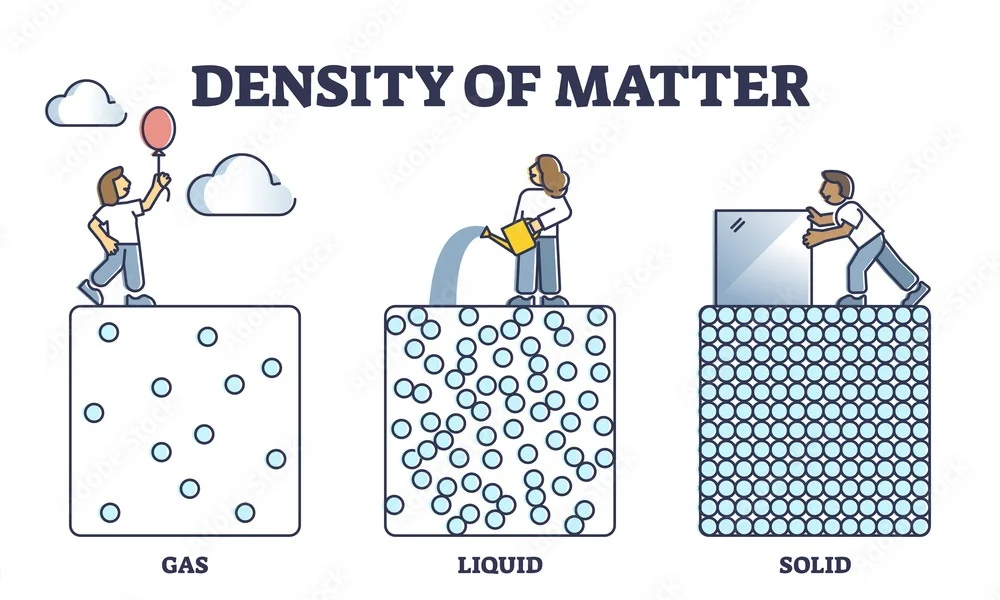
Density
Equal masses of different substances have different volumes, and equal volumes of different substances have different masses as they have different densities. Some substances float on the water surface, and others sink in the water due to the difference in their densities.
The materials that have a higher density than the water sink in it, such as iron nails and metallic coins, while the materials that have a lower density than the water float on its surface, such as wood, cork, ice, and drops of oil.
Density of Matter
Density is the physical property that describes the amount of mass contained in a unit volume of a substance. Every material has its own characteristic density, making density useful for identifying substances and predicting their behavior. Materials with high density contain more matter packed into the same volume than materials with low density.
For example:
- Iron has a high density.
- Wood has a lower density.
- Air has a very low density compared to solids and liquids.
What Does Density Mean?
Density means how tightly matter is packed together inside an object.
Imagine two boxes of the same size:
- One is filled with feathers.
- The other is filled with iron nails.
Although both boxes have the same volume, the box containing iron is much heavier because iron has a much higher density.
In simple words, Density tells us how heavy a material is for its size.
How is Density Calculated?
ρ = m / V, Density is calculated by dividing the mass of an object by its volume.
Where: Mass is measured in kilograms (kg) or grams (g). Volume is measured in cubic meters (m³) or cubic centimeters (cm³).
SI Unit of Density
- The standard SI unit is: kilograms per cubic meter (kg/m³).
- Another commonly used unit is: grams per cubic centimeter (g/cm³)
Density of Matter
In the context of different types of matter, density plays a vital role in various physical phenomena:
- Solids have high density because their particles are packed closely together. Metals such as iron or gold have much higher densities than non-metals like wood or plastic.
- Liquids have lower densities compared to solids. Water has a density of 1 g/cm³ at room temperature. However, some liquids, such as mercury, have unusually high densities.
- Gases have much lower densities because their particles are spread far apart. The density of a gas can change with temperature and pressure, as seen in the behavior of air at different altitudes or weather conditions.
- Plasma: This state of matter, like the sun’s core or fusion reactors, can have a wide range of densities depending on energy input and conditions, though it is less relevant for everyday life.
Life applications of density
The water is not used to put out the petrol fires as the density of petrol is less than that of the water so, so the petrol floats on the water surface, and the water does not put out the fire.
The balloons filled with hydrogen or helium rise up in the air carrying flags during the festivals as the densities of hydrogen and helium are less than the density of the air.
The determination of the change in the density of the matter is taken as evidence of the purity of the matter as a determination of the quality of the milk.
The principle of Floating is related to density. Objects float in a fluid (like water or air) if their density is less than that of the fluid, This is why boats float (even though they’re heavy) and why hot air balloons rise—because hot air is less dense than cool air.
Engineers and designers consider density when selecting materials for construction or manufacturing. Aircraft and spacecraft must use materials that are strong yet lightweight, meaning they have low density but high strength, such as aluminum or carbon composites.
In medicine, the density plays a vital role in diagnostic imaging. X-rays or CT scans can differentiate tissues based on their densities (bone, which is dense, versus soft tissue or fat). Body Mass Index (BMI) indirectly relates to density, as it considers a person’s mass relative to their height.
Earth’s structure is understood through density variations. The Earth’s core is extremely dense (due to high-pressure iron and nickel), while the crust is less dense. These density differences also affect tectonic plate movements and seismic wave propagation.
In chemistry, density is used to identify substances. A hydrometer is an instrument used to measure the density of liquids and is commonly used in industries like brewing or dairy to check fluid quality.
The density of food can affect its texture and flavor. The density of dough in baking determines whether bread turns out light and fluffy or dense and chewy. It helps in determining calorie content, as denser foods contain more energy.
Why is Density Important?
Density helps scientists and engineers understand the properties of materials without changing them.
Its importance includes:
- Identifying unknown substances.
- Designing ships and submarines.
- Manufacturing aircraft.
- Producing building materials.
- Quality control in factories.
- Geological exploration.
- Medical diagnostics.
Life Applications of Density
Density affects many aspects of everyday life.
- Ship Building: Large ships are made of steel, yet they float because their overall average density is lower than the density of water due to the air-filled spaces inside them.
- Submarines: Submarines change their density by filling or emptying ballast tanks with water. Higher density → sink. Lower density → rise.
- Hot Air Balloons: Heating the air inside the balloon decreases its density, allowing the balloon to rise into the atmosphere.
- Oil and Water Separation: Oil floats on water because its density is lower than that of water. This principle is used in oil spill cleanup, the petroleum industries, and cooking.
- Identifying Pure Metals: Scientists compare the measured density of a metal with known values to determine whether it is pure or mixed with other substances.
- Construction Engineering: Engineers choose building materials based on density to ensure buildings are both strong and safe. Concrete, steel, and lightweight insulation materials all have different densities suited to different purposes.
- Medicine: Density measurements are used in: Bone density scans, Medical imaging, Laboratory testing, and Body composition analysis.
Factors Affecting Density
Several factors influence density:
- Temperature: Increasing temperature usually decreases density because particles move farther apart.
- Pressure: Increasing pressure generally increases density, especially in gases.
- Material Composition: Different substances naturally have different densities because of differences in atomic structure.
Examples of Density
Substance Approximate Density
- Air: 1.2 kg/m³
- Water: 1000 kg/m³
- Ice: 917 kg/m³
- Aluminum: 2700 kg/m³
- Iron: 7870 kg/m³
- Gold: 19300 kg/m³
Density vs. Weight
Many people confuse density with weight.
- Weight is the force caused by gravity acting on an object.
- Density describes how much mass is contained in a given volume.
A small gold bar may weigh more than a much larger wooden block because gold has a much higher density.
Interesting Facts About Density
- Ice floats because it is less dense than liquid water.
- Mercury is one of the densest liquids found naturally.
- Gold is nearly 19 times denser than water.
- Warm air rises because it is less dense than cold air.
- Density helps identify gemstones and precious metals.
- Earth’s layers have different densities.
- Density is considered an intensive property, meaning it does not depend on the amount of material present.
Conclusion
Density is a fundamental property of matter that explains why materials behave differently under various conditions. By understanding what density means and how it is calculated, we can explain natural phenomena such as floating and sinking, improve engineering designs, identify substances, and develop technologies used in medicine, construction, transportation, and manufacturing.
Frequently Asked Questions (FAQ) about Density
1. What is density?
Density is the amount of mass contained in a unit volume of a substance.
2. What does density mean in simple words?
Density tells us how tightly matter is packed inside an object.
3. How is density calculated?
Density is calculated by dividing the mass of an object by its volume.
4. What is the SI unit of density?
The SI unit of density is kilograms per cubic meter (kg/m³).
5. Why is density important?
Density helps identify materials, predict whether objects float or sink, and is widely used in engineering, medicine, manufacturing, and environmental science.
6. What are some everyday applications of density?
Common applications include shipbuilding, submarines, hot air balloons, oil-water separation, construction, medicine, and quality control in manufacturing.
7. Why does ice float on water?
Ice floats because its density is lower than the density of liquid water.
8. Does temperature affect density?
Yes. Increasing temperature usually decreases the density of most substances because particles move farther apart.
You can follow Science Online on YouTube from this link: Science Online
The properties and the measuring devices of the mass
Properties of fluids, Factors affecting density and pressure
Matter, Properties & Kinds of molecules, Melting process & Vaporization process