15 Powerful Facts About Ionic Bonds and Characteristics of Ionic Compounds (Complete Guide 2026)
Ionic bonds and characteristics of ionic compounds are fundamental topics in chemistry that explain how atoms combine to form stable substances. An ionic bond is formed when one atom transfers one or more electrons to another atom, creating positively and negatively charged ions that attract each other through strong electrostatic forces. Understanding ionic bonds helps students explain the properties of many common compounds, including table salt, minerals, and numerous industrial chemicals.
Ionic Bonds and Characteristics of Ionic Compounds
Ionic Bonds and the Characteristics of Ionic Compounds
The element is composed of molecules. Each molecule consists of atoms. The atom is electrically neutral in its ordinary state (In the atom, the number of electrons equals the number of protons). Atoms combine with each other, forming molecules through chemical bonds.
Ionic bond
The ionic bond is a type of chemical bond that occurs between a metal atom and a nonmetal atom. The ionic compounds are formed from a metallic cation and a non-metallic anion.
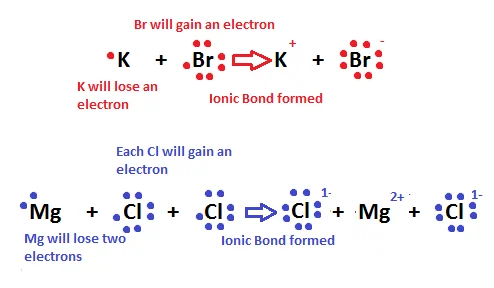
The metal atom loses electrons and changes into a positive ion; the nonmetal atom gains the electrons that were lost from the metal atom and changes into a negative ion.
A strong electrostatic attraction between the positive and the negative ions occurs through the ionic bond. The ionic bond is a bond resulting from the electric attraction between a positive ion and a negative ion.
The ionic bonds produce compounds, not the elements, as the ionic bond arises between two different elements (the metal and the nonmetal). The ionic bonds produce ionic compounds only, and it has one type.
Ionic bonds
The ionic bond is formed by the loss and gain of electrons, and it is formed between 2 atoms of two different elements. The metals with few electrons in their outermost orbital, by losing those electrons, these metals can achieve a noble-gas configuration. Non-metals that have close to 8 electrons in its valences shell tend to accept electrons to achieve a noble gas configuration.
Characteristics of the ionic compounds
The ionic compounds are solids at room temperature; they have high melting and boiling points, and they dissolve in water. They do not conduct electricity (when they are solids), and they conduct electricity (when they are liquids).
What is an Ionic Bond?
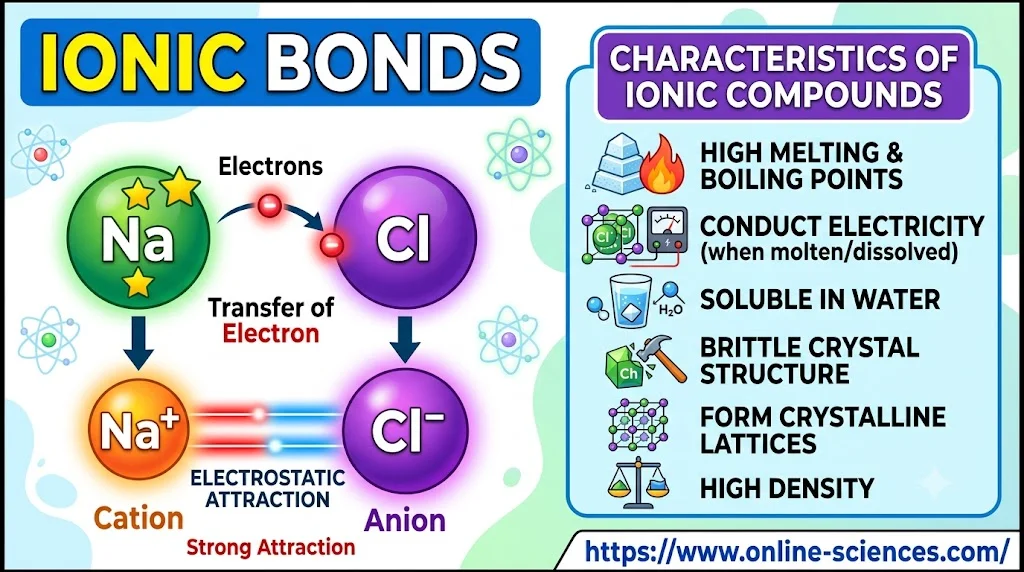
An ionic bond is a chemical bond formed by the transfer of electrons from one atom, usually a metal, to another atom, usually a nonmetal. This electron transfer produces oppositely charged ions: Positive ions are called cations, and negative ions are called anions. The strong electrostatic attraction between these ions forms the ionic bond and holds the compound together.
Example
When sodium (Na) reacts with chlorine (Cl): Sodium loses one electron and becomes Na⁺. Chlorine gains one electron and becomes Cl⁻. The attraction between Na⁺ and Cl⁻ forms the ionic compound sodium chloride (NaCl).
How are Ionic Compounds Formed?
Ionic compounds are formed when:
- A metal atom loses electrons.
- A nonmetal atom gains electrons.
- Oppositely charged ions attract each other.
- A stable ionic crystal lattice is produced.
This process helps atoms achieve a more stable electron configuration.
Characteristics of Ionic Compounds
- High Melting and Boiling Points: Ionic compounds have strong electrostatic forces between ions, requiring large amounts of energy to separate them.
- Crystalline Structure: They are usually arranged in a regular three-dimensional crystal lattice.
- Hard but Brittle: Ionic compounds are generally hard; however, they can break easily when subjected to strong force.
- Conduct Electricity When Molten or Dissolved: Ions become free to move when the compound melts or dissolves in water, allowing electrical conductivity.
- Poor Conductors in the Solid State: In solid form, ions are fixed in position and cannot carry electric current.
- Usually Soluble in Water: Many ionic compounds dissolve readily in water because water molecules attract and separate the ions.
- Consist of Positive and Negative Ions: Their structure is based on electrostatic attraction between cations and anions.
- Form Stable Compounds: Ionic bonding helps atoms achieve stable outer electron shells.
Examples of Ionic Compounds
- Sodium chloride (NaCl).
- Magnesium oxide (MgO).
- Potassium bromide (KBr).
- Calcium chloride (CaCl₂).
- Sodium fluoride (NaF).
- Lithium chloride (LiCl).
Uses of Ionic Compounds
- Food seasoning (table salt).
- Water treatment.
- Fertilizers.
- Medicine production.
- Industrial manufacturing.
- De-icing roads.
- Chemical laboratories.
Frequently Asked Questions (FAQ) about Ionic Bonds
1. What is an ionic bond?
An ionic bond is a chemical bond formed by the electrostatic attraction between positively and negatively charged ions after electron transfer.
2. How is an ionic bond formed?
It forms when one atom transfers electrons to another atom, creating oppositely charged ions that attract each other.
3. Which elements usually form ionic bonds?
Ionic bonds commonly form between metals and nonmetals.
4. What are cations?
Cations are positively charged ions formed when atoms lose electrons.
5. What are anions?
Anions are negatively charged ions formed when atoms gain electrons.
6. Why do ionic compounds have high melting points?
Strong electrostatic attractions between ions require a large amount of energy to overcome.
7. Can ionic compounds conduct electricity?
Yes, when molten or dissolved in water, but not usually in the solid state.
8. Why don’t solid ionic compounds conduct electricity?
Their ions are fixed in a crystal lattice and cannot move freely.
9. Are ionic compounds soluble in water?
Many ionic compounds are soluble in water due to interactions between water molecules and ions.
10. Why are ionic compounds brittle?
When layers of ions shift, similarly charged ions repel each other, causing the crystal to break.
11. What is the structure of ionic compounds?
They form giant crystal lattices composed of repeating positive and negative ions.
12. What is the most common example of an ionic compound?
Sodium chloride (NaCl), commonly known as table salt.
13. What is the difference between ionic and covalent bonds?
Ionic bonds involve electron transfer, while covalent bonds involve electron sharing.
14. Are ionic compounds stable?
Yes, ionic compounds are generally very stable due to strong electrostatic attractions.
15. Why are ionic bonds important?
They are essential for forming many substances used in daily life, industry, medicine, and biological systems.
Conclusion
The ionic bond and characteristics of ionic compounds are essential concepts in chemistry. Ionic bonds form through electron transfer between atoms, producing oppositely charged ions that attract each other strongly. As a result, ionic compounds exhibit powerful properties such as high melting points, crystalline structures, electrical conductivity when molten or dissolved, and excellent stability. Understanding these characteristics provides a strong foundation for studying chemical reactions, materials science, and industrial applications.
You can follow science online on YouTube from this link: Science online