
Chemical properties of Non-metals in the modern periodic table, How do non-metals react with metals?
Non-metals are the elements that have more than four electrons in their outermost energy levels. The non-metals are characterized by the smallest atomic sizes and the largest electronegativity.
Non-metals
Sulfur (S) is a nonmetal. It was known as brimstone. Phosphorus (P) is a reactive nonmetal. Graphite is not the only pure from carbon (C), Diamond is also carbon. The colour comes from the impurities caught within the crystal structure.
During the chemical reactions, the atom of the nonmetallic elements tends to gain electrons and change into negative ions. The negative ions carry a number of negative charges equal to the number of gained electrons.
The electronic structure of the negative ions is similar to that of the nearest inert gas that follows the non-metals in the periodic table. The negative ion is an atom of a nonmetallic element gaining an electron or more during the chemical reaction.
During the chemical reactions, the atoms of the elements tend to complete their outermost energy levels with electrons (8 electrons) to reach the stable state, this is done through losing of the electrons as in the case of the metal atoms, and gaining of the electrons as in the case of the non-metals as in the non-metals atoms.
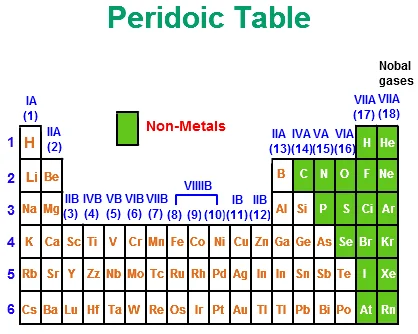
Non-metals on the periodic table
The non-metals (such as carbon and sulphur) do not react with dilute acids (such as HCl). The non-metals, such as carbon (C), react with oxygen, giving non-metal oxides, which are known as “Acidic oxides”. Non-metallic acidic oxides dissolve in the water, forming acids that turn the litmus solution red.
FAQ about Chemical Properties of Non-Metals
1. What are non-metals?
Non-metals are elements found mainly on the right side of the modern periodic table. They include elements like oxygen, nitrogen, sulfur, and chlorine.
2. How do non-metals behave in chemical reactions?
Non-metals usually gain electrons to form negative ions (anions).
3. Why do non-metals gain electrons?
Because they have high electronegativity and a strong attraction for electrons.
4. What type of bonds do non-metals form?
Non-metals mainly form covalent bonds by sharing electrons with other non-metals.
5. How do non-metals react with oxygen?
They react with oxygen to form acidic oxides. Example: Sulfur + Oxygen → Sulfur dioxide
6. How do non-metals react with hydrogen?
They form covalent compounds called hydrides.
Example: Hydrogen + Chlorine → Hydrogen chloride (HCl)
6. How do non-metals react with metals?
They gain electrons from metals to form ionic compounds.
Example: Sodium + Chlorine → Sodium chloride
7. Do non-metals react with acids?
Generally, non-metals do not react with acids as metals do.
8. What happens when non-metal oxides dissolve in water?
They form acids. Example: Carbon dioxide + Water → Carbonic acid
9. Are non-metals good oxidizing agents?
Yes, many non-metals (like oxygen and chlorine) are strong oxidizing agents because they gain electrons easily.
10. What is the trend of reactivity in non-metals?
Reactivity increases across a period (left → right) and decreases down a group.
11. What are examples of reactive non-metals?
- Oxygen.
- Chlorine.
- Fluorine.
12. What is special about noble gases?
They are non-metals but are chemically inert (unreactive) due to their full outer electron shells.
Non-metals gain electrons and form anions. They form covalent bonds with other non-metals. Their oxides are usually acidic. They are often good oxidizing agents.
You can subscribe to Science Online on YouTube from this link: Science Online