
Movement of Electrons Around the Nucleus and Energy Levels: 7 Amazing Facts You Should Know
Movement of Electrons Around the Nucleus and Energy Levels explains how electrons occupy specific energy levels around an atom’s nucleus and move between them by absorbing or releasing energy. Understanding these concepts helps explain atomic structure, chemical bonding, light emission, and many applications in modern chemistry and physics.
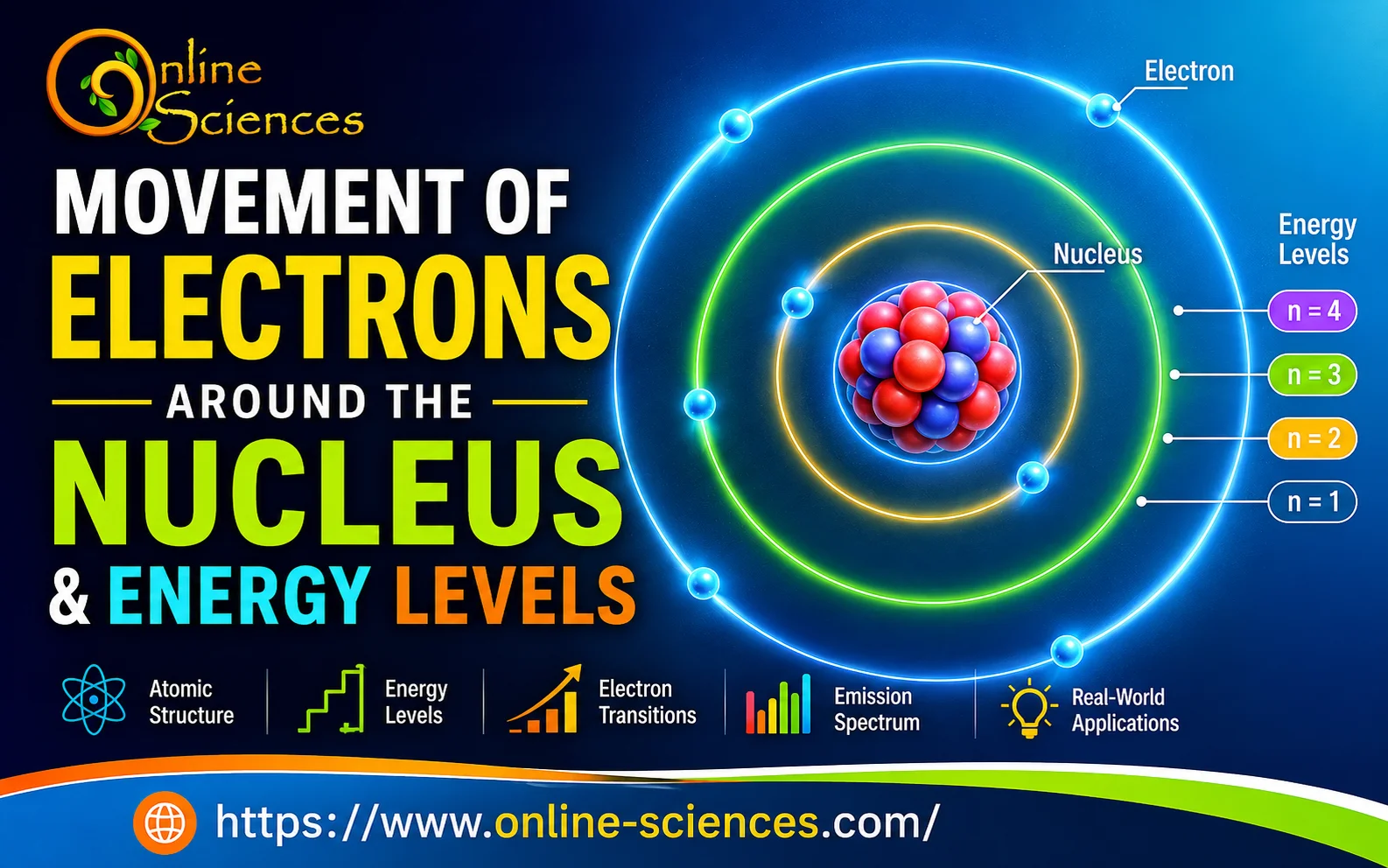
Movement of electrons around the nucleus
Movement of electrons
The electrons are negatively (- ve) charged particles. They revolve around the nucleus at very high speed. The electron has a negligible mass relative to that of the proton or the neutron, so the mass of the atom is concentrated in the nucleus.
The number of the negative electrons that revolve around the nucleus is equal to the number of positive protons in the nucleus, so the atom is electrically neutral in its ordinary state.
Atomic number = Number of protons = Number of electrons.
Mass number = Number of protons (atomic number) + number of neutrons.
What are the energy levels?
The electrons revolve around the nucleus in a number of orbits called the energy levels, and during their movement, they seem to form a cloud around the nucleus. The energy levels are the imaginary regions around the nucleus in which the electrons move according to their energies.
The nucleus contains the protons and the neutrons. The first energy level can hold a maximum of 2 electrons in one orbital, the second level can hold a maximum of 8 electrons that are distributed over 4 different orbitals, and the third energy level can hold a maximum of 18 electrons distributed over 9 different orbitals.
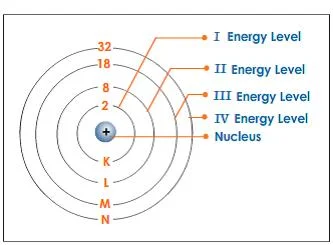
The arrangement of electrons in an atom.
The maximum number of energy levels is seven levels (in the heaviest atoms), which are arranged from the nucleus according to their energies. Each level has a certain amount of energy that increases with the increase in distance from the nucleus. The first energy level (K) has the least energy, followed by the second level (L) and so on.
The seventh energy level (Q) has the highest energy, and the energy of level (L) is greater than that of level (K), The energy of the electron depends on the energy of the level in which it revolves, where the energy of the electron = the energy of the level.
The electron is not transferred from one level to a higher one unless it gains some energy called the quantum, which equals the difference between the energies of two levels, and the atom will be excited atom. The electrons lose this energy, and it returns to its original level, and the state of the atom is the ground state.
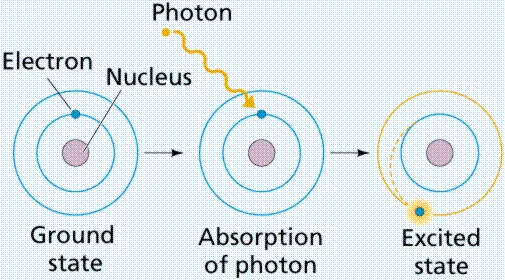
The excited atom
The excited atom is the atom that gains a quantum of energy, and the quantum is the amount of energy lost or gained by an electron when it transfers from one energy level to another.
Movement of Electrons Around the Nucleus
Movement of electrons around the nucleus is one of the most important concepts in modern atomic theory. Electrons are negatively charged subatomic particles that occupy specific regions around the positively charged nucleus. Instead of moving in fixed circular paths like planets around the Sun, electrons exist in probability clouds called orbitals, where they are most likely to be found according to quantum mechanics.
The nucleus contains protons and neutrons, while electrons are attracted to the nucleus by the electrostatic force between opposite charges. However, electrons do not spiral into the nucleus because they possess quantized energy and can only exist in specific energy states. This balance between attraction and quantum behavior keeps atoms stable.
What Are Energy Levels?
Energy levels are fixed amounts of energy that electrons can have while surrounding the nucleus. Each energy level, also known as an electron shell, is located at a certain average distance from the nucleus.
The first energy level (n = 1) is closest to the nucleus and has the lowest energy. As the energy level number increases (n = 2, 3, 4, and so on), electrons are generally farther from the nucleus and possess more energy. Electrons naturally occupy the lowest available energy level before filling higher ones, following the Aufbau principle.
Characteristics of Energy Levels
- Electrons can only occupy specific energy levels.
- Lower energy levels are closer to the nucleus and are more stable.
- Higher energy levels are farther from the nucleus and contain more energy.
- Each energy level can hold a maximum number of electrons according to the formula 2n², where n is the principal quantum number.
- Energy levels contain sublevels (s, p, d, and f), which further define electron distribution.
Electron Transitions Between Energy Levels
Electrons can move from one energy level to another by absorbing or releasing energy.
- Absorption of energy: An electron gains energy from heat, electricity, or light and jumps to a higher energy level. This is called an excited state.
- Emission of energy: When the electron returns to a lower energy level, it releases the excess energy as a photon of light. The wavelength and color of the emitted light depend on the energy difference between the two levels.
This process explains atomic emission spectra, which are unique for every chemical element.
Why Energy Levels Matter
Energy levels explain many important physical and chemical phenomena, including:
- Atomic stability.
- Formation of chemical bonds.
- Electrical conductivity.
- Spectroscopy and identification of elements.
- Laser technology.
- Fluorescent lighting.
- Semiconductor devices and modern electronics.
Understanding electron movement and energy levels is essential in chemistry, physics, materials science, and nanotechnology.
Electron Configuration
Electron configuration describes how electrons are arranged within an atom’s energy levels and orbitals. Electrons fill orbitals according to three major rules:
- Aufbau Principle: Lowest-energy orbitals fill first.
- Pauli Exclusion Principle: Each orbital holds a maximum of two electrons with opposite spins.
- Hund’s Rule: Electrons occupy equal-energy orbitals singly before pairing.
For example:
- Hydrogen (H): 1s¹
- Helium (He): 1s²
- Oxygen (O): 1s² 2s² 2p⁴
- Sodium (Na): 1s² 2s² 2p⁶ 3s¹
Factors Affecting Electron Energy
Several factors influence the energy of electrons:
- Distance from the nucleus.
- Nuclear charge (number of protons).
- Shielding effect from inner electrons.
- Orbital type (s, p, d, or f).
- External electric or magnetic fields.
Applications of Electron Energy Levels
Knowledge of electron movement and energy levels is applied in many fields:
- Atomic spectroscopy.
- Medical imaging.
- LED lighting.
- Solar cells.
- Quantum computing.
- Laser systems.
- Chemical analysis.
- Electronic device manufacturing.
Frequently Asked Questions (FAQ) about the movement of electrons around the nucleus
1. What is the movement of electrons around the nucleus?
Electrons occupy quantum orbitals surrounding the nucleus rather than fixed circular paths. They move according to the principles of quantum mechanics and exist in regions where they are most likely to be found.
2. What are energy levels?
Energy levels are discrete amounts of energy that electrons can possess. Electrons can only exist in these specific energy states.
3. Why can’t electrons exist between energy levels?
According to quantum mechanics, electron energies are quantized, meaning only certain energy values are allowed.
4. What happens when an electron absorbs energy?
The electron jumps to a higher energy level, entering an excited state.
5. What happens when an excited electron returns to a lower level?
It emits energy as a photon of light with a wavelength corresponding to the energy difference between the two levels.
6. Which energy level has the lowest energy?
The first energy level (n = 1) has the lowest energy and is closest to the nucleus.
7. Why are energy levels important?
They explain atomic structure, chemical bonding, light emission, electrical conductivity, and the behavior of atoms in chemical reactions.
8. How many electrons can each energy level hold?
The formula determines the maximum number: Maximum electrons = 2n², where n is the principal energy level.
7 Amazing Facts about the Movement of Electrons Around the Nucleus
1. Electrons Do Not Move in Fixed Circular Orbits: According to quantum mechanics, electrons do not travel in perfect circles around the nucleus. Instead, they exist in orbitals, which are regions where they are most likely to be found.
2. Electrons Occupy Specific Energy Levels: Electrons can only exist in discrete energy levels (shells) around the nucleus. They cannot stay between these levels because their energy is quantized.
3. Electrons Gain Energy by Absorbing Photons: When an electron absorbs energy from light, heat, or electricity, it jumps from a lower energy level to a higher one. This temporary state is called the excited state.
4. Electrons Release Light When Returning to Lower Levels: As excited electrons return to lower energy levels, they emit energy as photons (light). This process produces the unique emission spectrum of each element.
5. Lower Energy Levels Are More Stable: Electrons naturally occupy the lowest available energy level, known as the ground state, because it requires the least amount of energy.
6. Each Energy Level Has a Maximum Electron Capacity: The maximum number of electrons in an energy level is determined by the formula: Maximum electrons = 2n², where n is the principal energy level.
7. Electron Movement Determines Chemical Properties: The arrangement and movement of electrons—especially those in the outermost shell (valence electrons)—control how atoms bond, react, and form compounds, making electron behavior the foundation of chemistry.
You can subscribe to science online on YouTube from this link: Science Online
Theories explaining the covalent bond, Octet rule & Overlapped orbitals concept
The quantum numbers and principles of distributing electrons
Chemical combination, Types of bonds (Chemical bonds & Physical bonds)