15 Powerful Facts About the Law of Wave Propagation: Complete Guide 2026
Law of wave propagation is a fundamental concept in physics that explains how waves travel through different media while transferring energy from one location to another. The law establishes the relationship between wave velocity, frequency, and wavelength, helping scientists and students understand the behavior of sound waves, light waves, water waves, and electromagnetic radiation. Understanding wave propagation is essential for studying communication systems, acoustics, optics, and modern technology.
Law of Wave Propagation
What is the Law of Wave Propagation?
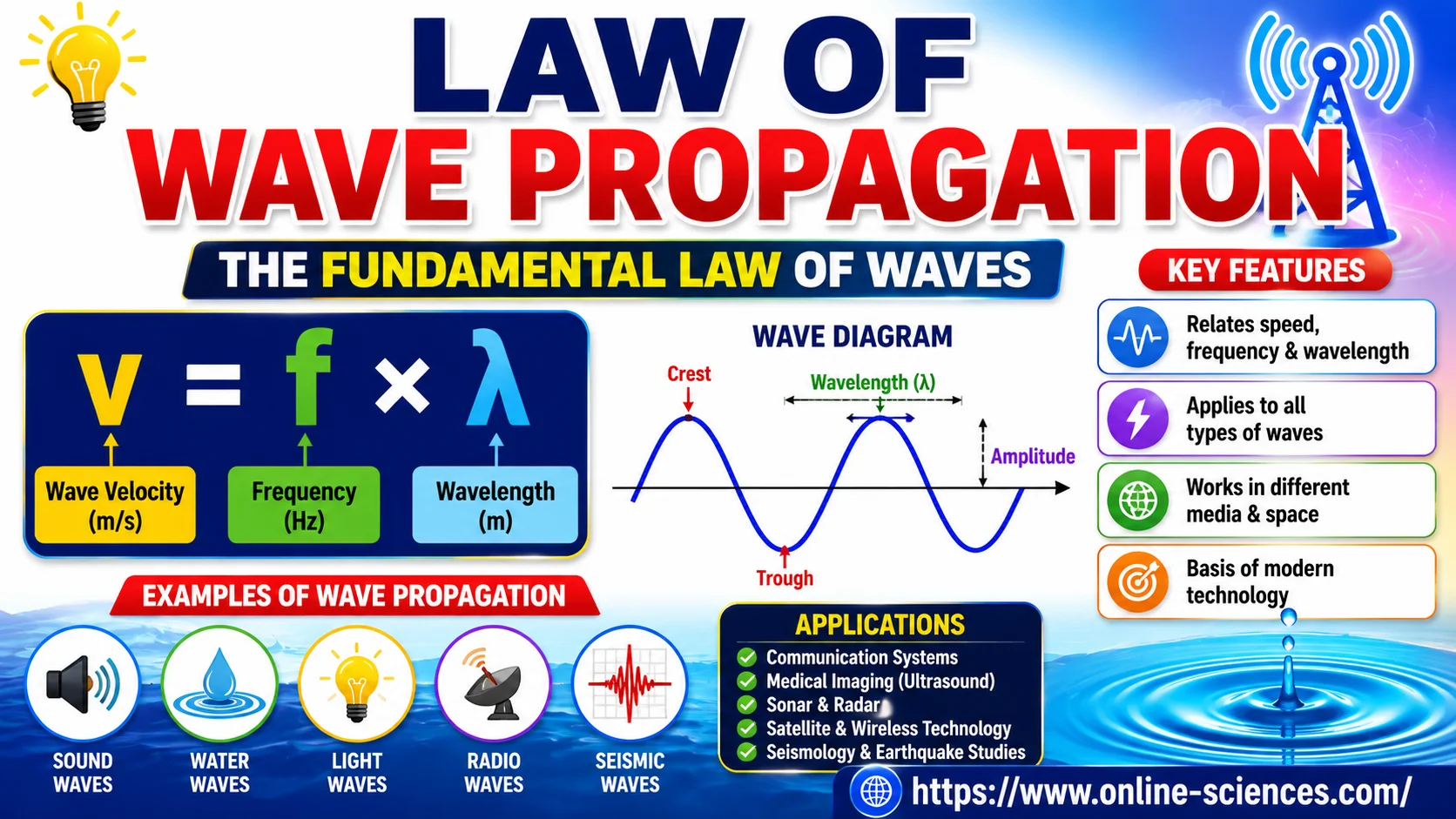
The law of wave propagation states that the speed of a wave is equal to the product of its frequency and wavelength. This relationship is expressed by the famous wave equation:
v = f × λ
Where:
- v = wave velocity (m/s).
- f = frequency (Hz)
- λ = wavelength (m)
This equation shows that wave speed depends on both frequency and wavelength and is one of the most important principles in wave mechanics.
Why is the Law of Wave Propagation important?
The law helps explain how energy moves through matter and space. It is used in fields such as telecommunications, medical imaging, seismology, astronomy, acoustics, and optical engineering. By understanding wave propagation, scientists can predict how waves behave under different conditions and media.
Applications of the Law of Wave Propagation
- Radio and television broadcasting.
- Mobile phone communications.
- Fiber-optic networks.
- Ultrasound medical imaging.
- SONAR and RADAR systems.
- Earthquake detection.
- Satellite communications.
- Wireless internet technologies.
Examples of Wave Propagation
Sound waves traveling through air, light waves moving through space, ripples spreading across water surfaces, and seismic waves traveling through Earth’s crust all follow the law of wave propagation. Although these waves differ in nature, they obey the same fundamental relationship between speed, frequency, and wavelength.
Some concepts related to the wave motion and its properties
Law of Wave Propagation
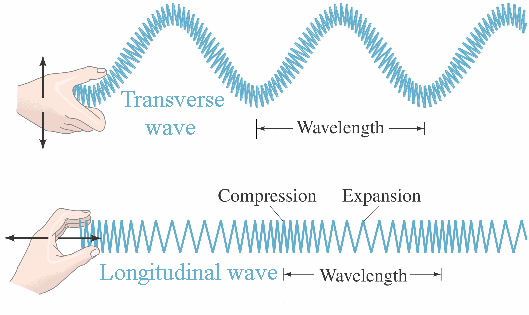
In the transverse pulse, if the displacements associated with the wave disturbances move in a direction perpendicular to the wave motion, then the wave is a transverse wave. In the longitudinal pulse, if the displacements associated with the wave disturbances move in a direction parallel to the wave motion, then the wave is a longitudinal wave.
The wavelength (λ) of the transverse wave is the distance between two successive crests or troughs. The wavelength (λ) of the longitudinal wave is the distance between the centers of two successive compressions or rarefactions, and the measuring unit of the wavelength is the metre.
The amplitude of the wave is the maximum displacement achieved by the medium particles away from their rest positions, and its measuring unit is “metre” or “centimetre”.
The wave velocity is the distance covered by the wave in one second, and the measuring unit of it is metre per second (m/s), The wave velocity represents the velocity of the transfer of the energy carried by the wave.
The wave velocity is constant through the same medium, but it changes from one medium to another. The velocity of the sound through the gases (the air) is smaller than that through the liquids. The velocity of the sound through the liquids is smaller than that through the solids.
The wave frequency is the number of waves produced from the source in one second. The measuring unit of frequency is “Hertz”, and the periodic time of the wave is the time of one wave.
Law of wave propagation
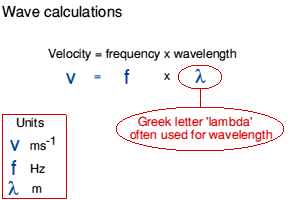
It is the relation between the wave velocity (V), its frequency (F) and the wavelength (λ) in the wave motion.
Law of Wave Propagation
The distance covered by the wave in one second (V) = the number of waves produced in one second (F) × wavelength (λ).
Frequently Asked Questions (FAQ) about the Law of Wave Propagation
1. What is the Law of Wave Propagation?
The Law of Wave Propagation states that wave velocity equals frequency multiplied by wavelength, represented by the equation v = f × λ.
2. What is the formula for wave propagation?
The formula is: v = f × λ, where v is wave speed, f is frequency, and λ is wavelength.
3. Why is wave propagation important?
Wave propagation explains how energy travels through different media and forms the basis of communication technologies, acoustics, and optics.
4. Does the law apply to all waves?
Yes. Mechanical waves and electromagnetic waves both follow the relationship between velocity, frequency, and wavelength.
5. What happens if the frequency increases?
If wave speed remains constant, an increase in frequency results in a decrease in wavelength.
6. What happens if the wavelength increases?
If wave speed remains constant, increasing wavelength causes frequency to decrease.
7. Do sound waves obey the Law of Wave Propagation?
Yes. Sound waves follow the same wave equation, and their speed depends on the properties of the medium.
8. Do light waves follow the Law of Wave Propagation?
Yes. Light waves obey the equation v = f × λ, where their speed in a vacuum is approximately 3 × 10⁸ m/s.
9. What is wave velocity?
Wave velocity is the speed at which a wave disturbance travels through a medium or space.
10. What is wavelength?
Wavelength is the distance between two successive crests, troughs, compressions, or rarefactions of a wave.
11. What is frequency?
Frequency is the number of complete wave cycles passing a point each second, measured in hertz (Hz).
12. How is wave propagation used in communication?
Radio waves, microwaves, and optical signals rely on wave propagation principles to transmit information over long distances.
13. What affects wave speed?
Wave speed depends on the properties of the medium, such as density, elasticity, and temperature.
14. Is wave propagation important in medicine?
Yes. Ultrasound imaging and several diagnostic technologies use wave propagation principles.
15. How does wave propagation help in earthquake studies?
Scientists analyze seismic wave propagation to locate earthquakes and study Earth’s internal structure.
Conclusion
The Law of Wave Propagation is one of the most powerful principles in physics, linking wave velocity, frequency, and wavelength through the equation v = f × λ. It explains how waves transfer energy across different media and underpins many technologies used in modern life. From sound and light to wireless communication and medical imaging, understanding wave propagation provides valuable insight into the behavior of waves and their practical applications.
You can follow science online on YouTube from this link: Science online