
REEM-C features, advantages, disadvantages, What can REEM-C do?
REEM-C is a full-size humanoid robot developed by PAL Robotics in Spain, primarily for research, education, and development in fields such as AI, bipedal locomotion, human-robot interaction, and service robotics.
REEM-C
It is a full-size humanoid research robot developed by PAL Robotics in Spain. It is designed as an open, customizable platform for studying bipedal locomotion, human-robot interaction, AI, and service robotics. It is ROS-compatible (Robot Operating System), It has 44 degrees of freedom, and it is equipped with advanced sensors such as LIDAR, stereo cameras, force-torque sensors, and an IMU.
REEM-C is primarily used by universities, research centers, and labs to develop and test new robotics technologies in mobility, perception, and communication.
- Developer: PAL Robotics.
- Type: Research humanoid robot.
- Height: ~1.65 m (5’5″).
- Weight: ~80 kg
- Degrees of Freedom (DoF): 44.
- Platform: ROS (Robot Operating System) compatible.
- Purpose: Research & development, academic projects, advanced robotics testing.
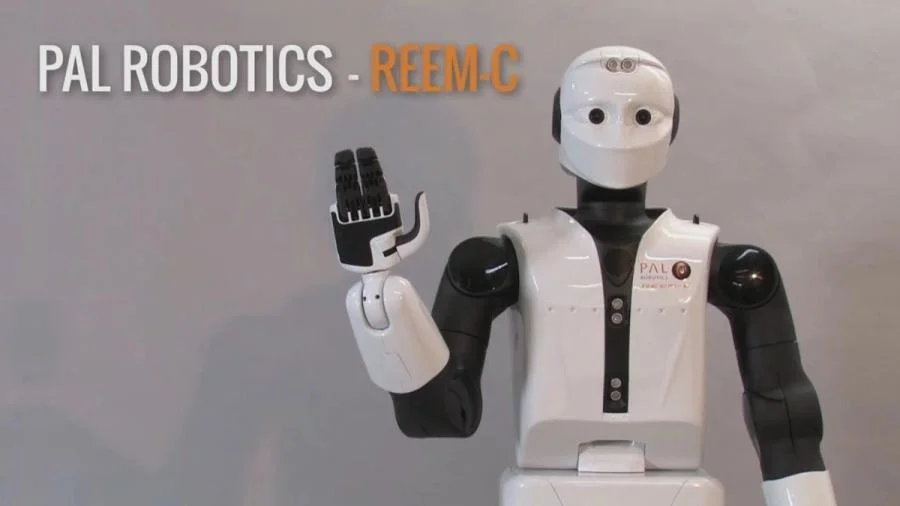
REEM-C
Main Capabilities
- Bipedal walking with dynamic balance.
- Omnidirectional navigation using LIDAR and SLAM.
- Stereo vision and object recognition.
- Speech recognition and synthesis for verbal interaction.
- Gesture and face recognition via cameras.
- Safe manipulation using force-torque sensors in arms and joints.
- Customizable software for different research needs.
Applications of REEM-C
- University robotics research.
- AI and perception system testing.
- Assistive robotics prototypes.
- Human-robot interaction experiments.
- Navigation and mapping studies.
What can REEM-C do?
REEM-C can perform a wide range of tasks designed for research, education, and human-robot interaction.
- Move Like a Human: REEM-C is capable of bipedal walking with dynamic balance control. It can walk forward, backward, turn, and sidestep. It can adjust stride and posture for stability. It can navigate stairs or small inclines in controlled conditions.
- Navigate Environments: REEM-C can map surroundings using LIDAR and stereo cameras (SLAM). It can avoid obstacles in real time. It can move autonomously between locations indoors. It can operate in crowded or dynamic environments.
- See and Understand: REEM-C uses stereo vision to perceive depth and recognize objects. It can detect and track people in its environment. It can recognize faces for personalized interaction. It can identify and locate objects for manipulation or assistance tasks.
- Manipulate Objects: REEM-C uses articulated arms and hands to grasp and hold items. It can apply safe force with force-torque sensors to avoid damage. It can perform handshakes or gentle handovers. It can assist in carrying lightweight objects.
- Communicate with People: REEM-C can understand speech commands. It can talk back with synthesized speech. It uses gestures and head movements to enhance communication. It can express emotions or status via a customizable facial display.
- Support Research & Education: REEM-C runs custom algorithms through ROS (Robot Operating System). It can collect and process environmental and interaction data. It serves as a testbed for AI, perception, and locomotion experiments.
REEM-C features
REEM-C is a full-size humanoid robot developed by PAL Robotics in Spain, designed for research in robotics, AI, human-robot interaction, and service applications.
1. Physical Design:
- Height: ~1.65 m (5’5″)
- Weight: ~80 kg
- Material: Lightweight aluminum and composite structure for strength and mobility.
- Degrees of Freedom (DoF): 44 (head, arms, hands, torso, legs).
- Human-like proportions for realistic interaction and navigation in human environments.
2. Mobility:
- Bipedal walking with dynamic balance control.
- Omnidirectional navigation using sensors and SLAM (Simultaneous Localization and Mapping).
- Speed: ~1.5 km/h walking pace.
- Stairs climbing capability in controlled conditions.
3. Sensors:
- Laser range finders (LIDAR) for mapping and obstacle detection.
- Stereo cameras for depth perception and vision processing.
- IMU (Inertial Measurement Unit) for balance and motion control.
- Force-torque sensors in joints for safe interaction.
- Microphones for speech recognition and sound localization.
4. Control & Software:
- ROS-compatible (Robot Operating System) for research and development.
- Real-time control system for stability and movement precision.
- Customizable open-source software for universities and labs.
- AI capabilities for perception, object recognition, and planning.
5. Interaction:
- Speech recognition and synthesis for verbal communication
- Gesture recognition via cameras.
- Touch sensors for tactile feedback.
- Customizable facial display for expressions.
6. Applications:
- Robotics research & education.
- Human-robot interaction experiments.
- Navigation and mapping studies.
- Assistive and service robot development.
- Bipedal locomotion research
REEM-C advantages
- Highly Realistic Humanoid Design: Human-like size and proportions make it ideal for studying human-robot interaction.
- Advanced Mobility: REEM-C is capable of bipedal walking, turning, and navigating indoor spaces, simulating real human movement.
- Open Architecture for Research: REEM-C is fully ROS-compatible with customizable software, allowing universities and labs to adapt it to their projects.
- Rich Sensor Suite: REEM-C is equipped with LIDAR, stereo vision, IMU, microphones, and force-torque sensors for versatile perception and interaction.
- Safe Human Interaction: Force sensors and compliance control help avoid harmful collisions during physical contact.
- Multi-Purpose Applications: REEM-C can be used in robotics research, AI development, mapping, locomotion studies, and assistive technology testing.
- Proven Platform by PAL Robotics: REEM-C is built by an experienced robotics company with strong support and documentation.
Disadvantages of REEM-C
- High Cost: Being a professional research platform, it is expensive and not feasible for casual or small-budget projects.
- Limited Outdoor Use: REEM-C is optimized for indoor environments; rough terrain or adverse weather can cause stability and navigation issues.
- Low Walking Speed: Around 1.5 km/h, which is slower than the average human walking speed.
- Complex Maintenance: REEM-C requires technical expertise for repairs, calibration, and software updates.
- No Autonomous General Purpose Intelligence: While programmable, it doesn’t have “out-of-the-box” high-level problem-solving; researchers must program capabilities.
- Energy Limitations: Battery life can be restrictive for long experiments, requiring recharging or tethered power for extended use.
You can follow Science Online on YouTube from this link: Science online
Sophia robot review, features, use, advantages and disadvantages
Robot teachers use, types, advantages and disadvantages
Advantages and disadvantages of using robots in our life
Automation in manufacturing use, advantages and disadvantages
Humanoid robots use, types, risks, advantages and disadvantages
Pepper robot review, features and What can Pepper do for your business?
Boston Dynamics Atlas review, advantages and features, How does Atlas robot work?