
XGO Rider Robot features, advantages, disadvantages, What can XGO Rider do?
The XGO Rider Robot is a desktop-sized, wheel-legged AI robot. It combines the agility of wheels with the adaptability of legs. It is equipped with self-balancing technology, AI vision, voice interaction, and open-source programmability, making it suitable for education, research, and interactive companionship.
XGO Rider Robot
XGO Rider is the world’s first desktop wheel-legged robot designed for learning, AI interaction, and playful robotics exploration. The XGO Rider Robot can move omnidirectionally, self-balance, recognize faces and gestures, converse using AI, and be fully programmed—making it a powerful desktop educational robot and AI companion.
What can XGO Rider do?
- Move with Unique Wheel-Legged Mobility: XGO Rider Robot travels forward, backward, sideways, and diagonally without turning. It self-balances on two wheels using IMU sensors + FOC hub motors. It can smoothly navigate desktops, classrooms, and small obstacles.
- Recognize and Interact Using AI: XGO Rider Robot uses its 5MP camera for face detection, gesture recognition, and skeleton tracking. It understands and responds to human movements in real time. It can be programmed for interactive games or vision-based tasks.
- Converse and Respond: XGO Rider Robot is equipped with microphones and a speaker for voice interaction. It supports ChatGPT integration, allowing it to chat, answer questions, and act as a learning companion.
- Perform Educational Tasks: XGO Rider Robot can be programmed with Blocky (visual coding), Python, MakeCode, MicroBlocks, or ROS. It helps students and hobbyists learn coding, AI, and robotics in a hands-on way. It runs on either micro: bit (beginner-friendly) or Raspberry Pi CM4 (advanced AI) versions.
- Remote Control & Smart Behavior: XGO Rider Robot is controlled via a mobile app (Bluetooth / Wi-Fi, depending on version). It can act as a desktop companion robot—patrolling, moving around, and interacting with users.
- Showcase Natural Motion: Its wheel-legged design gives it expressive movement that feels lively. XGO Rider Robot can perform tricks like spinning, balancing, and obstacle avoidance.
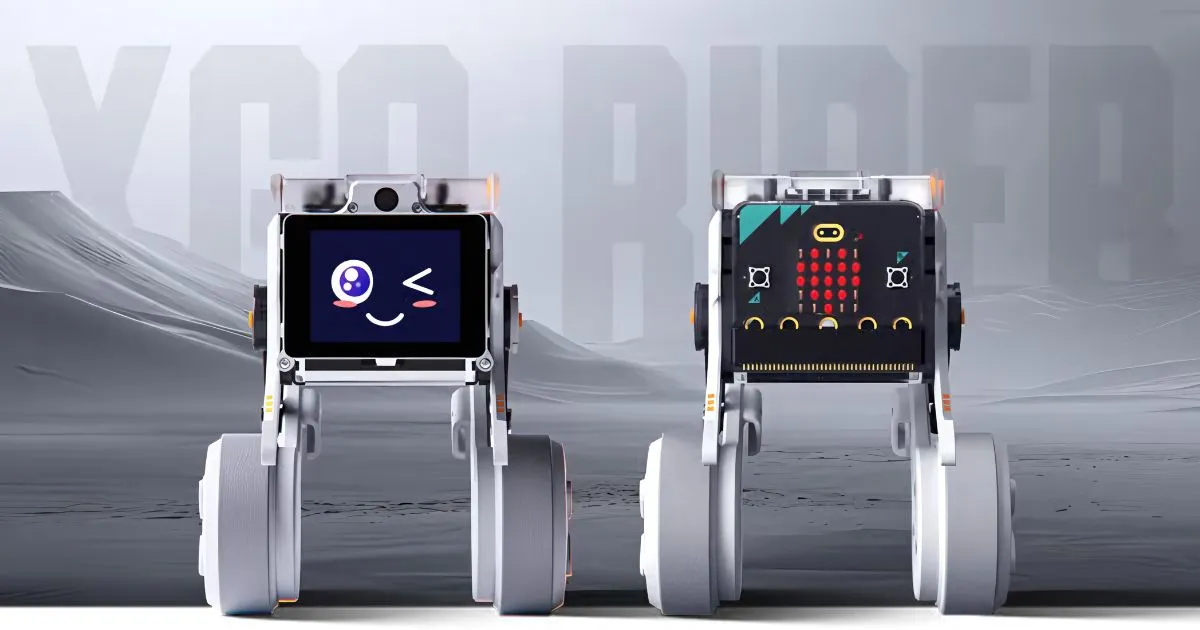
XGO Rider Robot
Features of the XGO Rider Robot
Mobility & Design
- Wheel-legged platform → XGO Rider combines wheeled speed with leg-like agility.
- Omnidirectional movement → XGO Rider moves forward, backward, sideways, and diagonally without turning.
- Self-balancing system → XGO Rider is powered by IMU sensors and FOC (Field-Oriented Control) hub motors for smooth balance and obstacle handling.
- Compact desktop size → The XGO Rider is palm-sized, portable, and designed for use on desktops or in classrooms.
- Durable materials → XGO Rider is built with aluminum alloy, carbon fiber, and all-metal servos with magnetic encoders.
Intelligence & Interaction
- AI vision → XGO Rider is equipped with a 5-megapixel camera for object recognition, gesture detection, face detection, and even skeleton tracking.
- Voice interaction → XGO Rider has Dual MEMS microphones + speaker for voice commands and AI conversation.
- ChatGPT integration → XGO Rider can hold interactive conversations and support smart responses.
- Expressive behavior → XGO Rider moves and interacts naturally, making it engaging for education and companionship.
Programming & Learning
- Open-source platform → XGO Rider supports ROS (Robot Operating System) for advanced robotics projects.
- Multiple coding options: Blocky (visual coding for beginners), Python (intermediate/advanced users), MakeCode & MicroBlocks (micro: bit version for kids and STEM education).
- Raspberry Pi CM4 core (for the advanced model) → XGO Rider provides powerful computing for AI and robotics.
- Micro: bit version available → Entry-level model tailored to younger learners.
Connectivity & Control
- Mobile app remote control → XGO Rider operates over Bluetooth for easy navigation and interaction. Wi-Fi support (CM4 version) for cloud interaction and updates.
- Expandable → XGO Rider can be customized with new programs and modules.
Power
- 1200 mAh battery → XGO Rider provides ~2 hours of operation per charge.
- USB-C charging for convenience.
Advantages of XGO Rider
The XGO Rider is a desktop-sized wheel-legged robot that combines AI vision, self-balancing mobility, and open-source programmability. It’s designed both for education (STEM, coding, robotics) and as a fun, interactive AI-powered companion.
- Innovative Wheel-Legged Mobility: XGO Rider combines wheeled motion with leg-like adaptability, allowing agile and omnidirectional movement—forward, backward, sideways, and diagonally—without needing to turn. It is equipped with IMU sensors and FOC-controlled hub motors that enable self-balancing and smooth traversal across various surfaces, handling obstacles with ease.
- Advanced AI and Interaction: XGO Rider is powered by a Raspberry Pi CM4 core with ChatGPT integration and AI features such as gesture recognition, face detection, and human skeleton tracking. It includes a 5-megapixel camera, dual MEMS microphones, and a speaker for rich image and voice interactions.
- Open-Source & Programmable: Open-source platform supporting Blocky, Python, and ROS (Robot Operating System) for both beginners and advanced users. It offers a micro:bit version compatible with MakeCode, MicroBlocks, and Python—great for educational settings.
- Compact and Well-Engineered: XGO Rider has an attractive, palm-sized design that’s portable and suited for small desktop or classroom setups. It is built with high-quality hardware: all-metal servos with magnetic encoders, FOC hub motors, aluminum/carbon fiber structure, and high integration.
- Remote Control & Rich Learning Resources: XGO Rider can be controlled via a mobile app over Bluetooth—making remote operation intuitive and interactive. It offers tutorials and structured learning materials to facilitate development and education.
- Cost-effective Desktop Companion: XGO Rider is marketed as an accessible and economical option that brings advanced robotics and AI to hobbyists, students, and desktop enthusiasts.
Disadvantages of XGO Rider
- Limited Battery Life: XGO Rider comes with a 1200 mAh (~2 hours under typical use) battery—not ideal for extended, uninterrupted usage.
- Complexity Can Be Overwhelming for Beginners: While it offers block-based programming, its full capabilities (like ROS integration, Python, ChatGPT features) might be intimidating or overkill for younger users or novices.
- Potential Overspecification: Offering both Raspberry Pi and micro: bit versions might cause confusion regarding which model fits best per use case (e.g., educational vs advanced).
- Unknown Durability Over Time: While built with quality materials, there’s limited publicly available data on long-term durability or reliability for heavy usage.
- Crowdfunding Risks: Being a Kickstarter-funded product means actual delivery schedules, post-purchase support, and updates may vary—early backers often face delays or uncertainties.
You can follow Science Online on YouTube from this link: Science online
Sophia robot review, features, use, advantages and disadvantages
Robot teachers use, types, advantages and disadvantages
Advantages and disadvantages of using robots in our life
Automation in manufacturing use, advantages and disadvantages
Humanoid robots use, types, risks, advantages and disadvantages
Pepper robot review, features, and What can Pepper do for your business?
Boston Dynamics Atlas review, advantages and features, How does Atlas robot work?