
Blue Frog Robotics, BUDDY: Your Family’s Companion Robot for emotional support
Blue Frog Robotics is a robotics company that specializes in developing emotional, social, and educational robots that interact naturally with humans using voice, facial recognition, and expressive behavior.
Blue Frog Robotics
Blue Frog Robotics is a French technology company that designs and develops social robots designed to enhance people’s daily lives. It is best known for creating Buddy, a companion robot designed to provide emotional support, assistance, and entertainment in homes, schools, and healthcare environments.
- Founded: 2014 in Paris, France
- Founder: Rodolphe Hasselvander
- Flagship product: Buddy – The Emotional Companion Robot
- Focus areas: Robotics for companionship, education, elder care, and smart home integration.
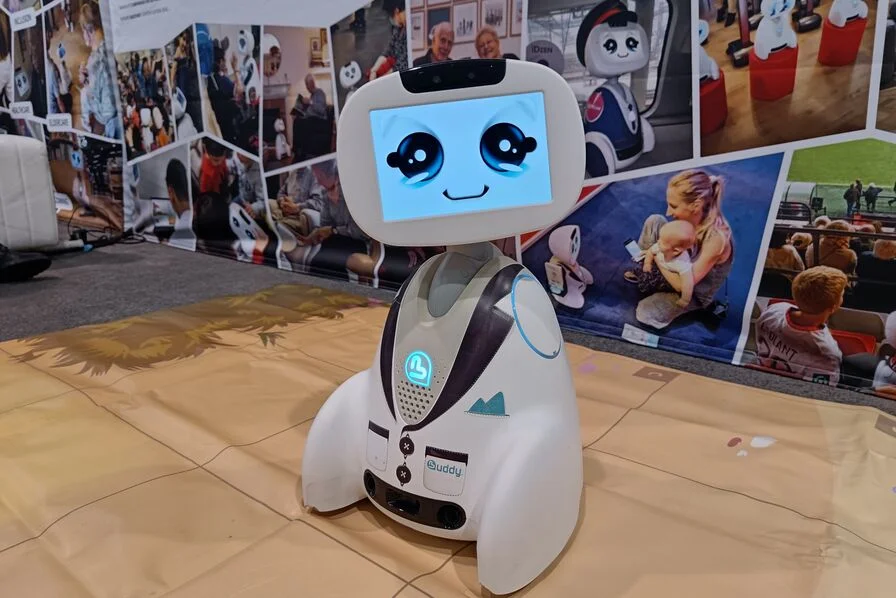
Buddy robot
Features of Buddy
Emotional & Social Interaction:
- Buddy is the companion/social robot from Blue Frog Robotics. It can express a variety of emotions (happy, grumpy, sad, etc) through its face/display and body language.
- Interaction is multi-modal, involving voice commands, touch (e.g., head stroking), and the detection of caresses.
- Buddy is designed to foster empathy and connection (especially in settings like education, inclusion, and elder-care).
Mobility & Physical Presence:
- Buddy is about 56 cm tall (~22″) and weighs ~8 kg.
- Buddy moves on wheels, has an articulated head, obstacle sensors, floor/ground sensors, etc.
- Buddy supports remote navigation/telepresence: for example, a remote user can pilot the robot via tablet and thereby participate virtually in a class or at home.
Rich Sensing & Interaction Hardware:
- Buddy has a touchscreen face (8-inch screen) that acts as an interface and “face”.
- Cameras (RGB & 3D), microphones (omni‐ and unidirectional), speakers, obstacle detectors, ground/cliff sensors, caress sensors.
- Connectivity: Wi-Fi, Bluetooth, optional 4G / SIM slot for remote use.
Platform for Developers & Customization:
- Buddy is built on an Android-based platform and comes with a full SDK (Software Development Kit) for developers: control of sensors, movement, facial expressions, vision/recognition, and voice interaction.
- Modular hardware/accessory ports: for example, USB accessory ports on the “shoulders” to attach custom modules or sensors.
- Open architecture: allows third‐party apps, custom hardware, and research use.
Application Areas & Use-Cases:
- Education: interactive quizzes, storytelling, teaching coding/AI, and engaging kids in learning via Buddy.
- Telepresence/inclusion: Buddy is used as an avatar for students who cannot attend class physically.
- Companion/Assistance: In homes, eldercare, hospitality — as a social/emotional companion, assistant, and interactive presence.
Some Technical Specs (for reference)
- Height: ~56 cm; Weight: ~8 kg.
- Mobility: Buddy can detect obstacles, climb small transitions (e.g., ~1.5 cm), etc.
- Interaction: Voice recognition, text-to-speech, face recognition, and tracking.
- SDK supports controlling movement (wheels/head), sensors, vision, and facial expressions.
Why These Features Matter
- The emotional/social interaction capabilities make Buddy more than a textbook “assistant robot” — it aims to be a companion.
- Mobility + sensing means Buddy isn’t fixed in one place: it can move and interact physically in a space (which increases its presence).
- Developer-friendly platform means the robot isn’t limited to manufacturer‐predefined uses — it can grow and be tailored.
- Use-cases in education & inclusion show real-world utility beyond novelty: helping remote students, children with special needs, etc.
Buddy advantages
- Emotional and social companion capabilities: Buddy is designed specifically to interact not just as a machine but as a “presence” — with facial expressions, mobility, voice, and touch sensors. For example, it has been used in inclusion/education contexts to help children feel less isolated. It supports interaction via voice, touch, head movements, etc. This means it can provide companionship, engagement, and possibly reduce loneliness or isolation.
- Versatility / multiple application domains: Buddy is positioned for education (quizzes, coding, remote presence), It is also for elder-care or home-assistant functions (reminders, video calls, monitoring). Developer-friendly: there is an SDK (software development kit) enabling custom apps, integration, sensors, etc. This means its utility can extend beyond a toy or single-use robot.
- Mobility + physical embodiment: Unlike static or screen-only assistants, Buddy is mobile (on wheels), it has sensors, and can physically move in an environment. Many users find the “embodied” nature (robot in space) enhances engagement over a screen only.
- Focus on inclusion & special-needs use: There are case studies of Buddy helping children with autism, children who are hospitalized, enabling remote classroom attendance. This sets it apart from many generic home assistants.
Buddy disadvantages
- High cost/affordability for the general consumer: Some reviews point out that while Buddy has many capabilities, the price (or projected price) is high compared to simpler smart devices. If the premium is mainly for the “emotional companion” aspect, some users may judge cost-benefit differently.
- Delayed development/deliverability issues: The company has been reported to struggle with funding, delays, and delivering products to market. This raises risks for early adopters (e.g., potential delays, support challenges).
- Technical and functional gaps: Some practical limitations: sensors, voice recognition, navigation around obstacles have been reported as weaker in early prototypes. For example, one reviewer noted the robot “had difficulty spotting people’s faces… and tried to charge off the edge of a table”. This suggests that while the concept is strong, real-world robustness may lag.
- Ecosystem/accessory dependence: While Buddy offers many functions, some of those depend on additional accessories, modules, or developer apps. The base package may not include arms/manipulators, advanced integrations, etc. If you expect “full home robot helper with arms,” you may be disappointed.
- Privacy/security concerns: As with any connected robot with cameras, microphones, mobility, and sensors, there are inherent concerns about data, remote access, and home security. While not heavily reported for Buddy specifically, it’s a typical caution for this category.
Buddy is a very interesting proposition in the social/companion robot space, especially for educational, inclusive, and emotionally-oriented use cases. Its strengths are in interaction, presence, adaptability, and ambition.
However, it carries the risks typical of advanced robotics in the consumer/hobby space: high cost, long development lead times, lesser maturity in some hardware/software functions, and the challenge of delivering value-for-money beyond novelty.
If you are considering Buddy (or similar) and your use case is one of the stronger ones (e.g., education, special-needs support, robotics development), then the advantages may well outweigh the disadvantages. If your use case is more generic (e.g., “just want a home assistant robot”), then you might want to compare carefully to simpler devices.
You can follow Science Online on YouTube from this link: Science online
Buddy Robot review, features, advantages, disadvantages, What can a buddy robot do?
Top trends on the Cozmo robot, Cozmo in the workplace, education, and as a companion
Vector robot review, advantages, disadvantages, and specifications
Emo robot review, advantages, disadvantages, features, and what can Emo do?
Ameca robot review, features, advantages, disadvantages, and what can Ameca Do?
Eilik Desktop Companion Robot structure, features, use, advantages and disadvantages
Sophia robot review, features, use, advantages and disadvantages
Tesla robots (Optimus) review, use, advantages and disadvantages
MarsCat features, advantages, disadvantages, What can MetaCat do?