
AI vs Machine Learning: 7 Powerful Differences You Need to Know. What is AI and machine learning?
AI vs. machine learning is one of the most searched technology topics today. But what is the actual difference between AI and machine learning? Learn what artificial intelligence and machine learning mean, how they work, their real-world applications, and why machine learning has become a major part of modern AI.
AI vs Machine Learning
AI vs Machine Learning
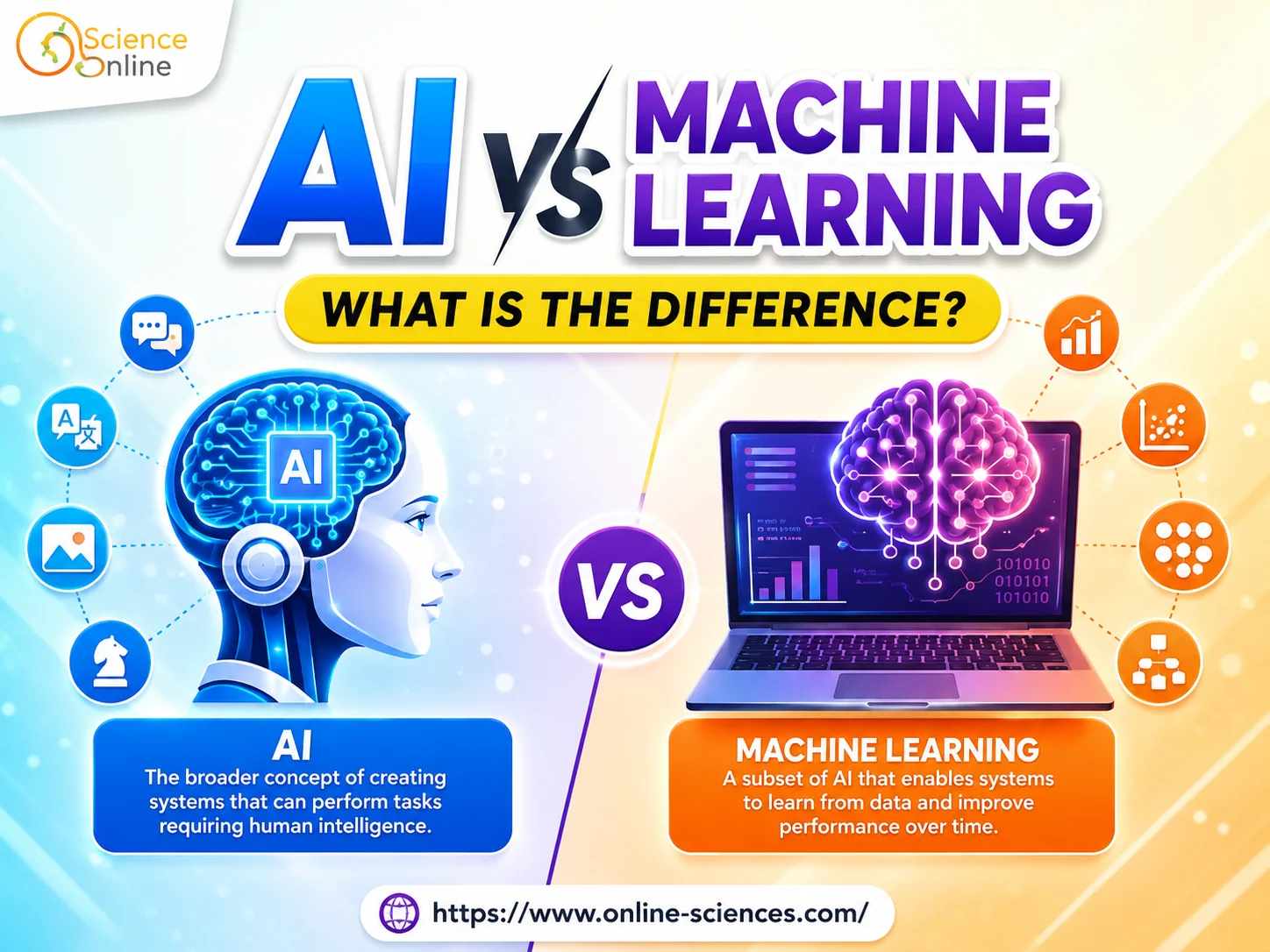
Artificial Intelligence (AI) and Machine Learning (ML) are two of the most important technologies shaping modern computing. Although the terms are often used interchangeably, they do not mean the same thing. AI is the broader concept of creating systems that can perform tasks associated with human intelligence, while machine learning is one of the main approaches for building AI systems.
From chatbots and recommendation systems to autonomous robots, fraud detection, image recognition, and generative AI, these technologies are becoming part of everyday life. Understanding the difference between AI and machine learning makes it easier to understand how today’s intelligent applications actually work.
What is Artificial Intelligence (AI)?
Artificial Intelligence, commonly called AI, is a broad field of computer science focused on developing machines and software that can perform tasks requiring capabilities associated with human intelligence. These capabilities can include learning, reasoning, perception, problem-solving, language understanding, planning, decision-making, and taking actions.
AI does not necessarily have to learn from data. Some AI systems can operate using predefined rules, logic, search algorithms, or other computational techniques. For example, a system can be designed to follow a complex set of rules to make decisions without using machine learning.
Modern AI systems, however, increasingly rely on machine learning because learning from data lets systems handle complex patterns and adapt more effectively.
What is Machine Learning?
Machine Learning (ML) is a subset of artificial intelligence that enables computer systems to learn patterns from data and improve their performance rather than relying entirely on explicitly programmed instructions. NIST describes machine learning as the development and use of computer systems that adapt and learn from data with the goal of improving accuracy.
Instead of telling a computer every rule it needs to follow, developers provide an ML algorithm with data from which it can identify patterns. The resulting model can then use those patterns to make predictions, classifications, recommendations, or other decisions on new data.
For example, an email spam filter can be trained using examples of spam and legitimate messages. After learning patterns in the training data, the model can estimate whether a new message is likely to be spam.
AI vs Machine Learning: What is the Difference?
The simplest way to understand the relationship is: Artificial Intelligence → Machine Learning → Deep Learning
AI is the broader field, while machine learning is a subset of AI. Deep learning is a further subset of machine learning based largely on multi-layer neural networks.
AI vs Machine Learning can be confusing because the two terms are closely related, but they are not the same. Artificial Intelligence (AI) is the broader concept of creating computer systems and machines that can perform tasks that normally require human intelligence, such as understanding language, recognizing images, solving problems, making decisions, and planning actions.
Machine Learning (ML) is a subset of AI that allows computers to learn patterns from data and improve their performance without being explicitly programmed for every possible situation. In simple terms, AI is the larger field, while machine learning is one of the most important methods used to create intelligent systems.
For example, an AI-powered robot may use machine learning to recognize objects, understand human speech, and make decisions based on what it observes. Therefore, all machine learning is part of AI, but not all AI systems use machine learning.
How Does AI Work?
An AI system generally receives information from its environment or from users, processes that information, and produces an output such as a prediction, recommendation, decision, or action.
For example, an intelligent robot may use cameras and other sensors to understand its surroundings. AI techniques can then help it recognize objects, plan movements, make decisions, and interact with people.
Modern AI can combine several technologies. These may include machine learning, computer vision, natural language processing, robotics, knowledge representation, optimization, and reasoning.
How Does Machine Learning Work?
Machine learning usually involves several important steps:
- Collecting data – Relevant examples are gathered.
- Preparing the data – Data is cleaned and organized.
- Training a model – An algorithm learns patterns from the training data.
- Testing the model – Its performance is evaluated using data it has not seen during training.
- Deployment – The trained model is used to make predictions or decisions.
- Monitoring and improvement – The model can be evaluated and updated as new data becomes available.
The fundamental objective is not simply to memorize the training data, but to generalize—that is, perform effectively on new data and real-world situations.
Types of Machine Learning
Machine learning can be divided into several major approaches.
1. Supervised Learning: In supervised learning, the model is trained using labeled examples. The input data is paired with the desired output.
For example, a model could be trained using medical images labeled according to whether a particular feature is present, or financial transactions labeled as legitimate or fraudulent. Supervised learning is commonly used for classification and prediction.
2. Unsupervised Learning: In unsupervised learning, the model works with data without predefined output labels. It attempts to discover structures, relationships, or patterns within the data. Clustering is a common example. A system might group customers according to similarities in their purchasing behavior.
3. Reinforcement Learning: In reinforcement learning, an agent interacts with an environment and learns through feedback. Actions can receive rewards or penalties, encouraging the system to discover strategies that produce better results. Reinforcement learning has applications in robotics, games, optimization, and autonomous decision-making.
What is Deep Learning?
Deep learning is a specialized area of machine learning that uses neural networks with multiple layers. These systems can learn increasingly complex representations from large quantities of data.
Deep learning is particularly important for applications involving images, speech, natural language, and other complex data. Neural networks form the foundation of many modern AI applications, including large language models and generative AI systems.
AI vs Machine Learning in Real Life
AI and machine learning are already used in many areas.
- Healthcare: AI and ML can support medical image analysis, risk prediction, research, and clinical decision-support systems.
- Transportation: Machine learning can contribute to perception, prediction, navigation, and autonomous-driving technologies.
- Smartphones: AI-powered features can include voice assistants, image processing, facial recognition, translation, and personalized recommendations.
- E-commerce: Recommendation systems analyze user behavior to suggest products that may be relevant to individual customers.
- Cybersecurity: ML models can help identify unusual activity and potentially detect suspicious patterns.
- Robotics: AI allows robots to perceive their surroundings, make decisions, plan actions, and interact with humans.
- Generative AI: Modern generative systems can create text, images, audio, video, and other content. Generative AI is closely connected to machine learning and deep learning.
Is Machine Learning the Same as AI?
No. Machine learning and AI are related, but they are not identical. Machine learning is one method of achieving artificial intelligence. AI can also involve systems based on predefined rules, reasoning, planning, search, optimization, and other techniques. A useful analogy is that AI is the larger field, while machine learning is one of the important tools inside that field.
Why is Machine Learning So Important to Modern AI?
Machine learning has become particularly important because many real-world problems are too complicated to solve efficiently by manually writing rules for every possible situation.
For example, it would be extremely difficult to manually program every possible appearance of a cat in an image. A machine learning system can instead learn visual patterns from many examples and use what it learned to recognize new images. This data-driven approach has helped machine learning become a major foundation of modern AI applications.
Advantages of AI and Machine Learning
Some major benefits include:
- Automating repetitive tasks.
- Analyzing huge amounts of data.
- Finding patterns that may be difficult for humans to detect.
- Making predictions and recommendations.
- Improving productivity.
- Supporting decision-making.
- Personalizing digital services.
- Enabling more capable robots and autonomous systems.
- Creating new forms of human-computer interaction.
Disadvantages of AI and Machine Learning
AI and machine learning also have important limitations. Their performance can depend heavily on the quality and suitability of the data used to develop them. AI systems can also produce incorrect or unreliable outputs, and responsible development requires attention to issues such as security, privacy, fairness, transparency, and human oversight. NIST emphasizes a risk-based approach to developing and using AI while maximizing benefits and reducing potential negative consequences.
Another important point is that impressive AI performance does not necessarily mean that a system possesses human-like understanding or consciousness. Many AI systems are highly specialized and operate within the capabilities for which they were designed.
AI vs Machine Learning: The Simple Answer
If you remember only one thing, remember this: AI is the broad concept of making machines capable of intelligent behavior, while machine learning is a technique that allows machines to learn patterns from data and improve their performance. In other words, all machine learning belongs to AI, but not all AI is machine learning.
Frequently Asked Questions
What is AI in simple words?
AI is technology that enables computers and machines to perform tasks associated with human intelligence, such as understanding language, recognizing objects, solving problems, making decisions, and learning.
What is machine learning in simple words?
Machine learning is a way of building computer systems that learn patterns from data and use those patterns to make predictions or decisions on new information.
Is AI better than machine learning?
It is not really a question of which is better. AI is the broader field, and machine learning is one of the technologies used within AI.
Is ChatGPT AI or machine learning?
ChatGPT is an AI application that relies heavily on machine learning and deep learning techniques, particularly large neural-network models trained on large datasets.
What is the difference between AI, ML, and deep learning?
AI is the broadest concept. Machine learning is a subset of AI, while deep learning is a subset of machine learning that uses multi-layer neural networks.
Does AI always use machine learning?
No. AI can be created using different approaches, including rules, logic, search, planning, optimization, and machine learning.
What are examples of machine learning?
Examples include spam detection, recommendation systems, image classification, fraud detection, predictive models, speech recognition, and many modern generative AI systems.
Why is machine learning important?
Machine learning allows computers to learn patterns from data instead of requiring programmers to manually specify every rule for complicated tasks.
Conclusion
AI vs. machine learning is not really a competition between two separate technologies. Instead, they describe two connected concepts. Artificial intelligence is the broader field concerned with creating systems capable of intelligent behavior, while machine learning is a major approach that enables computers to learn from data.
As AI continues to develop, understanding the relationship between AI, machine learning, deep learning, neural networks, and generative AI will become increasingly important. These technologies are already transforming software, robotics, healthcare, transportation, education, business, and many other fields.
You can follow Science Online on YouTube from this link: Science Online
Gemini Takes Over: The End of Google Assistant in 2026! 🚀
Goodbye Google Assistant: Can Your Android Phone Actually Run Gemini? 🚀
Applications of Artificial Intelligence and Machine Learning in business
Machine learning overview, definition, tools, applications, advantages and disadvantages
Artificial intelligence (AI) definition, advantages, disadvantages, features and applications
Robot software and Best Programming Language for Robotics
Computer programming, Advantages & disadvantages of being a computer programmer