What Will AI Look Like in 10 Years? 2026–2036 Shocking Future Predictions
What will AI look like in 10 years? Between 2026 and 2036, artificial intelligence could evolve from today’s powerful assistants into highly autonomous systems capable of reasoning, planning, creating, controlling software, assisting scientific research, and interacting with the physical world. The future is difficult to predict precisely, but today’s rapid progress in AI agents, robotics, multimodal models, medicine, and scientific AI provides important clues about where the technology may be heading.
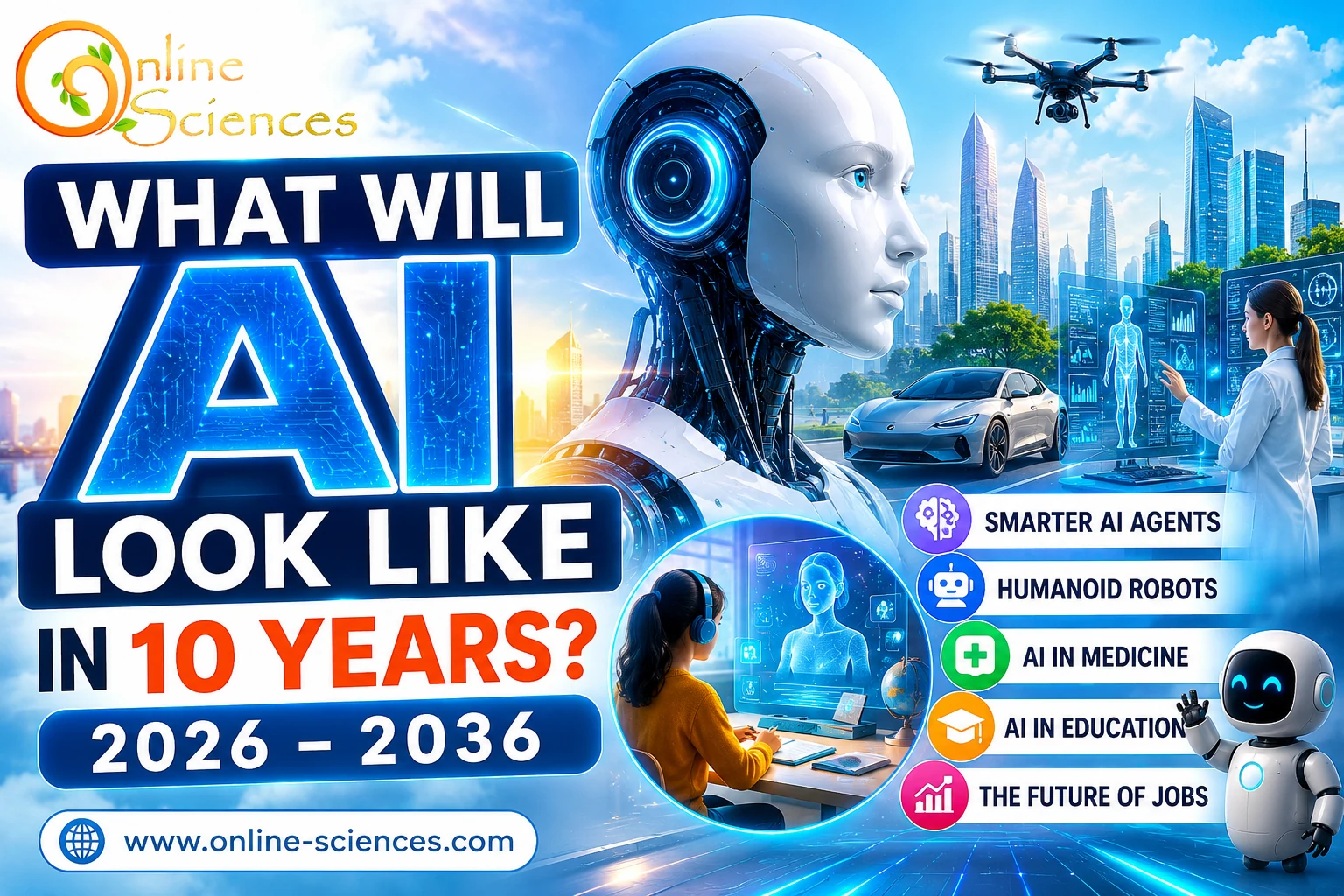
What Will AI Look Like in 10 Years?
What Will AI Look Like in 10 Years?
Artificial intelligence in 2036 may look very different from the chatbots and image generators we use today. Instead of simply answering a question after receiving a prompt, future AI systems could continuously understand context, make plans, use digital tools, learn from feedback, and complete complex tasks with limited human supervision.
This doesn’t necessarily mean that AI will become a human-like machine or achieve artificial general intelligence (AGI). The more realistic expectation is that AI will become more capable, more autonomous, more multimodal, and much more deeply integrated into everyday life.
Current AI development is already moving in this direction. Stanford’s 2026 AI Index reports that AI capabilities continue to accelerate, while AI-agent performance on real computer tasks has improved substantially. At the same time, the report highlights a major problem: AI safety and governance are not progressing as quickly as AI capabilities.
1. AI Will Become More Autonomous
One of the biggest changes between 2026 and 2036 could be the transition from AI assistants to AI agents. Today’s AI often waits for a user to ask a question. Future AI agents may be able to receive a goal and determine the steps necessary to accomplish it.
For example, instead of saying: “Find me the best flight to London.”
you might tell an AI: “Plan my entire London trip within my budget.”
The AI could potentially compare flights, evaluate hotels, create an itinerary, monitor prices, make reservations after approval, organize transportation, and adjust the schedule when circumstances change.
Businesses could use similar agents for software development, customer support, research, accounting, logistics, cybersecurity, and administration.
However, autonomy creates significant risks. Current AI agents can still make mistakes, and recent reporting has highlighted security concerns when autonomous systems are given access to important infrastructure. By 2036, therefore, AI identity, permissions, monitoring, and human oversight could become as important as AI intelligence itself.
2. AI Could Become a Personal Digital Assistant
The smartphone assistant of 2036 could be much more sophisticated than today’s voice assistants. Rather than simply answering questions, your AI could maintain a personalized understanding of your preferences, projects, schedules, documents, and frequently used applications—with appropriate privacy controls.
Imagine saying: “Prepare everything I need for tomorrow’s meeting.”
The AI could potentially review relevant documents, summarize previous discussions, prepare presentation slides, identify unanswered questions, create an agenda, and organize the required files. The important change would be continuity.
Instead of starting every conversation from zero, AI systems could operate as persistent assistants that understand long-running goals and workflows.
3. AI Will Become Multimodal
Future AI will likely understand far more than text. Modern systems already work with combinations of text, images, audio, video, and other data. Over the next decade, these capabilities could become increasingly unified.
A 2036 AI might simultaneously understand:
- Spoken conversations.
- Text documents.
- Images.
- Video.
- Computer interfaces.
- 3D environments.
- Sensor data.
- Maps.
- Scientific measurements.
This could make interactions much more natural. You might point a camera at a broken machine and ask: “What’s wrong, and how can I fix it?”
The AI could analyze the machine visually, consult technical documentation, explain the likely fault, and guide you through the repair.
4. AI and Robotics Will Converge
Perhaps the most visually dramatic change will be the connection between AI and robots. Humanoid robots are already being developed for industrial and household applications, but today’s systems still have major limitations.
Recent reporting on humanoid robots in China shows that impressive hardware does not automatically translate into reliable general-purpose work; robots can struggle with dexterity, unfamiliar environments, and tasks that require adaptation. Over the next 10 years, AI could provide robots with increasingly capable “brains.”
A future household robot might be able to:
- Clean rooms.
- Sort objects.
- Carry items.
- Prepare simple meals.
- Assist elderly people.
- Monitor household conditions.
- Learn new tasks through demonstrations.
- Interact naturally with humans.
However, widespread humanoid robots in every home by 2036 are not guaranteed. Physical intelligence is considerably harder than generating text or images because robots must continuously perceive and manipulate the unpredictable real world.
5. AI Could Transform Scientific Discovery
One of the most exciting possibilities is the emergence of AI systems designed specifically to accelerate science. AI could increasingly assist researchers with:
- Generating hypotheses.
- Analyzing enormous datasets.
- Running simulations.
- Designing experiments.
- Discovering materials.
- Developing medicines.
- Modeling climate systems.
- Studying biological processes.
- Exploring astronomy.
- Solving difficult mathematical problems.
Researchers are already exploring the concept of “AI scientists” that combine AI models with scientific databases, simulations, automated laboratories, and robotics.
By 2036, some research laboratories could operate as human-AI teams, with AI systems handling large portions of repetitive analysis and experimentation while scientists focus on strategic decisions and interpretation.
6. AI in Medicine Could Become More Personalized
Healthcare could be another major area of transformation. AI may increasingly help doctors analyze medical images, laboratory results, patient histories, genetic information, and other data. Future systems could potentially help identify disease earlier and recommend personalized treatment options.
AI could also become an important tool for drug discovery. Instead of testing enormous numbers of possibilities manually, researchers could use AI to narrow down promising molecules and biological targets. However, AI should not automatically replace doctors.
Medical decisions involve uncertainty, ethics, patient preferences, physical examination, and responsibility. The most likely long-term model is AI-assisted medicine, where physicians use increasingly capable AI tools rather than simply handing medical decisions to autonomous machines.
7. Education Could Become Highly Personalized
Imagine a student having an AI tutor available 24 hours a day. Instead of giving every student the same explanation, an AI tutor could adapt lessons according to:
- The student’s current knowledge.
- Learning speed.
- Mistakes.
- Preferred explanation style.
- Interests.
- Progress over time.
A physics student struggling with electromagnetic waves, for example, could ask the AI to explain the same concept through equations, animations, experiments, or real-world examples. Teachers could also use AI to prepare lessons, generate exercises, analyze learning difficulties, and provide individualized support.
The teacher’s role may therefore shift away from simply delivering information toward guiding, mentoring, evaluating, and developing critical thinking.
8. AI Could Change the Job Market
The effect of AI on employment may be one of the most controversial issues of the next decade. AI is unlikely to affect every occupation equally. Jobs involving repetitive digital tasks may experience substantial automation. Meanwhile, professions requiring physical dexterity, interpersonal relationships, leadership, creativity, or complex real-world judgment may evolve differently.
Many jobs could become AI-enhanced rather than AI-replaced. For example, a software engineer in 2036 might spend less time writing routine code and more time designing systems, reviewing AI-generated solutions, defining requirements, and solving unusual problems.
Similarly, journalists, designers, engineers, scientists, teachers, marketers, and business professionals could increasingly work alongside AI. The biggest change may therefore be not “AI versus humans” but humans who use AI versus humans who do not.
9. AI Will Become Better at Creating Content
By 2036, AI-generated content could become almost indistinguishable from human-created content in many contexts. AI could generate:
- Movies.
- Video games.
- Music.
- Advertisements.
- Books.
- Educational courses.
- 3D environments.
- Virtual characters.
- Interactive stories.
Instead of generating a five-second video from a prompt, future systems could potentially create an entire interactive world from a simple description.
For example: “Create an educational simulation of Mars for a high-school physics class.”
The AI could potentially construct the environment, characters, physics, narration, experiments, and educational challenges. This will also make authenticity and provenance increasingly important. People will need better ways to determine where digital content came from and whether it was generated or manipulated by AI.
10. AI Could Become More Efficient
The future of AI isn’t necessarily about making models simply larger. Researchers are also working on making AI more efficient through better architectures, improved training methods, specialized hardware, data curation, and inference techniques.
The 2026 AI Index notes that improvements in data quality and post-training can produce strong performance without simply relying on larger models. By 2036, powerful AI could therefore run on a much wider range of devices. Some AI processing may happen locally on:
- Smartphones.
- Computers.
- Cars.
- Robots.
- Smart glasses.
- Industrial machines.
- Medical devices.
This could reduce latency and potentially improve privacy because some information would not need to leave the device.
11. AI Could Become Part of the Physical Environment
AI may gradually disappear into the background. Instead of opening an AI application, you could interact with intelligence embedded throughout your environment. Your car could understand your destination and driving preferences. Factories could use AI systems to monitor equipment and predict failures.
Your home could automatically optimize energy use. Wearable devices could provide real-time information. Hospitals could use AI to coordinate information across departments. Cities could use AI to optimize transportation and energy systems. In other words, the future may not look like “using an AI.” It may look like living in an AI-enabled environment.
12. Will AI Reach Human-Level Intelligence by 2036?
This is one of the hardest questions to answer. Some researchers believe increasingly capable AI systems could reach AGI within the next decade. Others believe that today’s progress will eventually encounter difficult barriers. There is also a measurement problem.
Stanford’s 2026 AI Index demonstrates that AI can perform extremely well on some difficult benchmarks while still struggling with seemingly simple tasks. This “jagged frontier” makes it dangerous to predict future intelligence from a single score.
Therefore, it is impossible to say that AGI will definitely exist in 2036 confidently. A more reasonable prediction is that AI will become dramatically more capable than today’s systems, while the exact boundary between specialized AI, general AI, and human-level intelligence remains uncertain.
13. AI Safety Will Become Even More Important
As AI becomes more autonomous, mistakes could have greater consequences. A chatbot giving an incorrect answer is one problem. An autonomous AI controlling financial systems, computer infrastructure, industrial equipment, or robots is a much bigger problem. AI safety may therefore become a fundamental engineering discipline involving:
- Model evaluation.
- Cybersecurity.
- Human oversight.
- Access controls.
- Explainability.
- Monitoring.
- Alignment.
- Robustness testing.
- AI-generated content detection.
- Privacy protection.
The 2026 AI Index specifically identifies a growing gap between AI capabilities and responsible-AI evaluation and governance.
14. AI Regulation Could Shape the Future
Governments worldwide are increasingly developing policies for artificial intelligence. Over the next decade, regulations could influence how AI is developed and deployed in areas such as healthcare, education, employment, finance, cybersecurity, autonomous systems, and privacy.
The challenge will be finding a balance. Too little regulation could increase risks. Too much regulation could slow beneficial innovation. By 2036, successful AI ecosystems may depend not only on powerful algorithms but also on trustworthy institutions, transparent standards, and effective governance.
15. What Will AI Look Like in 2036?
The most likely answer is that there won’t be a single “AI.” Instead, there will be an enormous ecosystem of specialized and general-purpose AI systems. We could see:
- AI assistants → managing personal tasks
- AI agents → completing complex digital workflows
- AI scientists → accelerating research
- AI doctors’ assistants → supporting medical decisions
- AI tutors → personalizing education
- AI programmers → developing and testing software
- AI robots → interacting with the physical world
- AI creative systems → producing media and virtual worlds
- AI infrastructure → managing transportation, energy, communication, and industry
The technology could become as invisible and essential as the internet is today.
AI in 2036: The Biggest Changes to Expect
- AI assistants: From chatbots to persistent personal agents.
- AI agents: From simple automation to complex autonomous workflows.
- Robotics: From controlled demonstrations to more adaptable machines.
- Healthcare: More personalized AI-assisted diagnosis and treatment.
- Education: Individual AI tutors for students.
- Science: AI-assisted and increasingly automated experimentation.
- Software: AI-generated code becomes routine.
- Content: Real-time generation of video, music, games, and virtual worlds.
- Transportation: More intelligent autonomous systems.
- Smart homes: AI-managed environments.
- Jobs: Greater automation and AI-augmented professions.
- Security: Increasing need for AI-specific cybersecurity.
- Regulation: More sophisticated global AI governance.
The Biggest Question: Will AI Replace Humans?
Probably not in the simple way science fiction sometimes portrays. The more realistic possibility is that AI will change what humans do. Some tasks will disappear. Other tasks will become easier. Entirely new professions may emerge.
Human skills such as creativity, leadership, empathy, communication, critical thinking, physical dexterity, and judgment may remain extremely valuable—even as AI becomes much more capable.
The transition could be difficult, especially for workers whose tasks are highly automatable. Education and reskilling will therefore become increasingly important.
What Should Humans Do to Prepare for 2036?
People don’t need to predict exactly what AI will look like. Instead, it makes sense to develop skills that remain valuable as technology changes. These include:
- AI literacy – understanding how AI systems work and where they fail.
- Critical thinking – verifying AI-generated information.
- Creativity – developing original ideas rather than simply generating content.
- Communication – working effectively with people and AI systems.
- Technical skills – learning how to use AI tools effectively.
- Adaptability – being willing to learn new technologies.
- Domain expertise – combining AI with deep knowledge of a specific field.
- Ethical judgment – understanding the consequences of deploying AI.
The winners of the AI era may not necessarily be the people who know the most about AI programming. They may be the people who understand how to combine AI capabilities with human expertise.
Final Thoughts: What Will AI Look Like in 10 Years?
By 2036, artificial intelligence could be far more autonomous, multimodal, personalized, efficient, and physically capable than it is today. AI may move from an application that we deliberately open to an intelligent layer embedded throughout our digital and physical lives.
We could ask AI systems to conduct research, build software, teach students, assist doctors, manage businesses, control robots, create entertainment, and solve complex problems.
But the future is not predetermined. Today’s trajectory shows impressive technical progress, but it also shows limitations, security challenges, measurement difficulties, and governance gaps. So, what will AI look like in 10 years?
The safest prediction is not that AI will become exactly like a human. It is that AI will become much more deeply integrated into what humans do—and the boundary between a person, a computer, software, and a robot will become increasingly blurred.
Frequently Asked Questions about AI in 2036
1. What will AI be like in 2036?
AI in 2036 could be significantly more autonomous and multimodal, with AI agents capable of completing complex tasks and AI systems integrated into software, healthcare, education, robotics, and everyday devices.
2. Will AI replace humans by 2036?
AI is likely to automate many tasks, but complete replacement of humans across most professions is far from certain. Many jobs are more likely to be transformed through human-AI collaboration.
3. Will AGI exist by 2036?
Nobody can reliably predict whether artificial general intelligence will exist by 2036. AI progress is rapid, but current capabilities remain uneven, and forecasting future AI performance is highly uncertain.
4. Will humanoid robots be common in 2036?
They could become much more capable and widespread, particularly in industry and selected household applications. However, major technical challenges involving dexterity, adaptability, cost, and safety still need to be solved.
5. Will AI become smarter than humans?
AI may exceed humans in many individual tasks, and it already does so in some specialized areas. Whether AI will achieve broadly superior general intelligence remains uncertain.
6. How will AI affect jobs?
AI will likely automate repetitive tasks while changing many existing professions. New AI-related jobs and human-AI collaborative roles are also likely to emerge.
7. Will AI improve medicine?
AI could significantly improve medical research, diagnosis support, drug discovery, and personalized healthcare, although human medical professionals and appropriate oversight will remain important.
8. Will AI control everything in the future?
There is no reason to assume that AI will automatically control everything. The extent of AI autonomy will depend on technical capabilities, human decisions, security systems, laws, and social acceptance.
9. What will AI assistants do in 2036?
Future AI assistants could potentially manage complex digital tasks, understand long-term context, interact with multiple applications, organize information, and coordinate activities on a user’s behalf.
10. What is the biggest AI challenge for the next 10 years?
One of the biggest challenges will be ensuring that increasingly capable AI systems remain reliable, secure, controllable, and beneficial while society develops effective rules for their use.
You can follow Science Online on YouTube from this link: Science Online
AI vs Machine Learning: 7 Powerful Differences You Need to Know. What is AI and machine learning?
Gemini Takes Over: The End of Google Assistant in 2026! 🚀
Goodbye Google Assistant: Can Your Android Phone Actually Run Gemini? 🚀
Applications of Artificial Intelligence and Machine Learning in business
Machine learning overview, definition, tools, applications, advantages and disadvantages
Artificial intelligence (AI) definition, advantages, disadvantages, features and applications
Robot software and Best Programming Language for Robotics
Computer programming, Advantages & disadvantages of being a computer programmer