Tesla Bot Gen 3: 1,000 Robots a Week — 7 Powerful Reasons You Still Can’t Buy One
Tesla Bot Gen 3, also known as Tesla Optimus Gen 3, represents a major step toward Elon Musk’s vision of humanoid robots that can work in factories and eventually help people at home. Tesla is working to scale up production, with a reported target of more than 1,000 robots per week by the end of 2026. However, manufacturing thousands of robots is only part of the challenge. Improving artificial intelligence, dexterity, reliability, and safety is essential before Tesla can offer a practical robot for everyday consumers.
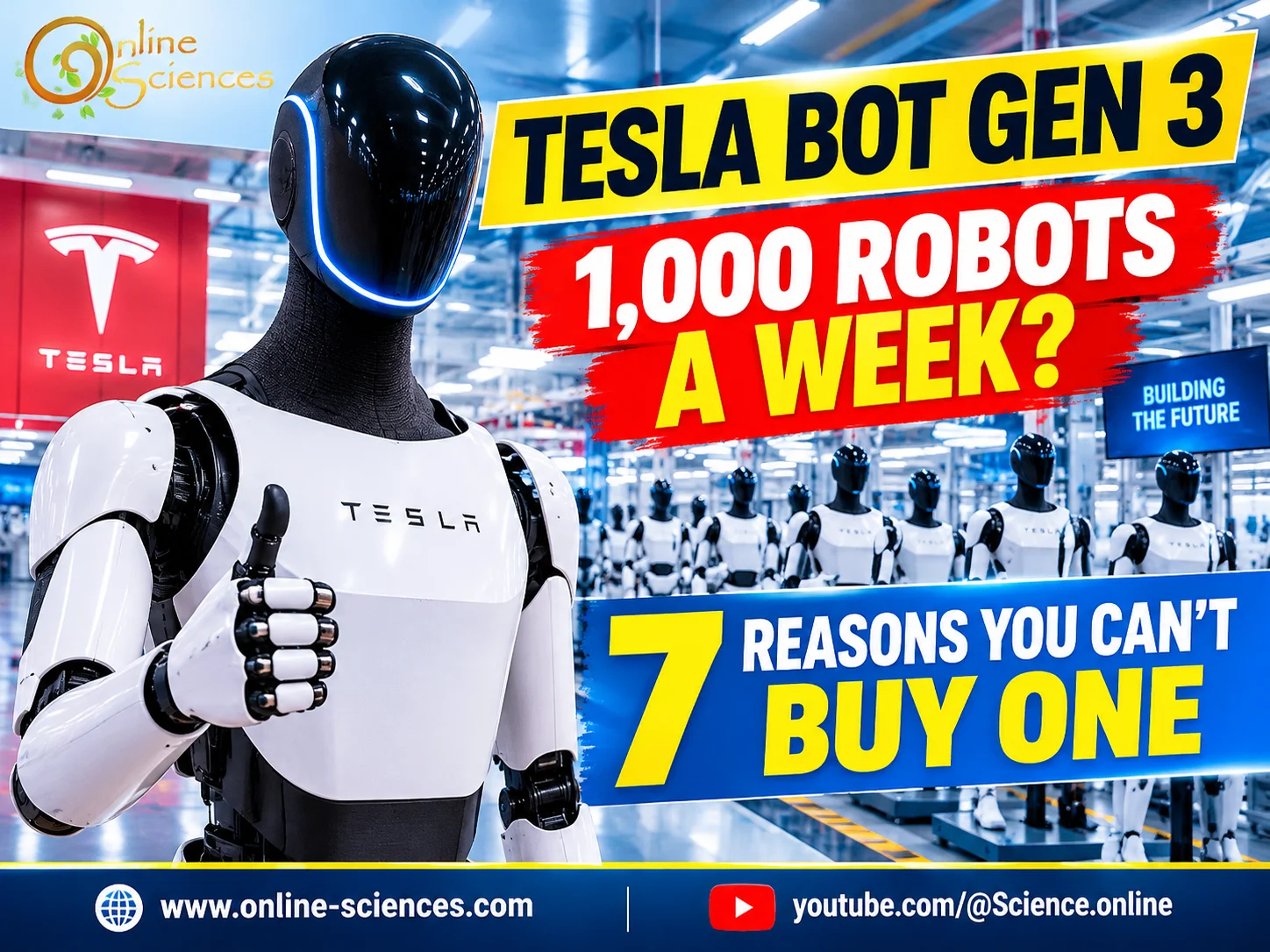
Tesla Bot Gen 3 Optimus humanoid robot in a futuristic factory
What Is Tesla Bot Gen 3?
Tesla Bot Gen 3 is the third-generation version of Tesla’s Optimus humanoid robot program. Unlike traditional industrial robots designed for specific manufacturing tasks, Optimus is intended to operate in human-built environments.
The robot is being developed to perform repetitive, physically demanding, and potentially dangerous jobs. In the future, Tesla hopes that humanoid robots could help with manufacturing, material handling, household chores, and other tasks that currently require human labor.
Tesla‘s broader strategy combines robotics hardware, artificial intelligence, computer vision, and large-scale manufacturing. The company wants Optimus to recognize objects, understand its surroundings, learn new tasks, and interact with the physical world.
Tesla‘s January 2026 investor materials described Gen 3 as its first Optimus design intended for mass production, with production planned to begin before the end of 2026. The company also outlined an eventual annual production capacity target of one million robots. These are future production ambitions, not proof that this capacity has already achieved this capacity.
Can Tesla Really Produce 1000 Robots a Week?
The headline about 1,000 robots a week reflects Tesla‘s production ambitions rather than a guarantee that this output has already been reached.
Reports published in September 2026 indicated that Tesla had increased Optimus production to several hundred units per week, while targeting more than 1,000 per week by the end of the year. The company has also faced challenges in manufacturing precision components and increasing production-line efficiency.
Producing 1,000 robots weekly would equal approximately 52,000 units annually if the factory maintained that rate for an entire year. However, reaching this milestone requires more than installing assembly equipment.
Tesla must secure a consistent supply of motors, actuators, sensors, electronic components, batteries, and specialized robotic hands. Every component must meet strict quality standards, and the complete robot must work reliably after assembly.
A factory’s theoretical capacity is also different from its actual output. Equipment problems, component shortages, design changes, and quality inspections can all reduce production. The important question is therefore not simply how many robots Tesla can assemble, but how many can perform useful tasks safely and consistently.
7 Reasons You Still Can’t Buy Tesla Bot Gen 3
1. Tesla Is Prioritizing Its Own Factories
Tesla‘s initial strategy focuses on using Optimus internally. Company-owned factories provide controlled environments where engineers can test robots, observe their performance, and identify problems.
Internal deployment also helps Tesla collect real-world data before introducing the robots to external customers. Rather than immediately selling an unfinished product, the company can use its facilities as testing grounds.
2. Human-Like Hands Are Extremely Difficult to Build
One of the biggest challenges in humanoid robotics is creating hands that can perform delicate tasks. A human hand can grip a glass, turn a small screw, fold clothing, and handle objects with different shapes and textures. Reproducing these abilities requires precise motors, sensors, control systems, and durable mechanical components.
Tesla CEO Elon Musk has acknowledged the difficulty of developing hands with human-like dexterity. Reports about Optimus Gen 3 have also highlighted manufacturing challenges involving its hands and forearms. Until these systems become sufficiently reliable, many everyday tasks will remain difficult for the robot.
3. Artificial Intelligence Must Work Beyond Demonstrations
A robot may complete a task during a demonstration but struggle when conditions change. For example, picking up a familiar object on a clean table is easier than finding the same object in a cluttered room. A useful household robot must recognize unfamiliar objects, respond to obstacles, and recover when something goes wrong.
Tesla needs AI systems that can generalize what they have learned to new environments rather than depend on carefully prepared routines.
4. Reliability Matters More Than Impressive Videos
Consumers will expect a home robot to work repeatedly without constant supervision. Imagine a robot that can load a dishwasher but frequently drops plates or stops when a dish is positioned differently. Such a machine might be impressive to watch but frustrating to use. Tesla must demonstrate dependable performance over extended periods, including the ability to recognize mistakes and recover safely.
5. Safety Standards Must Be Met
Humanoid robots operate close to people, children, pets, furniture, and fragile objects. Their movements must be predictable, and their systems must respond appropriately when someone enters their path.
A commercial robot needs effective collision avoidance, force control, emergency stopping, secure software, and dependable operation. Tesla must also address applicable product safety requirements and liability concerns before widespread consumer deployment becomes practical.
6. The Price Could Be Too High for Most Households
Elon Musk has discussed a long-term target price of approximately $20,000 to $30,000 for Optimus once production reaches sufficient scale. However, this is an ambition, not a confirmed retail price for Gen 3.
Early robots may cost considerably more to manufacture because specialized components, low production volumes, engineering work, and testing are expensive. For ordinary households, the robot would need to justify its price by performing enough useful tasks to save time or reduce labor costs.
7. Tesla Has Not Opened General Consumer Sales
Perhaps the simplest reason is that Tesla has not established a general consumer purchasing process for Optimus Gen 3. The current development strategy emphasizes manufacturing, internal testing, and improving the robot‘s capabilities. Public demonstrations and production targets do not automatically mean a product is ready for retail.
As of October 2026, buyers should not assume they can order a standard Tesla Bot Gen 3 for home delivery. Musk has previously discussed consumer availability by the end of 2027, but that timeline remains subject to development progress and may change.
What Could Tesla Bot Gen 3 Do in the Future?
The potential applications of Optimus extend well beyond factory production. In manufacturing facilities, robots could move materials, transport tools, sort components, and assist with repetitive assembly tasks. In warehouses, they could help organize inventory and move packages.
Future household applications could include carrying groceries, tidying rooms, collecting laundry, and helping people complete simple daily activities. However, these are potential uses rather than proof that Gen 3 can currently perform every task independently.
The most valuable capabilities will depend on how well the robot understands instructions, adapts to unfamiliar situations, and completes jobs without human intervention.
How Tesla Optimus Gen 3 Could Change the Future of Robotics
If Tesla can combine reliable hardware with capable AI and affordable mass production, Optimus could influence how businesses approach automation.
Traditional industrial robots generally excel at specific, repetitive tasks. A general-purpose humanoid robot could eventually perform several different jobs without requiring an entirely new robotic system for every application.
This flexibility could help companies automate tasks that are difficult to redesign around conventional machinery. It could also create new opportunities in logistics, manufacturing, and assistance services.
Nevertheless, the technology still faces substantial engineering and commercial challenges. Successful demonstrations, factory output, and real-world productivity are different measures of progress. Tesla’s long-term success will depend on whether Optimus becomes a dependable tool that solves practical problems at a competitive cost.
Conclusion
Tesla Bot Gen 3 could become an important milestone in the development of humanoid robots, but producing 1,000 units a week would not automatically make the robot ready for consumers.
Tesla must overcome challenges involving dexterous hands, adaptable AI, manufacturing quality, reliability, safety, and affordability. Its immediate focus is on internal applications and scaling production before pursuing broader availability.
For people hoping to own a Tesla humanoid robot, the key milestone is not simply a larger production number. It is proof that the robot can reliably perform useful tasks in real-world environments at a price people are willing to pay.
The big question is no longer just whether Tesla can build thousands of robots. It is whether those robots can become genuinely useful workers and practical household assistants.
Frequently Asked Questions (FAQ) about Tesla Bot Gen 3
1. What is Tesla Bot Gen 3?
Tesla Bot Gen 3, also called Optimus Gen 3, is Tesla’s third-generation humanoid robot designed for future industrial and consumer applications.
2. Can you buy Tesla Bot Gen 3 in 2026?
As of October 2026, Tesla has not opened general consumer sales for Optimus Gen 3. Its current development strategy focuses on internal deployment and improving production.
3. Is Tesla producing 1000 Optimus robots per week?
Tesla reportedly reached production of several hundred robots per week in 2026, with a target of exceeding 1,000 weekly units by the end of the year. The target should not be confused with independently confirmed, sustained output.
4. What is the Tesla Bot Gen 3 price?
Elon Musk has discussed a long-term target of approximately $20,000 to $30,000. The final retail price, specifications, and purchase terms have not been confirmed for general consumers.
5. When will Tesla Optimus be available to the public?
Musk has previously discussed consumer sales by the end of 2027. This is a projected timeline, not a guaranteed release date.
6. What jobs could Tesla Bot Gen 3 perform?
Potential applications include moving materials, handling objects, assisting with repetitive factory work, sorting items, and eventually helping with selected household chores. Actual capabilities depend on software and hardware development.
7. Why is Tesla Optimus difficult to manufacture?
The robot requires numerous precision components, sophisticated actuators, sensitive electronics, and highly capable robotic hands. Scaling production while maintaining consistent quality is a significant engineering challenge.
8. Will Tesla Bot Gen 3 replace human workers?
Optimus could automate some repetitive or physically demanding jobs. However, its effect on employment will depend on its capabilities, cost, reliability, adoption rate, and the types of tasks businesses choose to automate.
9. Is Tesla Bot Gen 3 fully autonomous?
Tesla is developing Optimus for autonomous task performance, but a production milestone does not prove that the robot can independently complete every task in an unpredictable environment.
10. What makes Tesla Optimus different from traditional industrial robots?
Traditional industrial robots usually perform specialized tasks in structured environments. Optimus is intended to be a general-purpose humanoid robot that can operate in spaces designed for people and eventually perform a wider variety of tasks.
Explore more science and technology articles on Science Online: https://www.online-sciences.com/
Watch more technology videos on Science Online Channel: https://www.youtube.com/@Science.online
🔥 Tesla Bot Gen 3: 1,000 Robots a Week — 7 Powerful Reasons You Still Can’t Buy One 🤯
🔥 Tesla Bot Gen 4 UPDATE 5000 Tasks As HOMEMAKER & Surgeon! Elon Musk SHOCKED Inside Optimus! 🤯
Boston Dynamics Atlas review, advantages and features, How does Atlas robot work?
Tesla robots (Optimus) review, use, advantages and disadvantages
Emo robot review, advantages, disadvantages, features and what can Emo do?
Advantages and disadvantages of using robots in our life
Artificial intelligence (AI) definition, advantages, disadvantages, features and applications
Robot teachers use, advantages and disadvantages
Sophia robot review, features, use, advantages and disadvantages
Vector robot review, advantages, disadvantages and specifications