New Elon Musk’s Tesla Optimus Gen 3 Capabilities LEAKED: 10 Powerful Features to Watch
Tesla Optimus Gen 3 is attracting attention as Elon Musk’s vision of advanced humanoid robots continues to develop. Designed to combine artificial intelligence, computer vision, and human-like movement, Tesla Optimus could transform the way repetitive tasks are performed in factories, warehouses, and potentially homes. Many technology enthusiasts are eager to discover whether the next generation will feature smarter AI, more precise robotic hands, improved walking abilities, and greater independence. Although online reports about leaked capabilities are generating excitement, the latest specifications must be verified through official Tesla announcements and demonstrations.
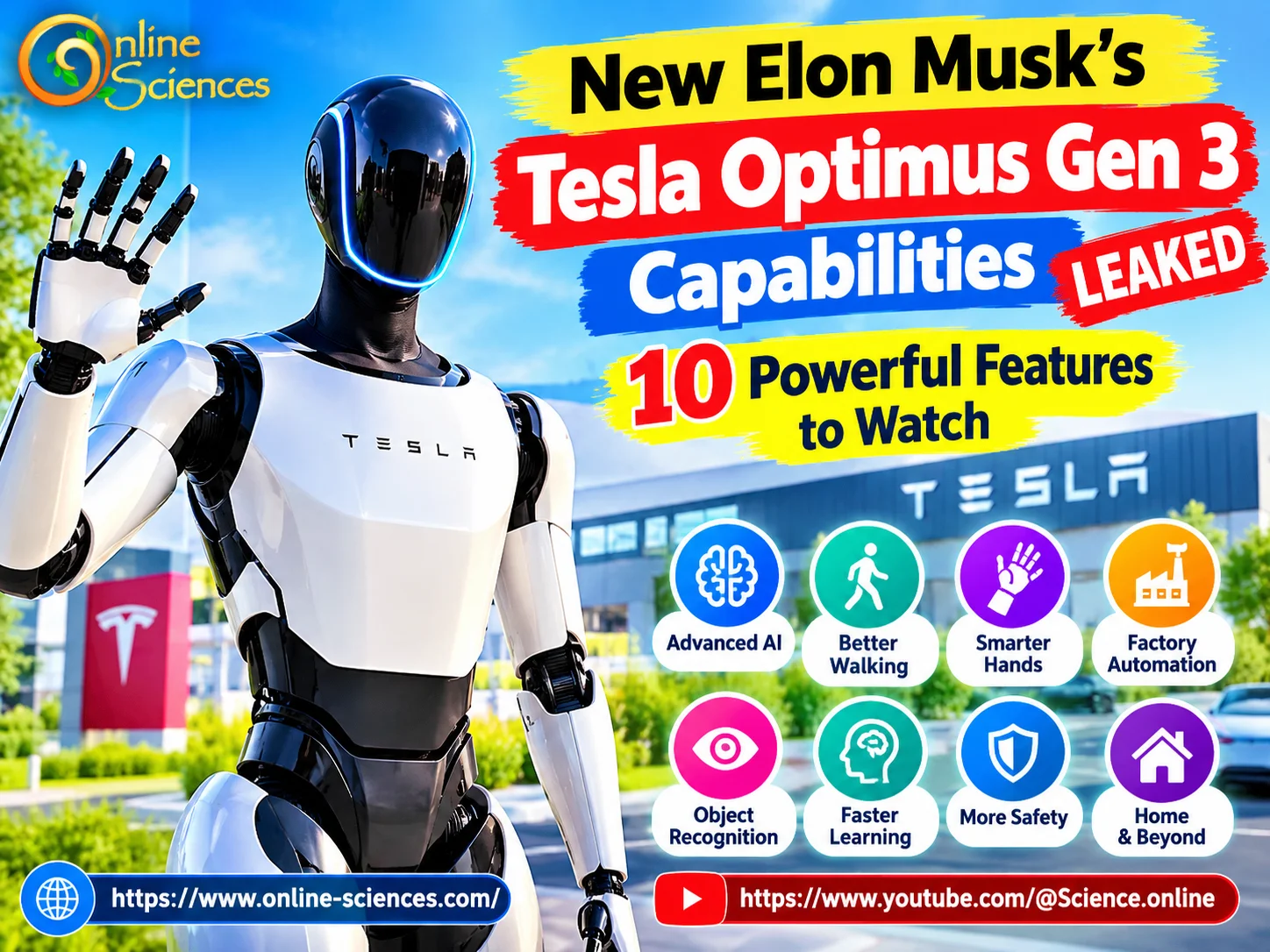
New Elon Musk’s Tesla Optimus Gen 3 Capabilities LEAKED
Tesla Optimus Gen 3
Tesla Optimus Gen 3 represents the growing ambition to create humanoid robots capable of performing useful physical tasks in environments designed for humans. By combining robotic hardware with AI-powered perception and movement control, future Optimus robots could help transport materials, organize objects, handle components, and support manufacturing operations. Improvements in balance, dexterity, and task learning could make these robots more versatile and practical.
However, their real-world success will depend on reliability, safety, operating costs, and the ability to perform tasks consistently without constant human supervision. As Tesla continues developing its humanoid robotics technology, Optimus remains an exciting example of how artificial intelligence could move beyond computers and become part of the physical world.
Elon Musk’s Tesla Optimus humanoid robot is attracting attention as Tesla works to bring advanced robotics and artificial intelligence into everyday life. With expectations surrounding Optimus Gen 3, many people want to know whether the next generation will walk more naturally, handle complex tasks, learn new skills faster, and work safely alongside humans. Although claims about leaked capabilities require careful verification, Tesla’s robotics ambitions point toward a future in which humanoid robots could assist with repetitive work in factories, warehouses, and eventually homes.
What is Tesla Bot Optimus Gen 3?
Tesla Optimus is a humanoid robot developed by Tesla to perform physical tasks using robotics, sensors, and artificial intelligence. Also known as the Tesla Bot, it is designed to operate in environments built for people, including workplaces with doors, shelves, tools, and equipment designed around human movement.
Elon Musk has described humanoid robots as a potentially important part of Tesla‘s future. The company’s broader goal is to develop robots that can undertake repetitive, physically demanding, or undesirable tasks, potentially increasing productivity and reducing the need for people to perform dangerous work.
The name Optimus Gen 3 refers to expectations surrounding a newer generation of the robot. However, it is important to distinguish between officially demonstrated features, announced development plans, and rumored specifications. Without verified technical documentation or an official demonstration, claims about specific Gen 3 capabilities should not be treated as confirmed facts.
Tesla Optimus Gen 3 Features
1. More Advanced Artificial Intelligence
Artificial intelligence is central to the vision for Tesla Optimus. A capable humanoid robot must do more than follow a fixed sequence of movements. It needs to recognize objects, interpret its surroundings, respond to changing conditions, and choose suitable actions.
Future Optimus generations could benefit from improved AI models that help them understand instructions and adapt to unfamiliar situations. For example, a worker might ask a robot to move a container to a designated area. The robot would need to identify the container, find a safe route, grasp it correctly, and place it in the appropriate location.
However, the ability to understand complex instructions reliably in real-world environments remains a major robotics challenge. The precise AI capabilities of Optimus Gen 3 should be confirmed through official demonstrations rather than assumed from online rumors.
2. Improved Walking and Human-Like Movement
One of the most noticeable features of a humanoid robot is its ability to walk and maintain balance. A robot working in a factory may need to navigate around people, avoid obstacles, turn through narrow spaces, and carry objects without falling.
A future Optimus generation could improve its walking speed, balance, coordination, and energy efficiency. Better control systems could also help the robot recover from small disturbances and move more smoothly across different surfaces.
Human-like movement is not simply about appearance. Reliable mobility is essential for practical work because a robot must remain stable while reaching, lifting, turning, and transporting objects. Nevertheless, specific claims about Gen 3 walking speed, running ability, or balance performance require verified test results.
3. Smarter Hands and More Precise Fingers
Human hands can perform a remarkable range of tasks, from holding large boxes to manipulating tiny components. Reproducing this flexibility is one of the most difficult problems in humanoid robotics.
Improved robotic hands could help Optimus handle tools, sort products, pick up objects, and manipulate materials more accurately. Advanced sensors and control software could allow the robot to adjust its grip depending on an object’s shape, weight, and fragility.
These improvements could be especially valuable in manufacturing, where robots may need to handle components that cannot be moved safely using simple mechanical grippers. However, dexterity should be evaluated through real demonstrations of tasks rather than promotional descriptions alone. The exact hand design and manipulation capabilities of Optimus Gen 3 need official confirmation.
4. A Bigger Role in Tesla Factories
Factories are among the most practical environments for testing humanoid robots. They provide structured workspaces, repeatable tasks, and opportunities to measure performance. Tesla has explored using Optimus for manufacturing-related activities. Future versions could potentially assist with moving materials, transporting components, organizing supplies, and performing other repetitive operations.
A successful factory robot must work consistently, avoid damaging equipment, and interact safely with employees. It must also complete tasks at a useful speed without requiring constant human intervention. If Optimus becomes reliable and economical enough, it could help manufacturers improve productivity. However, widespread deployment depends on demonstrated performance, maintenance requirements, production costs, and safety standards.
5. Better Object Recognition and Environmental Awareness
A useful humanoid robot needs to understand what is happening around it. It must identify objects, estimate distances, recognize obstacles, and respond when people or equipment move unexpectedly. Improved computer vision and sensor processing could help future Optimus robots navigate complex workspaces and locate items more accurately.
For example, a robot might need to distinguish between a full container and an empty one or identify the correct component among several similar objects. These seemingly simple tasks can become difficult when lighting changes, objects are partially hidden, or items appear in unexpected positions.
More advanced perception systems could make robots more flexible, but reliable real-world understanding remains a significant technical challenge.
6. Faster Learning and Task Adaptation
Traditional industrial robots often perform carefully programmed movements. Humanoid robots promise greater flexibility because they are intended to operate in environments that change frequently.
Future Optimus models could use demonstrations, training data, and AI-based control systems to acquire new tasks more efficiently. Instead of programming every movement individually, developers might train a robot to perform a task through repeated examples.
This approach could reduce the time needed to introduce new applications. Nevertheless, learning a task in a simulation or controlled demonstration does not automatically mean that a robot can perform it safely in an unpredictable workplace. Whether Optimus Gen 3 introduces major improvements in learning speed remains a question for official technical updates.
7. Potential Applications Beyond Factories
Although industrial work is a major target, humanoid robots could eventually assist in warehouses, laboratories, commercial buildings, and other environments. Possible tasks include carrying supplies, organizing storage areas, moving equipment, and performing basic material-handling activities. In the longer term, domestic robots could help with selected household chores.
However, homes present a more complicated challenge than controlled industrial environments. They contain pets, children, fragile objects, stairs, clutter, and unpredictable human behavior. A robot that performs one factory task successfully is not necessarily ready to cook meals, clean an entire house, or care for older people. Those applications require additional capabilities, reliability, and safety testing.
8. Safety Around Humans
Safety will be essential if Optimus robots are expected to work near employees or eventually enter homes. A humanoid robot must control its movements, detect obstacles, manage its force when handling objects, and respond appropriately when someone enters its working area.
Developers must also consider failures involving software, sensors, mechanical components, and communication systems. Emergency stopping mechanisms, testing procedures, and appropriate operating restrictions are important parts of safe deployment.
The more capable a robot becomes, the more important it is to demonstrate that it can operate predictably around people. Safety claims should therefore be supported by testing and independent evaluation rather than appearance alone.
9. Can Tesla Optimus Become Affordable?
Tesla‘s experience with large-scale manufacturing could be relevant to its humanoid robotics ambitions. Producing robots in substantial quantities may eventually reduce manufacturing costs, especially if components and assembly processes become more standardized.
Lower costs could make humanoid robots attractive to businesses that need help with repetitive tasks. However, the purchase price is only one part of the overall cost.
Companies must also consider maintenance, software, charging, downtime, training, and the cost of supervising robots. A robot becomes economically valuable when it performs useful work reliably enough to justify these expenses. Any specific Gen 3 price, production target, or delivery date should be checked against current official Tesla announcements.
10. What Could Tesla Optimus Mean for the Future?
Tesla Optimus represents a broader shift toward combining AI with machines capable of interacting physically with the world. If humanoid robots become reliable, they could change how factories operate and how certain repetitive tasks are performed.
They could also create new jobs involving robot maintenance, programming, safety testing, system integration, and AI development. At the same time, businesses and governments will need to consider workforce transitions, training, privacy, and accountability.
The most important question is not whether a robot looks human. It is whether it can perform useful tasks safely, consistently, and at a competitive cost. For now, Tesla Optimus remains a developing robotics platform, and the real significance of Gen 3 will depend on demonstrated capabilities rather than unverified leaks.
Conclusion
Elon Musk’s Tesla Optimus Gen 3 has generated interest because it represents the possibility of more capable, flexible, and intelligent humanoid robots. Better AI, improved dexterity, more reliable movement, advanced perception, and safer human interaction are important areas to watch.
However, not every online claim about leaked specifications is reliable. Until Tesla confirms specific Gen 3 features and demonstrates their performance, readers should distinguish between genuine announcements and speculation. If Tesla can combine practical capabilities with dependable operation and affordable manufacturing, Optimus could become an important development in industrial automation and humanoid robotics.
Frequently Asked Questions (FAQ)
1. What is Tesla Optimus Gen 3?
Tesla Optimus Gen 3 refers to expectations surrounding a newer generation of Tesla’s humanoid robot. It is designed around the broader goal of using AI-powered robots to perform physical tasks, particularly in industrial environments. Specific Gen 3 features should be verified through official announcements.
2. What can Tesla Optimus Gen 3 do?
Potential capabilities include object recognition, walking, grasping objects, manipulating tools, and assisting with repetitive tasks. The exact capabilities of Gen 3 depend on Tesla‘s confirmed specifications and demonstrated performance.
3. Is Tesla Optimus Gen 3 officially released?
The release status of a specific generation should be checked against Tesla‘s latest official announcements. Online videos and claims about leaked specifications do not necessarily confirm that a particular version has been released.
4. Can Tesla Optimus work in factories?
Tesla has explored using Optimus for manufacturing-related tasks. Humanoid robots could help move materials, handle components, and perform repetitive operations if they can meet the necessary safety and reliability requirements.
5. Will Tesla Optimus replace human workers?
Humanoid robots could automate some repetitive or physically demanding tasks. However, their impact on employment will depend on their capabilities, costs, adoption rates, and the types of jobs involved. They may also create demand for workers who develop, maintain, and supervise robotic systems.
6. Can Tesla Optimus perform household chores?
Household assistance is a potential long-term application for humanoid robots. However, performing chores reliably in unpredictable home environments is considerably more challenging than completing repetitive tasks in controlled workplaces.
7. How much will Tesla Optimus Gen 3 cost?
A confirmed price for a specific Gen 3 version should be obtained from official Tesla announcements. Manufacturing costs, production volume, maintenance, and software requirements will influence its eventual commercial value.
8. What makes Tesla Optimus different from traditional industrial robots?
Traditional industrial robots often perform specialized tasks in fixed positions or controlled workspaces. A humanoid robot is intended to use human-like mobility and manipulation to work in environments designed for people.
9. Does Tesla Optimus use artificial intelligence?
AI is an important part of Tesla’s humanoid robotics development. Vision, perception, planning, and movement control can help robots interpret their surroundings and perform physical tasks.
10. Are the leaked Tesla Optimus Gen 3 features confirmed?
Not necessarily. Claims about specific hardware, speed, battery life, production numbers, or new AI capabilities should be treated as unverified until supported by reliable evidence or official Tesla announcements.
Explore more science and technology articles on Science Online: https://www.online-sciences.com/
Watch more technology videos on Science Online Channel: https://www.youtube.com/@Science.online
🔥 New Elon Musk’s Tesla Bot Optimus Gen 3 Capabilities LEAKED 🤯
🔥 Tesla Bot Gen 3: 1,000 Robots a Week — 7 Powerful Reasons You Still Can’t Buy One 🤯
🔥 Tesla Bot Gen 4 UPDATE 5000 Tasks As HOMEMAKER & Surgeon! Elon Musk SHOCKED Inside Optimus! 🤯
Boston Dynamics Atlas review, advantages and features, How does Atlas robot work?
Tesla robots (Optimus) review, use, advantages and disadvantages
Emo robot review, advantages, disadvantages, features and what can Emo do?
Advantages and disadvantages of using robots in our life
Artificial intelligence (AI) definition, advantages, disadvantages, features and applications
Robot teachers use, advantages and disadvantages
Sophia robot review, features, use, advantages and disadvantages
Vector robot review, advantages, disadvantages and specifications