
Advantage and disadvantage of friction and ways to decrease the friction
Do you know what is the meaning of friction?
The friction force is the force that exists between the two surfaces when they touch each other, and it acts in the opposite direction to the movement.
There are different types of friction, such as the friction between the bodies and the air, the friction between the solids, and the friction between the bodies andthe water.
What are the factors affecting the friction force?
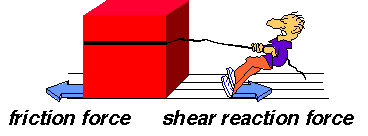 |
| The friction force increases by increasing the body surface area |
- The surface area of the moving object.
- The body’s speed.
- The type of material surface.
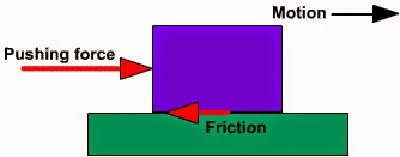 |
| The friction force occurs when there is contact between two surfaces |
Disadvantages of the friction
The friction causes damage to most of the machines as it raises the temperatureof the internal moving parts of the machines to more than a certain extent, so the machines are damaged, and a lot of money is wasted.
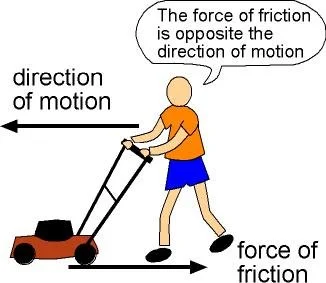
The friction force helps us to walk.
What are the ways to decrease the friction force?
-
You should use the lubricants and the oil in the machines to form a thin layer between the internal moving parts of the machines to reduce the effect of the friction force.
Example: Using lubricants and oil in the car engines.
-
You should use the ball bearing in the machines. They are formed of a group of small metallic balls which have a smooth surface, So, the friction between them is almost non-existent.
Example: The ball bearing that exists in the axis ofthe car engine, and it transmits the motion fromthe carengine to the wheels.
Advantages of the friction
-
Friction is necessary for the lighting of a match.
-
The friction force helps in moving and stopping cars or bicycles.
-
The friction force is very important in controlling the car speed and changing the car direction.
-
It helps us to walk as the friction force between the ground and our shoes prevent us from slipping down.
-
Life applications of the friction
-
You should replace the cartires when their grooves disappear, because they are necessary to squeeze the waterout. The waterreduces the friction and makes the control of the car very hard.
-
The air resistance is also a friction force resulting from the movement of solid objects through the air.
-
You should not increase the car speed up to a certain limit to reduce the air resistance and the consumption of fuel.
-
To decrease the air resistance, the rockets, the aircrafts and the trains should be designed in streamlined shapes. Also, the bodies of the birds have streamlined shapes.
-
The parachutist should open the parachute to land safely.
-
The birds stretch their wings on landing to decrease their speed on landing.
-
Water resistance is also a friction force resulting from the movement of any object through the water. To decrease the water resistance, the ships are designed in streamlined shapes. Also, fish have streamlined shapes.
FAQ about Friction and Ways to Decrease It
1. What is friction?
Friction is a force that occurs when two surfaces move or try to move against each other. It acts in the opposite direction of motion and slows down or stops movement.
2. What are the main types of friction?
The common types of friction include:
- Static friction: prevents objects from starting to move.
- Sliding friction: occurs when two surfaces slide over each other.
- Rolling friction: happens when an object rolls on a surface, such as a wheel.
- Fluid friction: occurs when objects move through liquids or gases like air or water.
3. What are the advantages of friction?
Friction has many useful benefits, such as:
- Helping us walk without slipping.
- Allowing vehicles to move and stop safely.
- Enabling us to write with a pen or pencil on paper.
- Helping objects stay in place without sliding.
- Making it possible for machines like brakes and clutches to work.
4. What are the disadvantages of friction?
Despite its benefits, friction also has some disadvantages:
- It causes wear and tear in machine parts.
- It produces heat, which may damage materials.
- It reduces the efficiency of machines by wasting energy.
- It makes it harder to move heavy objects.
5. Why is friction important in everyday life?
Friction is essential because it allows movement and control in daily activities such as walking, driving, holding objects, and writing.
6. How can friction be decreased?
Friction can be reduced in several ways, including:
- Using lubricants such as oil or grease between moving parts.
- Polishing surfaces to make them smoother.
- Using wheels or ball bearings to convert sliding friction into rolling friction.
- Using air cushions or special materials that reduce resistance.
7. What are lubricants, and how do they reduce friction?
Lubricants are substances such as oil, grease, or graphite placed between surfaces. They form a thin layer that prevents direct contact between surfaces, which reduces friction.
8. Why are wheels useful in reducing friction?
Wheels reduce friction because rolling friction is much less than sliding friction, making it easier to move objects like carts and vehicles.
9. Why are ball bearings used in machines?
Ball bearings are small metal balls placed between moving parts. They reduce friction by allowing parts to roll smoothly instead of sliding against each other.
10. Can friction be eliminated?
No, friction cannot be eliminated, but it can be greatly reduced using proper materials, lubricants, and design techniques.
11. In which situations do we increase friction instead of decreasing it?
Sometimes we increase friction for safety, such as:
- Using rubber soles in shoes.
- Adding treads to tires.
- Using sand on slippery roads.
You can follow science online on YouTube from this link: Science online
The friction between the solid objects and the air
The factors affecting the friction between the solid objects and the water
The factors affecting the friction between two solid objects
The positive and negative effects of cars
Accompanied forces of motion, Forces of inertia, Friction forces & Biological forces



Very nice topic
Thank you very much